Waves
Work through one section at a time. Higher-only material is labelled explicitly; optional challenges can also use Foundation content.
 GCSE PHYSICS · AQA TRILOGYTutor dashboardSaves on this device
Your answers save automatically as you work.
Saved in this browser on this device.
From ripples and sound to light and radio: use diagrams, measurements and evidence to see how waves transfer energy.
Supported GCSE version · Clear examples, worked calculations and optional challenges.
Work through one section at a time. Higher-only material is labelled explicitly; optional challenges can also use Foundation content.
A disturbance that transfers energy without an overall transfer of the material.
Vibrations are perpendicular to the direction of wave travel.
Vibrations are parallel to the direction of wave travel.
A region where particles in a longitudinal wave are closer together.
A region where particles in a longitudinal wave are farther apart.
Maximum displacement from the undisturbed position.
Distance from one point on a wave to the equivalent point on the next wave.
Number of complete waves passing a point each second, measured in Hz.
Time taken for one complete vibration, measured in seconds.
Change in direction when a wave crosses a boundary at an angle because its speed changes.
A line at 90° to a surface at the point where a ray meets it.
The continuous range of electromagnetic waves, from radio waves to gamma rays.
Take in energy carried by radiation.
Give out radiation.
Allow a wave to pass through.
Able to remove electrons from atoms, potentially damaging living cells.
A measure of the risk of harm from radiation exposure.
A repeated back-and-forth change or vibration.
A wave is a disturbance that transfers energy. It can also carry information, such as speech in a phone call.
| Wave type | Direction of vibration | Example |
|---|---|---|
| Transverse | At right angles to the direction the wave travels | Ripples on water; waves on a rope |
| Longitudinal | Parallel to the direction the wave travels | Sound in air |
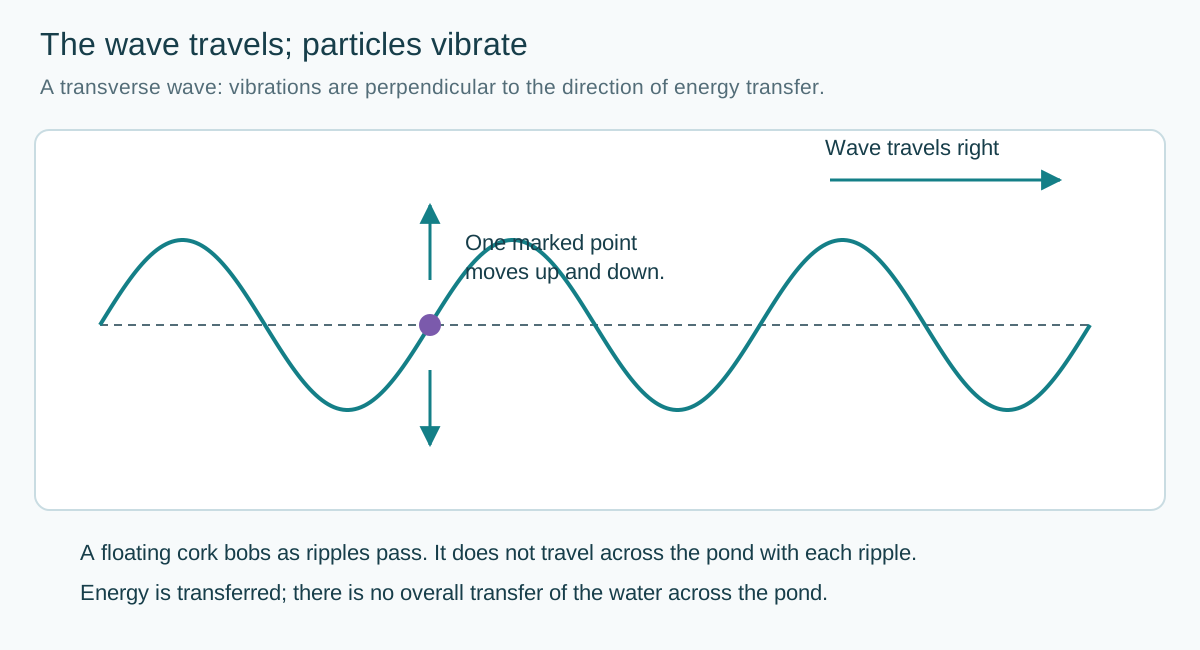
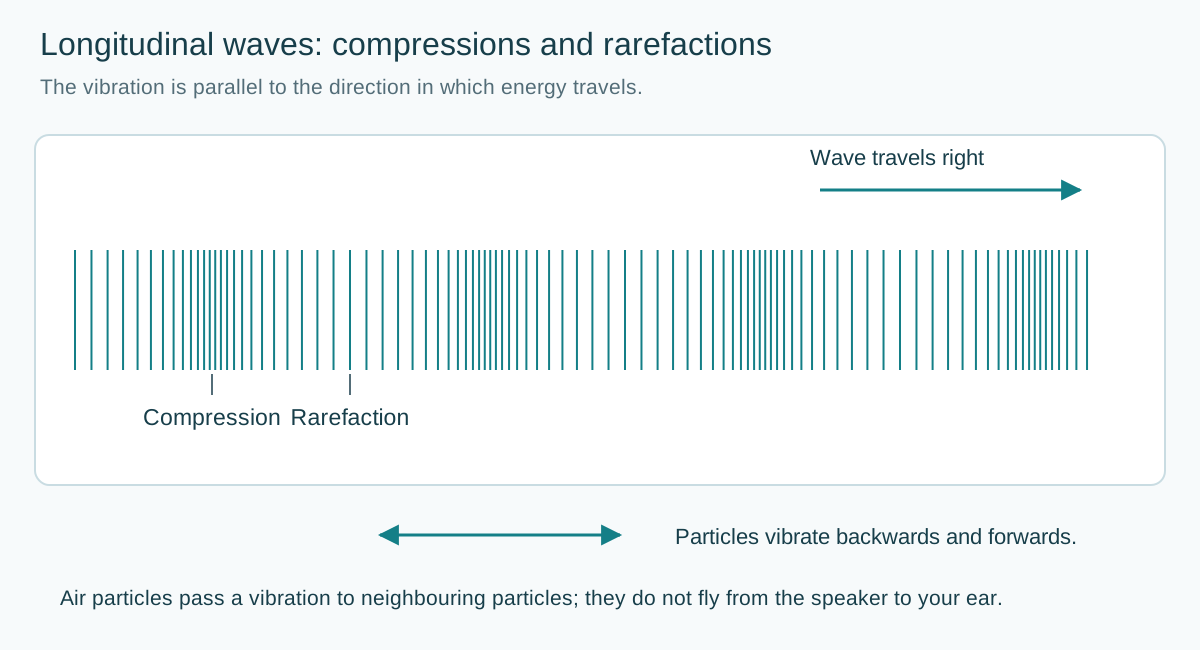
Evidence: a cork bobs as ripples pass without travelling across the tank with them. A loudspeaker makes nearby air vibrate; a listener can hear the sound without a steady stream of air arriving from the speaker.
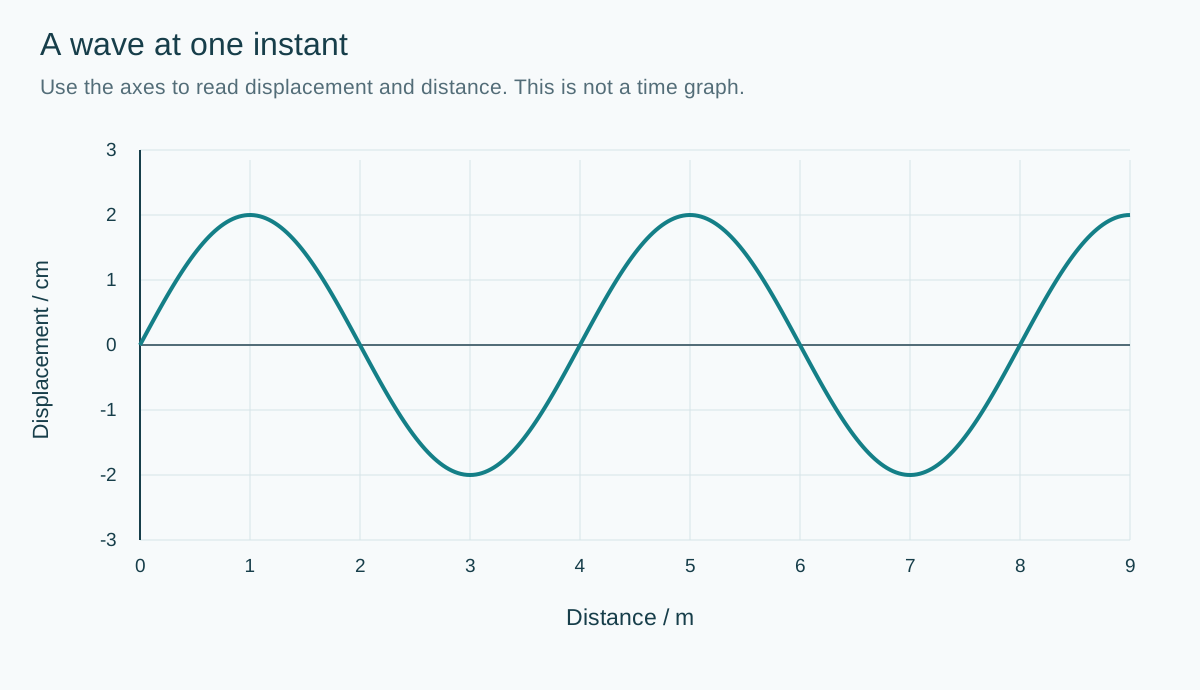
| Quantity | What it means | Unit |
|---|---|---|
| Amplitude | Maximum displacement from the undisturbed position | m |
| Wavelength, λ | Distance between equivalent points on adjacent waves, such as crest to crest | m |
| Frequency, f | Number of complete waves passing a point each second | hertz, Hz |
| Period, T | Time for one complete vibration | seconds, s |
| Find | Equation | Rearrangement |
|---|---|---|
| Wave speed | v = f × λ | f = v ÷ λ; λ = v ÷ f |
| Period | T = 1 ÷ f | f = 1 ÷ T |
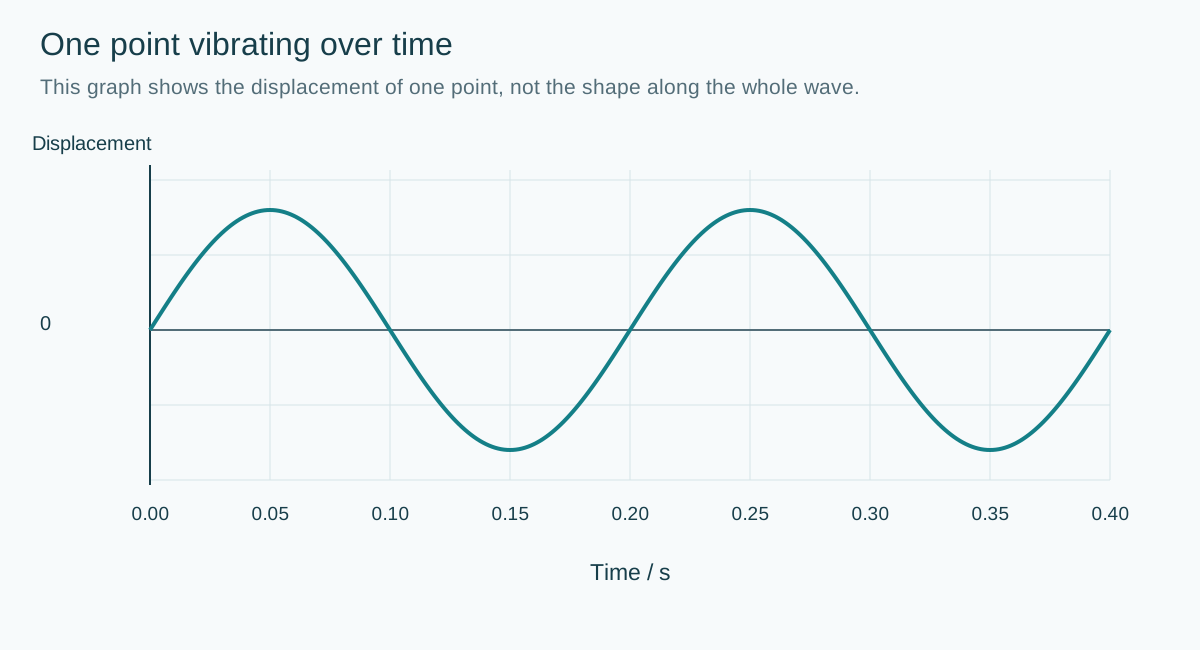
A wave’s speed tells you how fast its energy moves. Frequency tells you how often waves arrive. They are different quantities.
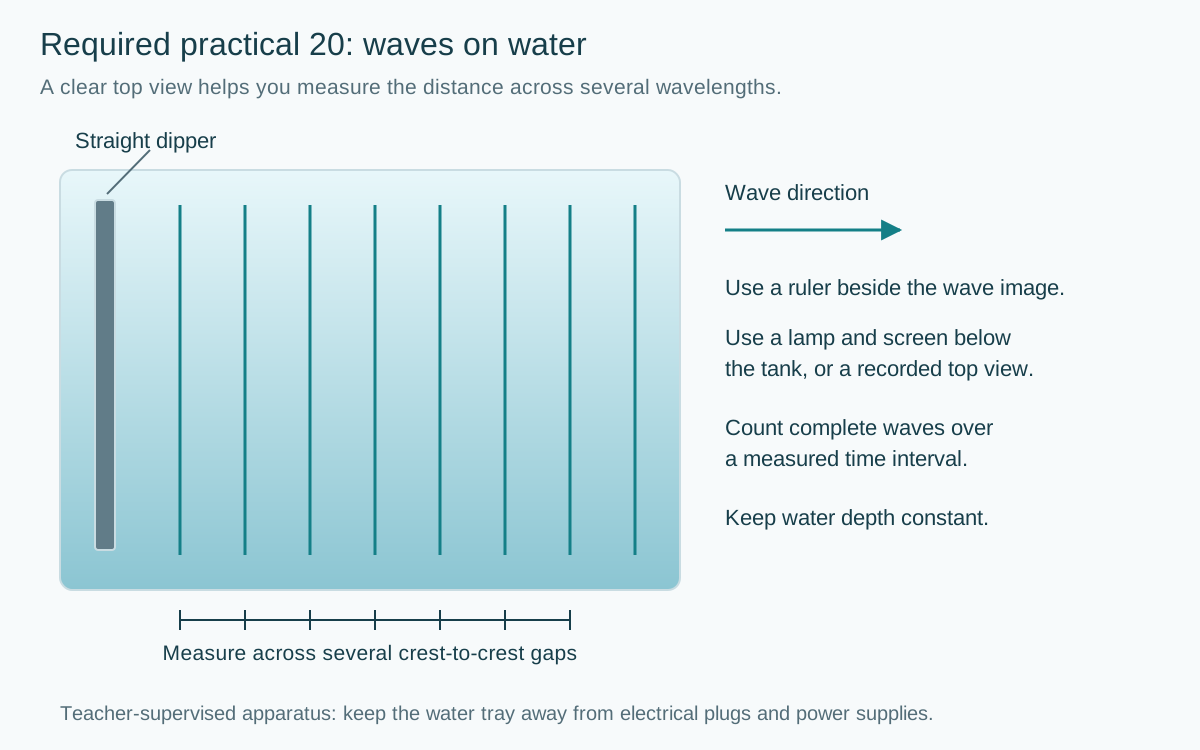
Improve the measurement: use several gaps, keep water depth constant, reduce reflections from the tank edges and view from directly above. Keep water away from electrical connections.
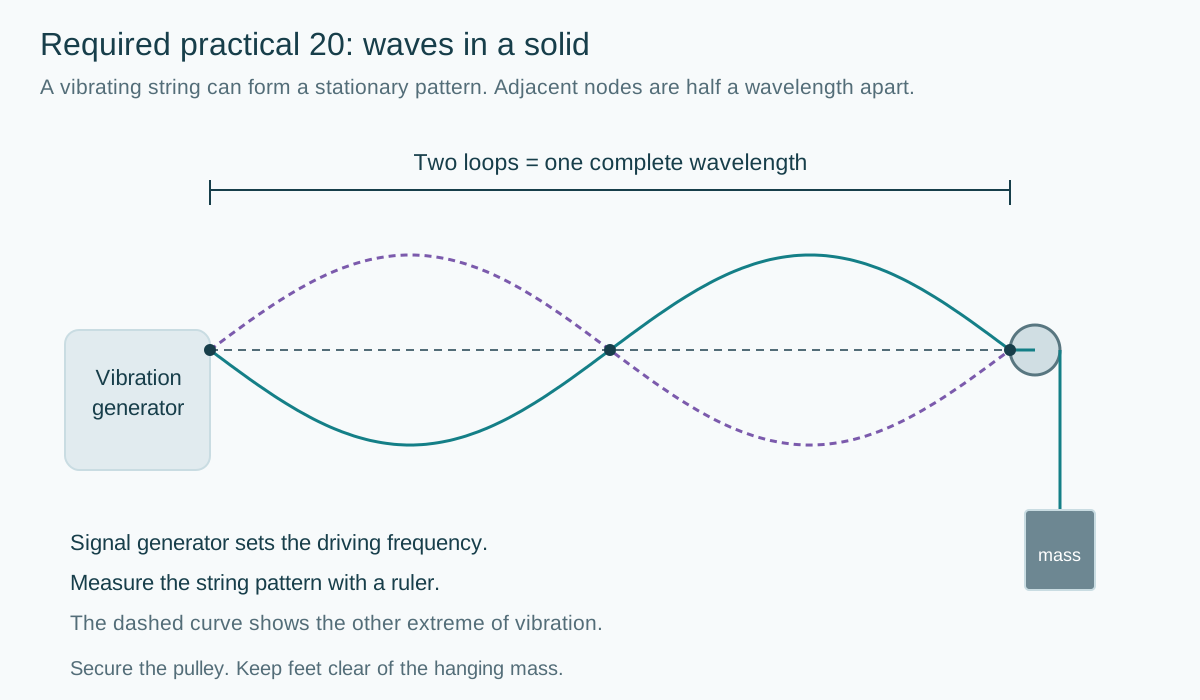
Standing waves are used here as a measurement technique; you do not need a separate theory of standing waves. Secure the pulley and keep feet clear of the suspended mass.
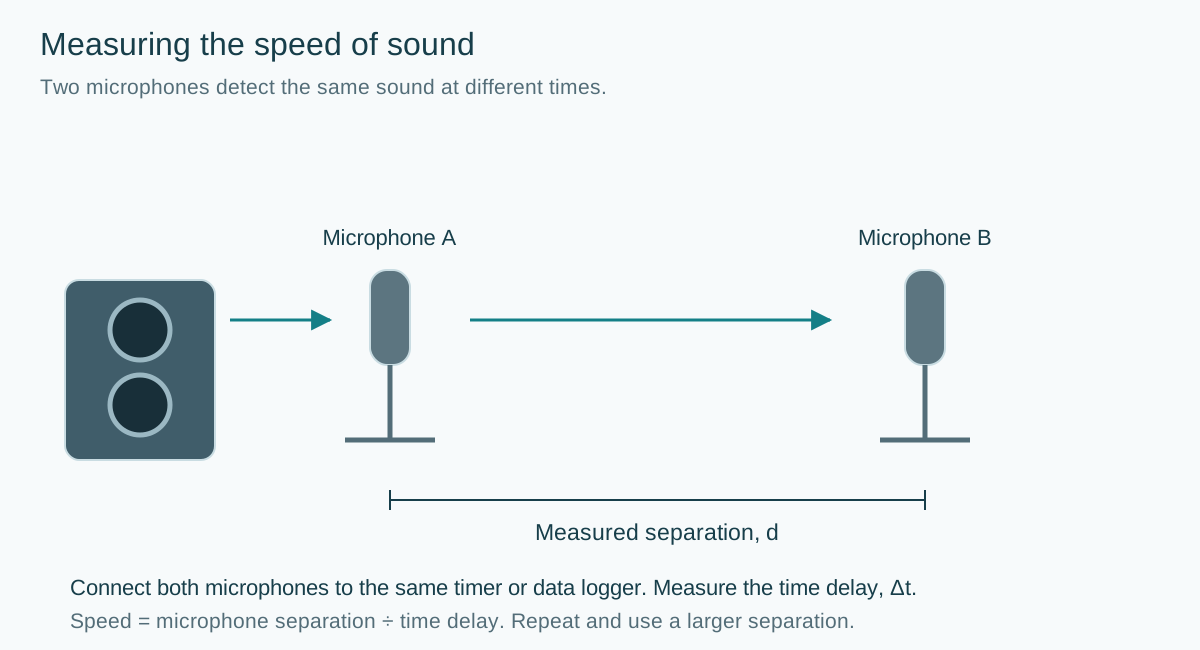
An alternative: time an echo from a distant wall. The sound travels to the wall and back, so use twice the wall distance. Time several echoes or use recording software to reduce timing uncertainty.
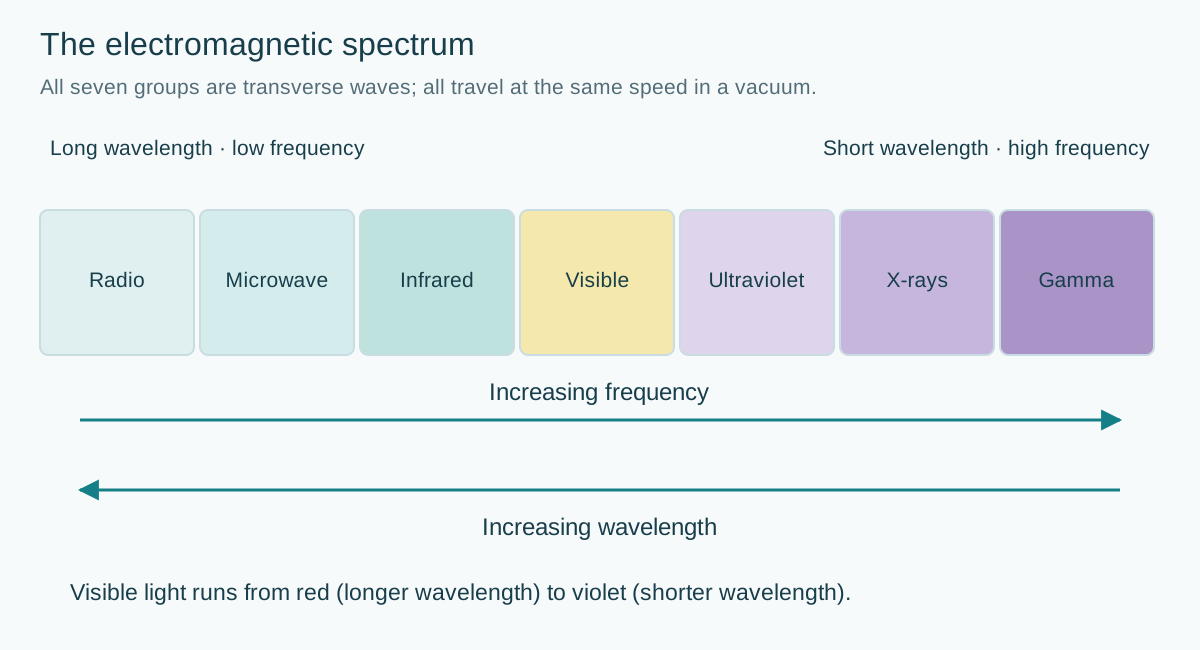
A heater transfers energy to your skin by infrared radiation. Sunlight transfers energy to a solar panel. These examples do not require air particles to carry the wave.
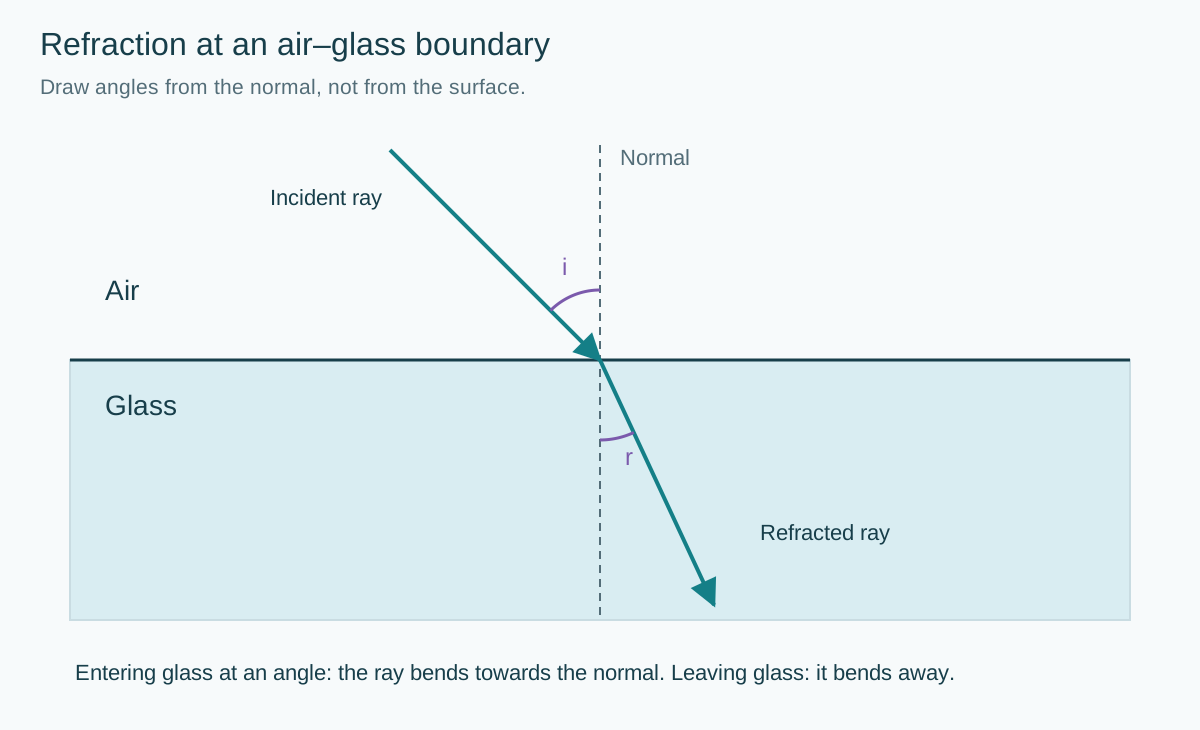
Drawing these ray diagrams is shared Foundation and Higher content. Practise using a ruler and protractor on paper.
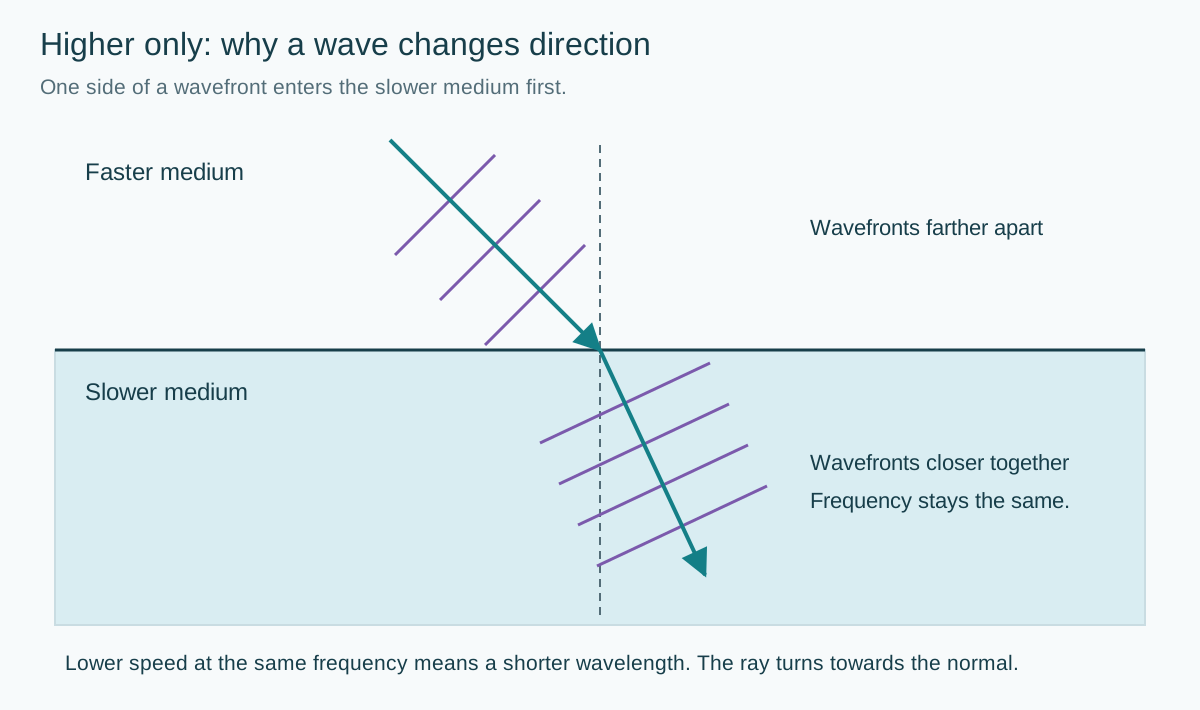
Different substances may absorb, transmit, reflect or refract different wavelengths by different amounts. A material that transmits visible light need not transmit infrared in the same way.
Warm objects emit infrared radiation. Surfaces can absorb infrared too. Compare finishes fairly rather than comparing two completely different objects.
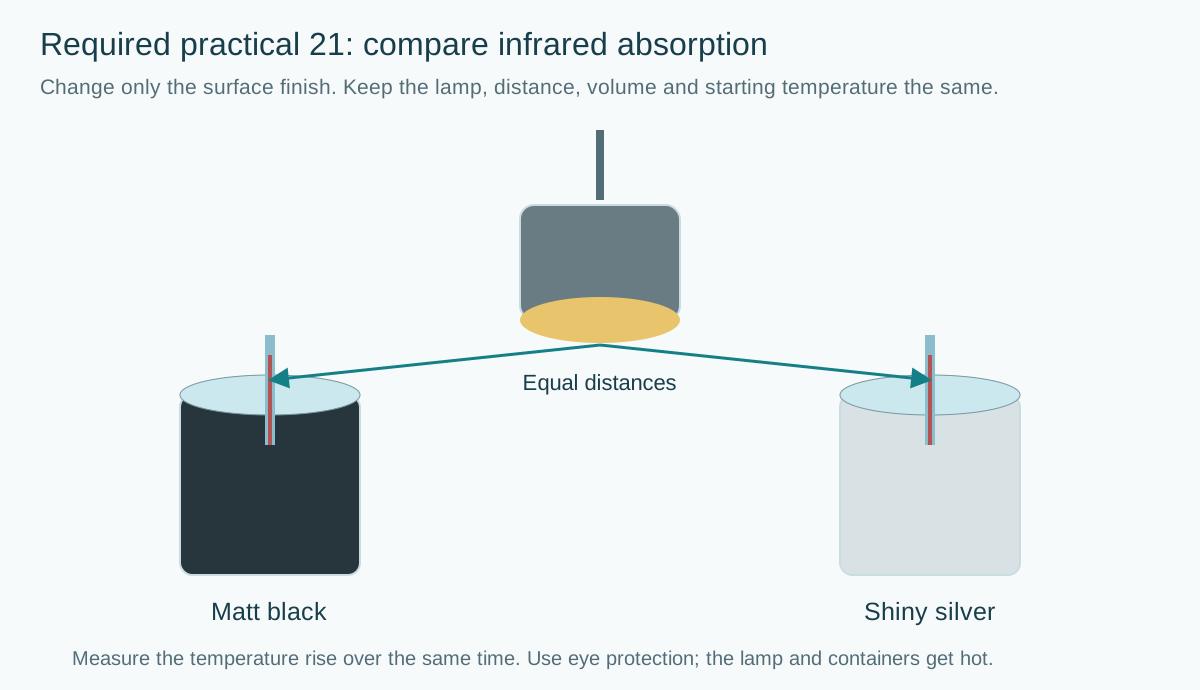
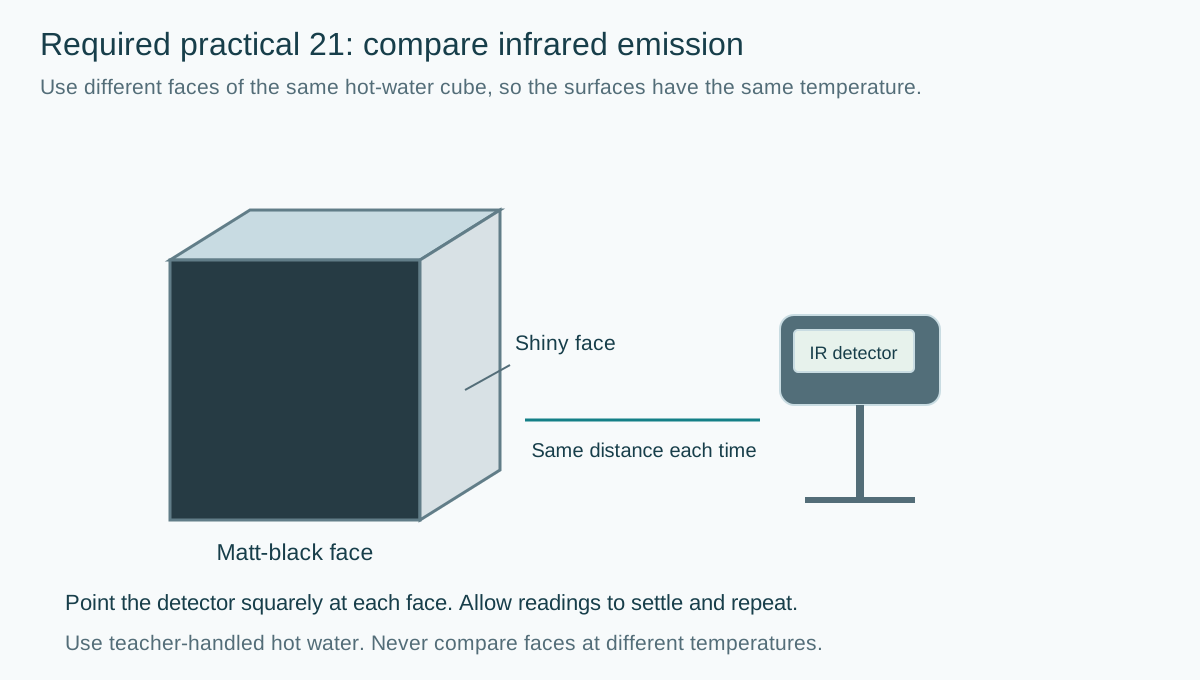
Safety: teacher supervision, eye protection, stable containers, care with hot water and lamps. Do not touch hot surfaces.
Changes involving electrons in atoms can generate or absorb electromagnetic radiation. Changes in atomic nuclei can also release radiation: gamma rays come from changes in the nucleus.
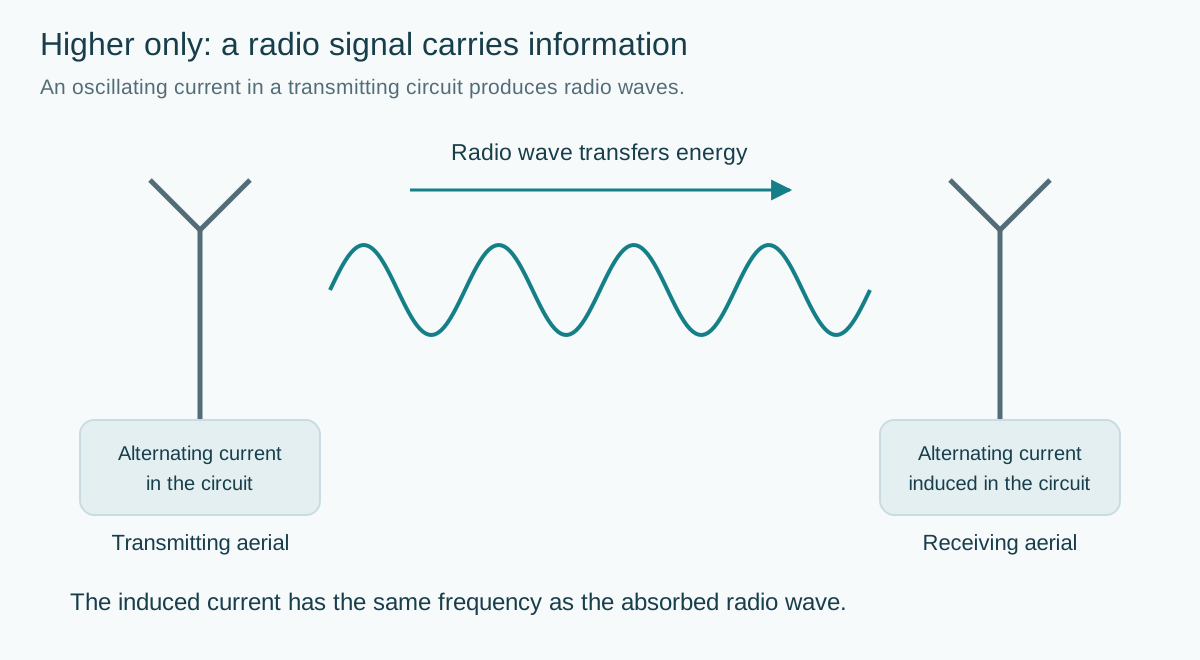
Higher only: oscillations in electrical circuits can produce radio waves. When a receiving circuit absorbs those waves, an alternating current may be induced at the same frequency as the absorbed wave.
| Radiation | Possible harm |
|---|---|
| Ultraviolet | Premature skin ageing and an increased risk of skin cancer |
| X-rays and gamma rays | Ionisation can damage cells and cause gene mutations, increasing cancer risk |
Radiation dose is a measure of the risk of harm from exposure. When dose is given in sieverts (Sv), remember 1 Sv = 1000 mSv. You do not need to recall the unit from memory, but you must use supplied units correctly.
Use evidence, not “all radiation is dangerous” or “a small dose is completely safe”. A medical team weighs the benefit of an image or treatment against the radiation risk. Reduce unnecessary exposure.
| Group | Applications to know | Higher only: why suitable |
|---|---|---|
| Radio | Radio and television broadcasting | Can carry signals over long distances and induce signals in receiving aerial circuits |
| Microwave | Satellite communication; cooking food | Suitable frequencies pass through the atmosphere to satellites; food absorbs microwaves and gains energy |
| Infrared | Electrical heaters, cooking, infrared cameras | Absorption transfers energy for heating; warm objects emit infrared detected by cameras |
| Visible | Fibre-optic communication | Light pulses carry information along fibres |
| Ultraviolet | Energy-efficient fluorescent lamps; sun tanning | A fluorescent coating absorbs UV and emits visible light; UV changes skin pigmentation but brings skin damage risks |
| X-rays | Medical imaging | Different tissues absorb different amounts, forming image contrast |
| Gamma rays | Medical imaging and treatment | Can pass out of the body to a detector; carefully targeted doses can destroy cancer cells |
The applications are shared content. Explaining why each wave is suitable is Higher-only. Total internal reflection calculations and lens diagrams are not needed for this Trilogy topic.
Start with the 40 main questions. Higher-only questions are labelled. You can complete this topic over several sessions; your answers save as you go. Use a hint if you get stuck, then compare your work with an example answer. Your tutor can mark written answers.
A calibrated ripple image shows five crest-to-crest gaps across 12 cm. Thirty complete waves pass a point in 10 s. A second group measures only one gap with the same ruler.
λ = 12 ÷ 5 = 2.4 cm = 0.024 m. f = 30 ÷ 10 = 3 Hz. v = 3 × 0.024 = 0.072 m/s. Measuring a longer length reduces the percentage effect of the ruler-reading uncertainty; divide by five to recover one wavelength.
Use a ruler. Your website answers are typed; these drawing exercises are for your notebook or a tutoring whiteboard.
When connected with your pupil code, your answers save online for Kevin to see. Click Submit to Kevin when you have finished. Downloads are optional.
Connect with your pupil code above to submit.
Use a scientific idea and a specific example in your reflection.