Particle model of matter
Work through one section at a time. Higher-only material is labelled explicitly; optional challenges can also use Foundation content.
 GCSE PHYSICS · AQA TRILOGYTutor dashboardSaves on this device
Your answers save automatically as you work.
Saved in this browser on this device.
Why does ice float, how do we measure a stone’s density, and why does a warm gas push harder? Use particles, practical measurements and clear calculations to find out.
Supported GCSE version · Clear examples, worked calculations and optional challenges.
Work through one section at a time. Higher-only material is labelled explicitly; optional challenges can also use Foundation content.
An atom or molecule used as a unit in a model of matter.
Mass per unit volume: how much mass fits into a given space.
Liquid pushed aside by an object; its volume can reveal the object’s volume.
The curved surface of a liquid in a narrow container. Read water at the bottom of the curve.
The smallest change an instrument can distinguish on its scale or display.
A change that makes no new substance; reversing it restores the original material’s properties.
A change directly from solid to gas, without becoming liquid first.
The total kinetic and potential energy of all particles in a system.
Energy needed to raise the temperature of 1 kg of a substance by 1 °C.
Energy needed to change the state of 1 kg without a temperature change.
The solid-to-liquid change, also called melting.
The change from a liquid to a gas.
Movement in constantly changing, unpredictable directions.
The object or group of objects being considered.
An error that shifts measurements consistently, such as an incorrect zero reading.
A particle model helps us explain what we cannot see directly. The particles might be atoms or molecules. Start with two questions: How are they arranged? How do they move?
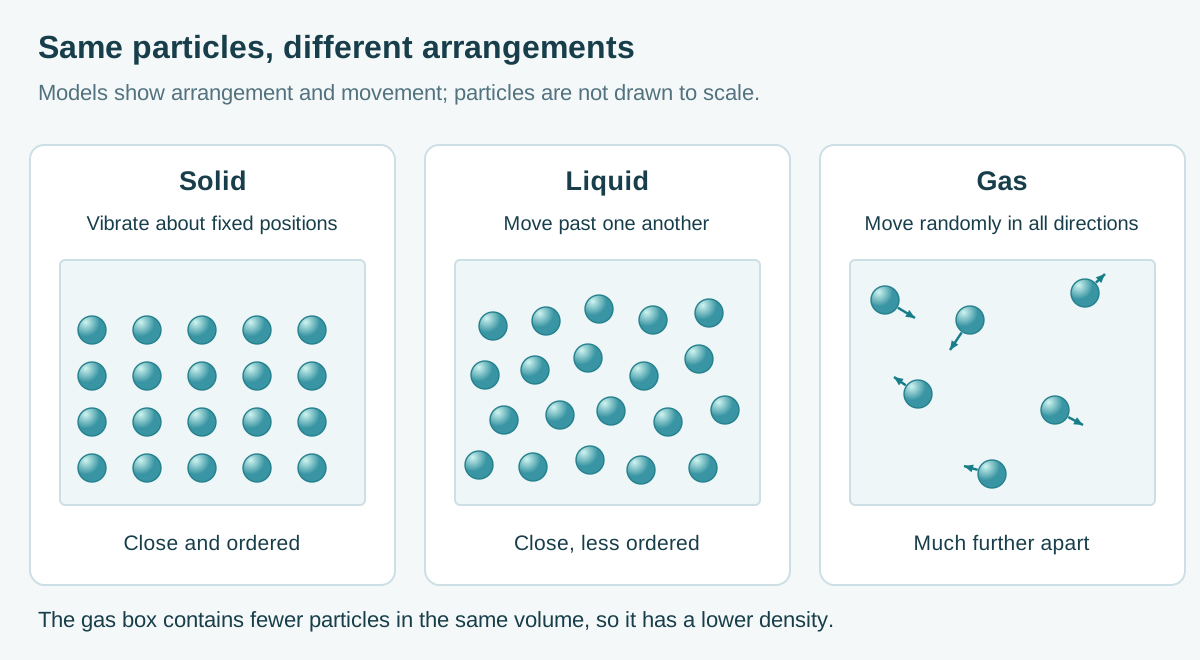
| State | Arrangement and movement | What we notice |
|---|---|---|
| Solid | Close together; vibrate about fixed positions. | Keeps its shape and volume. |
| Liquid | Close together; move past one another. | Flows and takes the container’s shape. |
| Gas | Far apart; move constantly and randomly. | Spreads to fill its container and is easily compressed. |
Density is mass per unit volume. Compare equal volumes: the one with the greater mass has the greater density.
For the same substance, gas particles are much further apart than liquid or solid particles. A fixed volume of gas therefore contains fewer particles and less mass. Gases usually have much lower densities. Solids and liquids both have close particles; their densities are often similar.
Useful exception: ice is less dense than liquid water. Its particles form a more open arrangement. The water molecules do not become heavier when ice melts.
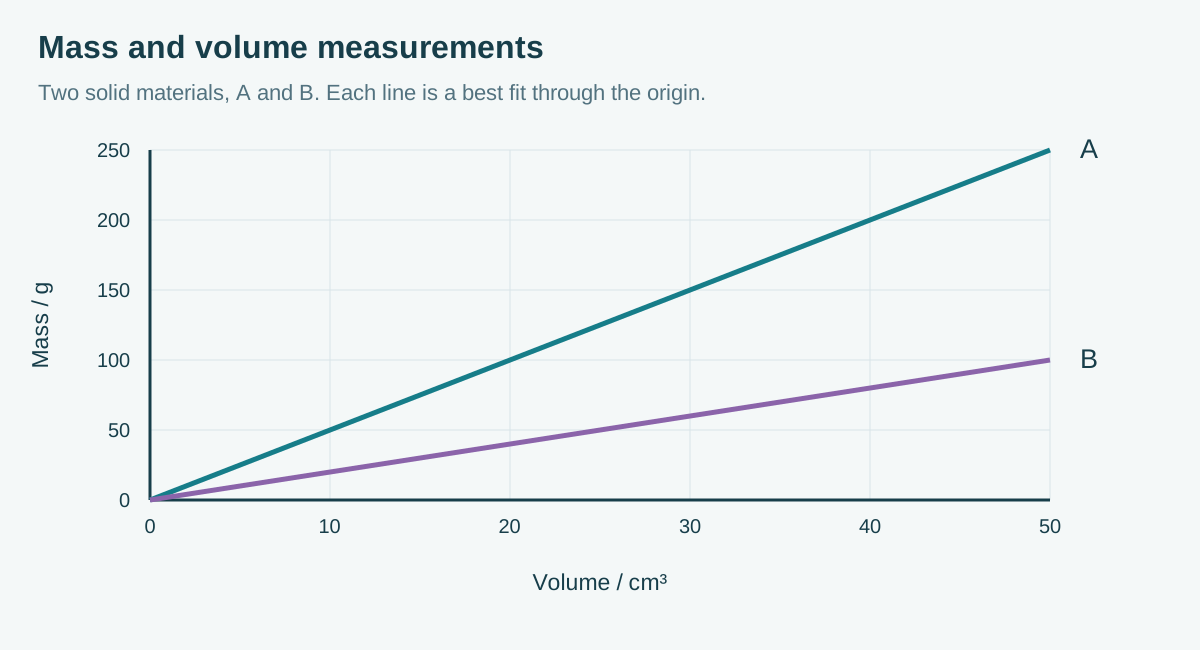
A sample has mass 540 g and volume 200 cm³. Density = 540 ÷ 200 = 2.7 g/cm³.
To find mass: m = ρV. To find volume: V = m/ρ.
| Conversion | Example |
|---|---|
| 1 kg = 1000 g | 250 g = 0.250 kg |
| 1 m³ = 1 000 000 cm³ | 40 cm³ = 0.000040 m³ |
| 1 cm³ = 1 mL | 25 mL = 25 cm³ |
| 1 g/cm³ = 1000 kg/m³ | 2.7 g/cm³ = 2700 kg/m³ |
A rectangular metal block has a shape we can measure directly. Measure mass and volume separately.
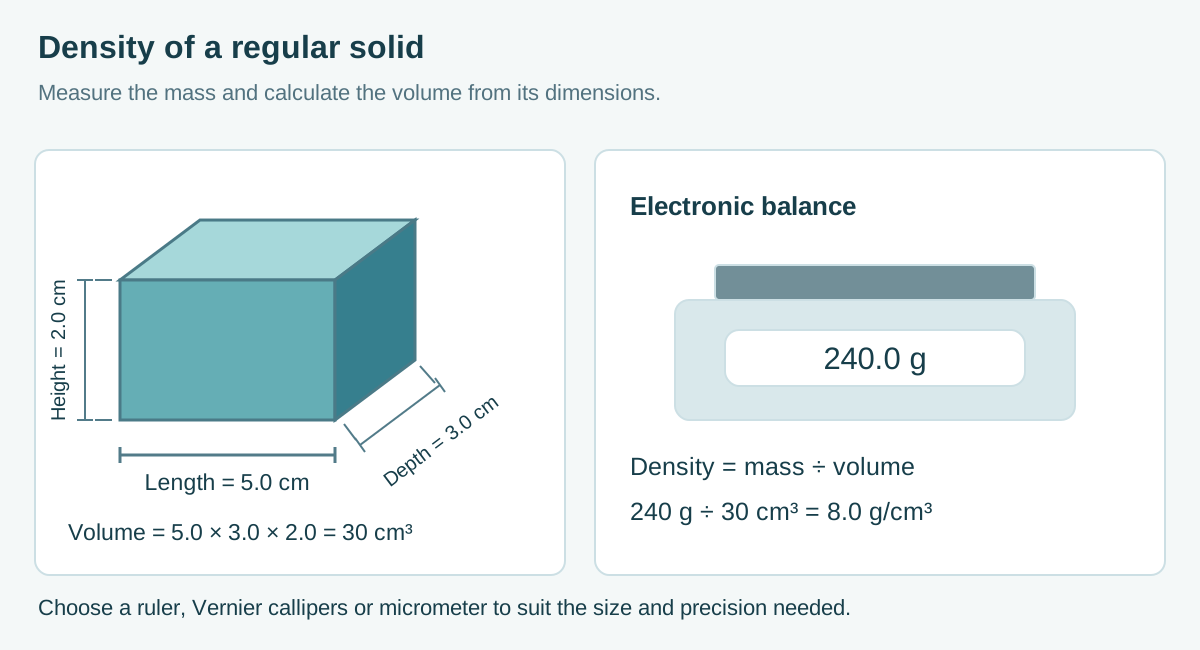
Improve the result: measure small dimensions with finer-resolution equipment. Measure at several positions if the block is not perfectly even. Repeats reveal variation; they do not automatically remove a zero error.
A stone has no simple length × width × height volume. Instead, measure the water it displaces when submerged.
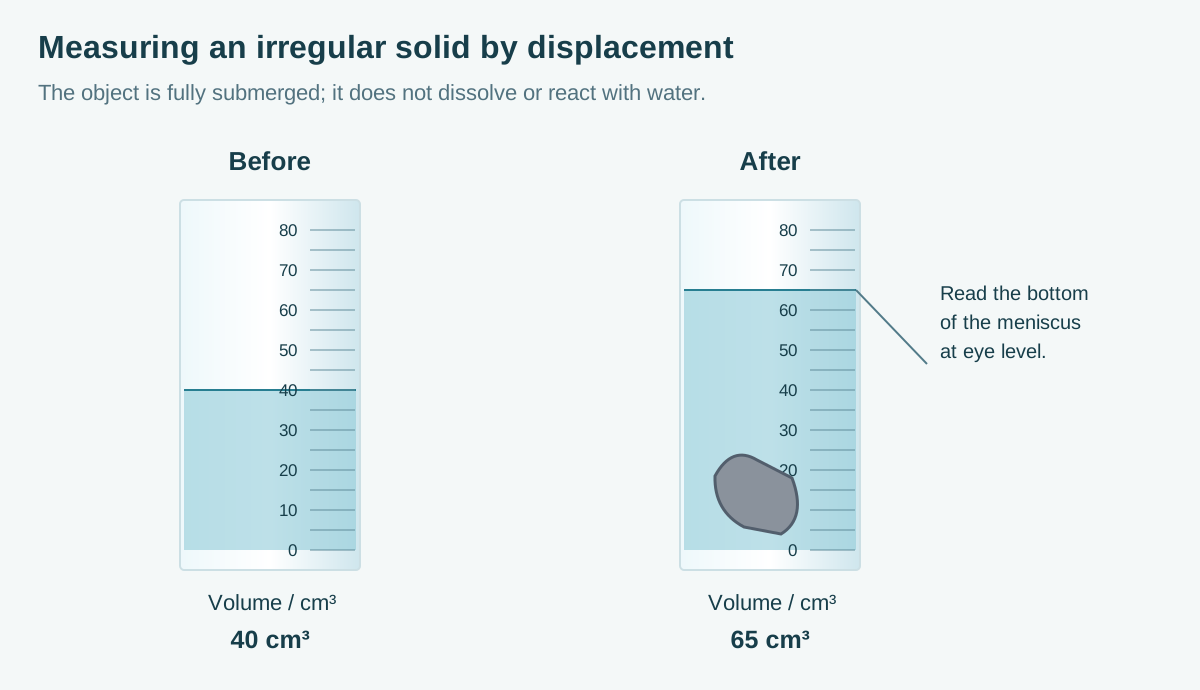
Use a solid that does not dissolve or react with the liquid. Avoid splashing. Trapped bubbles make the measured volume too large, giving a density that is too small.
The balance also measures the container. We must subtract its mass to find the liquid’s mass.
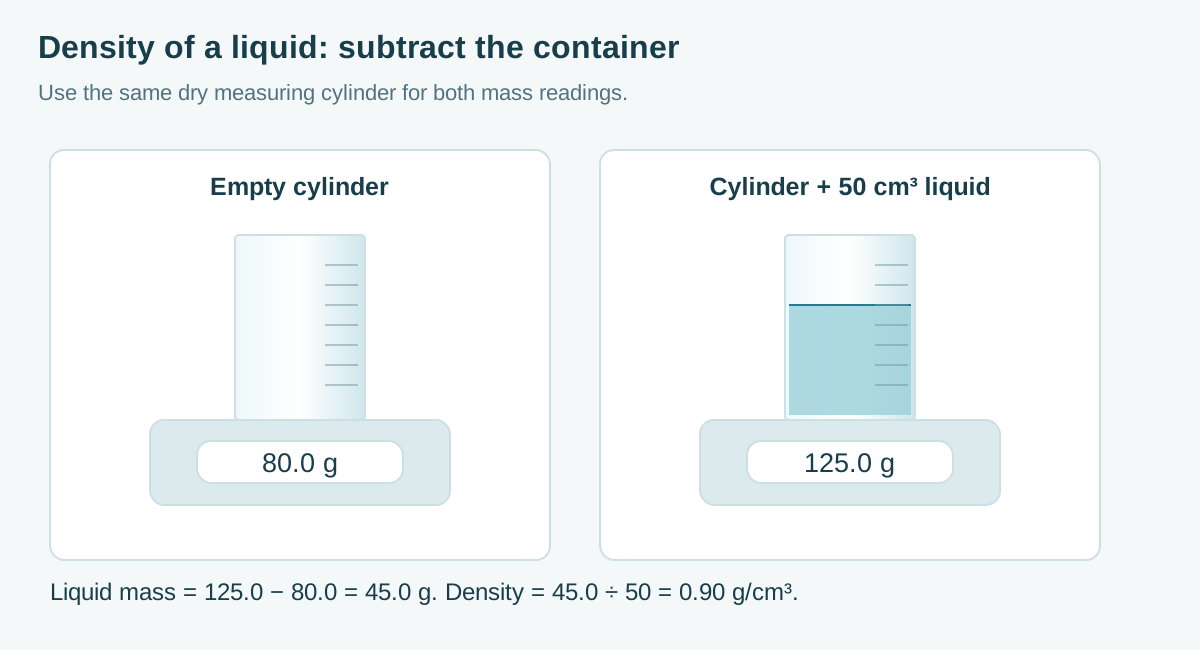
A balance can be tared with the empty cylinder on it, so it displays liquid mass directly. Use a suitable cylinder scale, wipe liquid from the outside, and keep the balance dry.
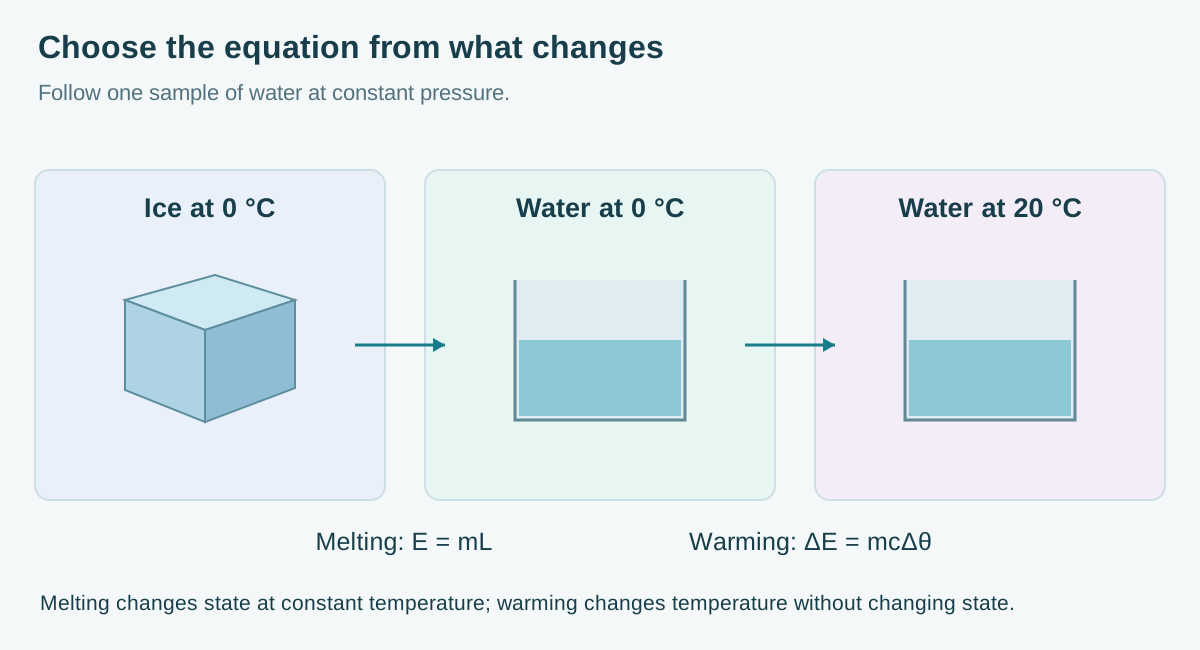
Melting ice makes liquid water, not a new substance. If the water freezes, it recovers the properties of ice. This makes it a physical change.
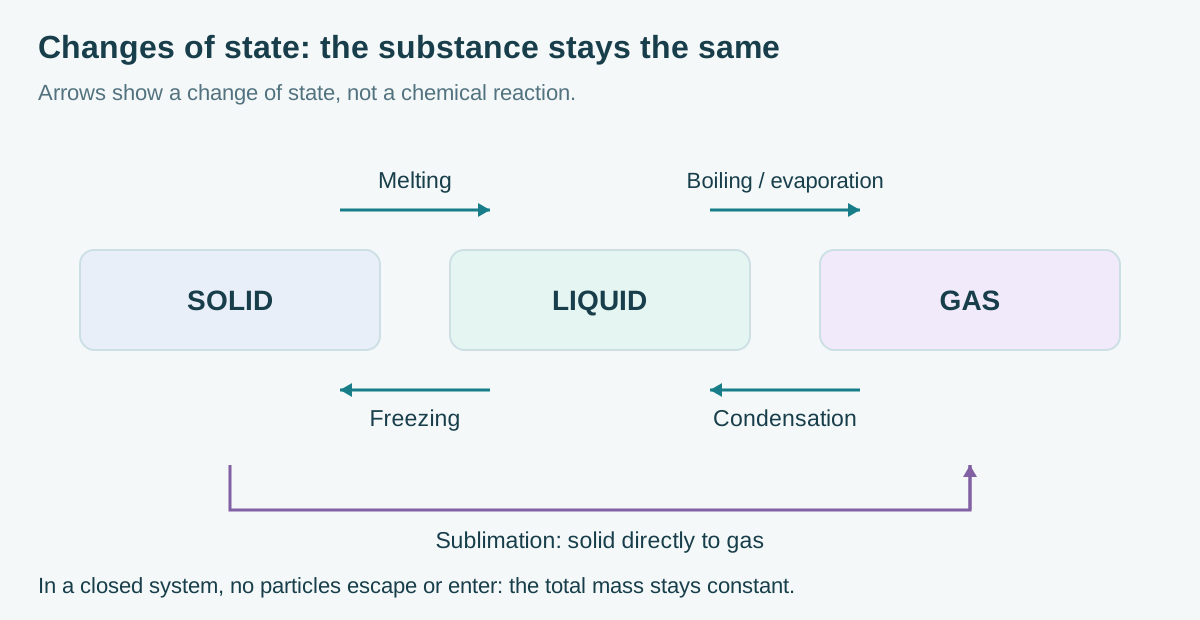
| Process | What changes? |
|---|---|
| Boiling | Liquid becomes gas throughout the liquid at its boiling point. |
| Evaporation | Particles escape from the liquid surface; this can happen below the boiling point. |
| Sublimation | A solid changes directly into gas. |
Mass is conserved: the same particles are still present during a change of state. In an open beaker, the balance reading may fall when gas escapes. The total mass of beaker contents plus escaped gas is unchanged.
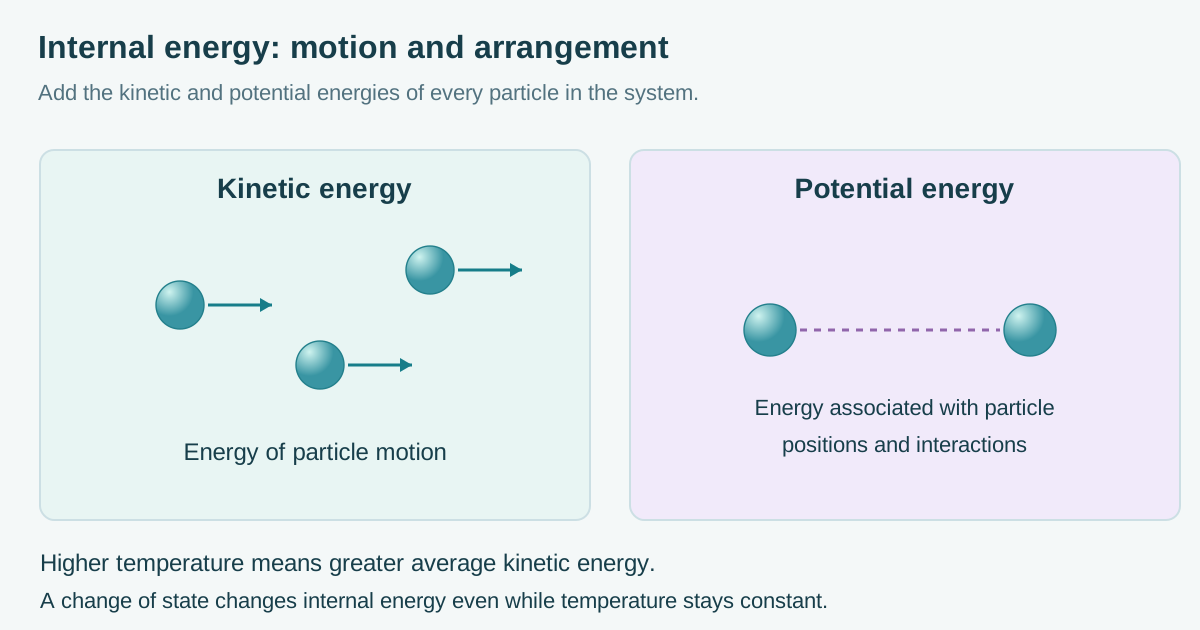
Internal energy is the total kinetic energy and potential energy of all the particles in a system.
Specific heat capacity, c, is the energy needed to raise the temperature of 1 kg of a substance by 1 °C, without a change of state.
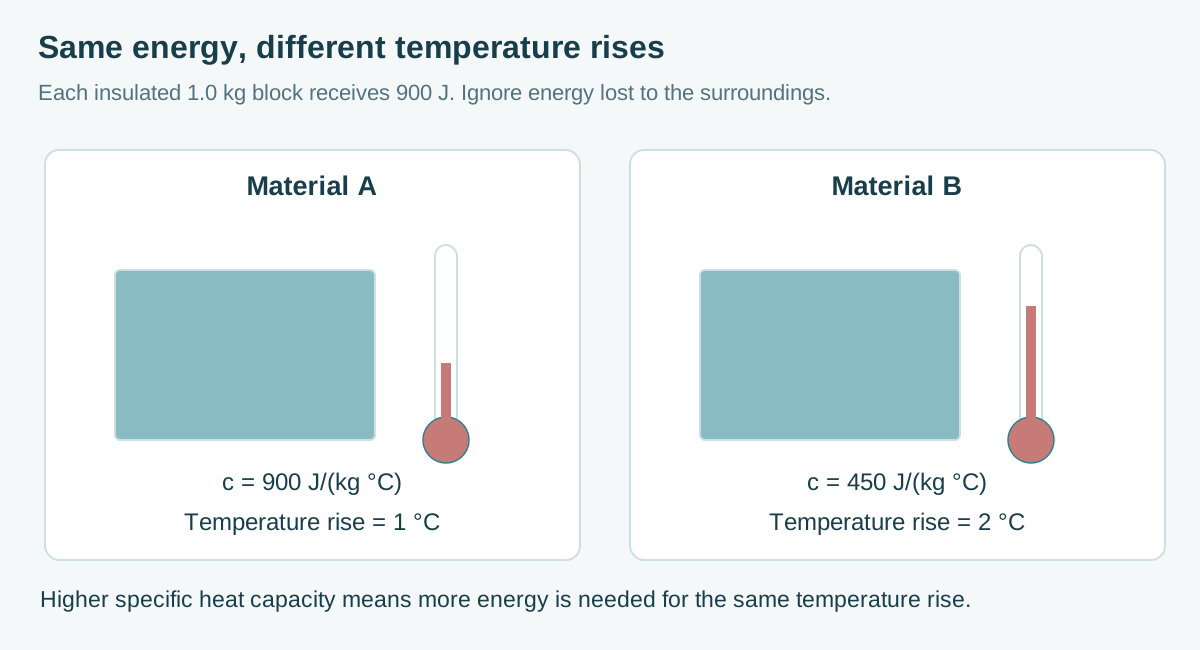
Rearrangements: c = ΔE/(mΔθ); Δθ = ΔE/(mc).
For the same energy input, a smaller mass or a smaller c gives a bigger temperature rise. This is the same relationship used in the Energy worksheet; required practical 14 is covered there.
Specific latent heat, L, is the energy needed to change the state of 1 kg of a substance without changing its temperature.
| Quantity | Change | Unit |
|---|---|---|
| Specific latent heat of fusion | Solid ↔ liquid | J/kg |
| Specific latent heat of vaporisation | Liquid ↔ gas | J/kg |
Mass = 0.20 kg; L of fusion = 334 000 J/kg.
E = 0.20 × 334 000 = 66 800 J.
This energy melts the ice. It does not also warm the resulting water. Freezing the same mass releases the same energy under these conditions.
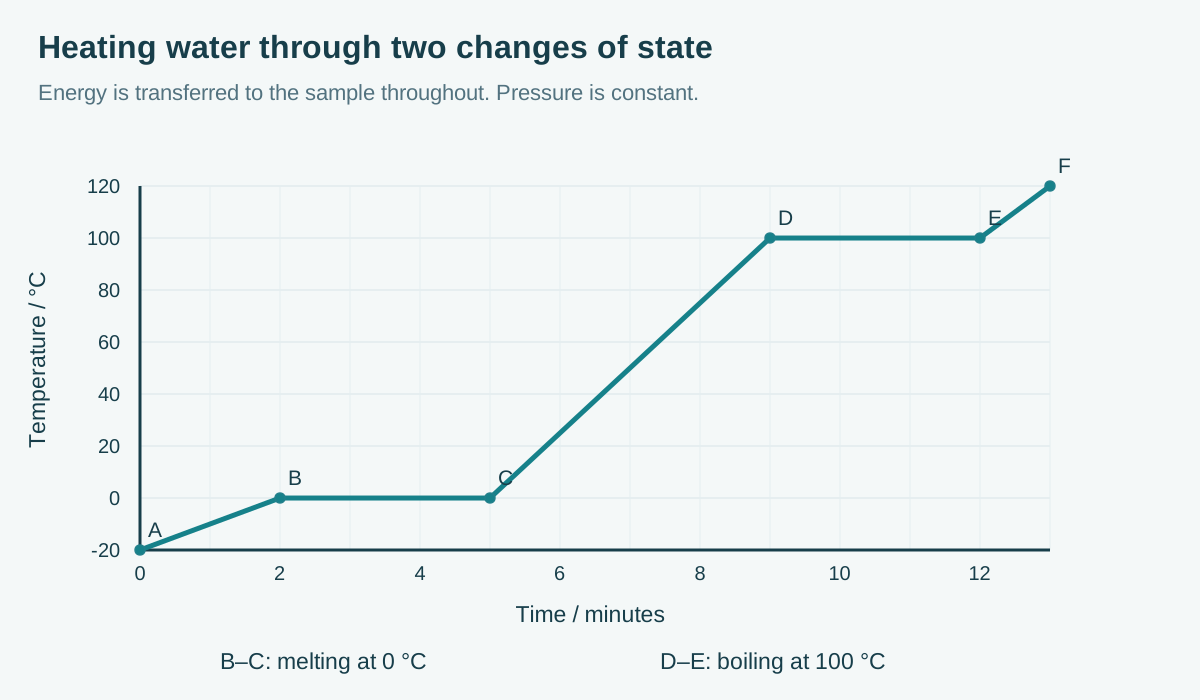
During melting or boiling, energy changes particle arrangement and potential energy. Average kinetic energy, and therefore temperature, stays constant during the change of state of a pure substance at constant pressure.
Read the axes first. A rising line means temperature increases. A flat section can show a change of state while energy is still being transferred.
| Section | What is happening? |
|---|---|
| A–B | Solid warms; average particle kinetic energy increases. |
| B–C | Melting; solid and liquid are both present. |
| C–D | Liquid warms. |
| D–E | Boiling; liquid and gas are both present. |
| E–F | Gas warms. |
For cooling, follow the changes in reverse: temperature falls between changes of state; energy is released during condensation or freezing at constant temperature.
Gas particles are in constant random motion. When they hit a container wall, they exert a force. The combined effects of many collisions produce gas pressure.
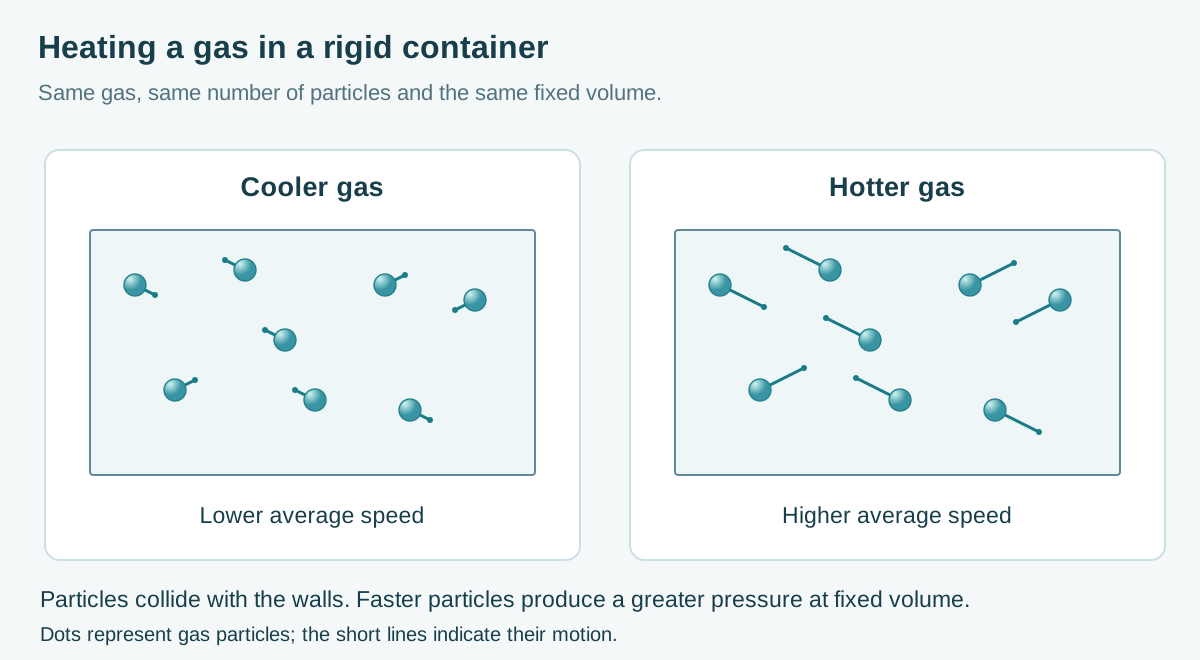
Cooling a fixed amount of gas at constant volume has the opposite effect. Not every particle has the same speed: temperature is related to the average kinetic energy.
Start with the 35 main questions. Higher-only questions are labelled. You can complete this topic over several sessions; your answers save as you go. Use a hint if you get stuck, then compare your work with an example answer. Your tutor can mark written answers.
An irregular metal sample has mass 135 g. It raises the water level from 40.0 to 65.0 cm³. A second student leaves air bubbles on the sample.
Metal volume = 65.0 − 40.0 = 25.0 cm³. Density = 135/25.0 = 5.4 g/cm³. Bubbles increase displaced volume, so the calculated density is too low. For a liquid, measure its volume and find its mass by subtracting the empty cylinder’s mass, then divide mass by volume.
These drawing activities are completed on paper. Written explanations can be saved in the answer boxes.
When connected with your pupil code, your answers save online for Kevin to see. Click Submit to Kevin when you have finished. Downloads are optional.
Connect with your pupil code above to submit.
Use a scientific idea and a specific example in your reflection.