Organic chemistry
Work through one section at a time. Higher-only material is labelled explicitly; optional challenges can also use Foundation content.
 GCSE CHEMISTRY · AQA TRILOGYTutor dashboardSaves on this device
Your answers save automatically as you work.
Saved in this browser on this device.
Follow crude oil from underground to useful fuels and materials. Use molecule diagrams and evidence to explain separation, combustion and cracking.
Supported GCSE version · Clear examples, worked calculations and optional challenges.
Work through one section at a time. Higher-only material is labelled explicitly; optional challenges can also use Foundation content.
A compound containing carbon and hydrogen atoms only.
A finite mixture of many compounds, mainly hydrocarbons, found in rocks.
Material from living or once-living organisms.
A resource with a limited supply that is not replaced as quickly as we use it.
A saturated hydrocarbon with only single carbon–carbon bonds; open-chain formula CₙH₂ₙ₊₂.
A family of compounds with the same general formula and similar chemical reactions.
A mixture collected from crude oil that contains hydrocarbons with similar boiling points.
Change from a liquid to a gas.
Change from a gas to a liquid.
How much a liquid resists flowing; a thicker liquid has higher viscosity.
How easily a substance catches fire.
A raw material used to make other chemicals.
Burning in enough oxygen; hydrocarbons form carbon dioxide and water.
Breaking larger hydrocarbon molecules into smaller, more useful molecules.
An unsaturated hydrocarbon containing a carbon–carbon double bond.
A substance that increases reaction rate without being used up overall.
Crude oil is a dark liquid found in rocks underground. It formed over millions of years from ancient biomass—the remains of living things, mainly tiny plankton buried in mud. Heat and pressure changed these remains.
Crude oil is finite: there is a limited supply, and we use it far faster than it forms. It is a mixture of many compounds, not one pure chemical. Most are hydrocarbons, molecules containing carbon and hydrogen atoms only.
Carbon atoms can bond to other carbon atoms, forming chains and many families of compounds. This helps explain the huge range of carbon-based materials around us.
Most hydrocarbons in crude oil are alkanes. They have only single bonds between carbon atoms. They are saturated: they have the maximum number of hydrogen atoms for these open carbon chains.
A homologous series is a family of compounds with the same general formula and similar chemical reactions. Alkanes follow CₙH₂ₙ₊₂. Here, n is the number of carbon atoms.
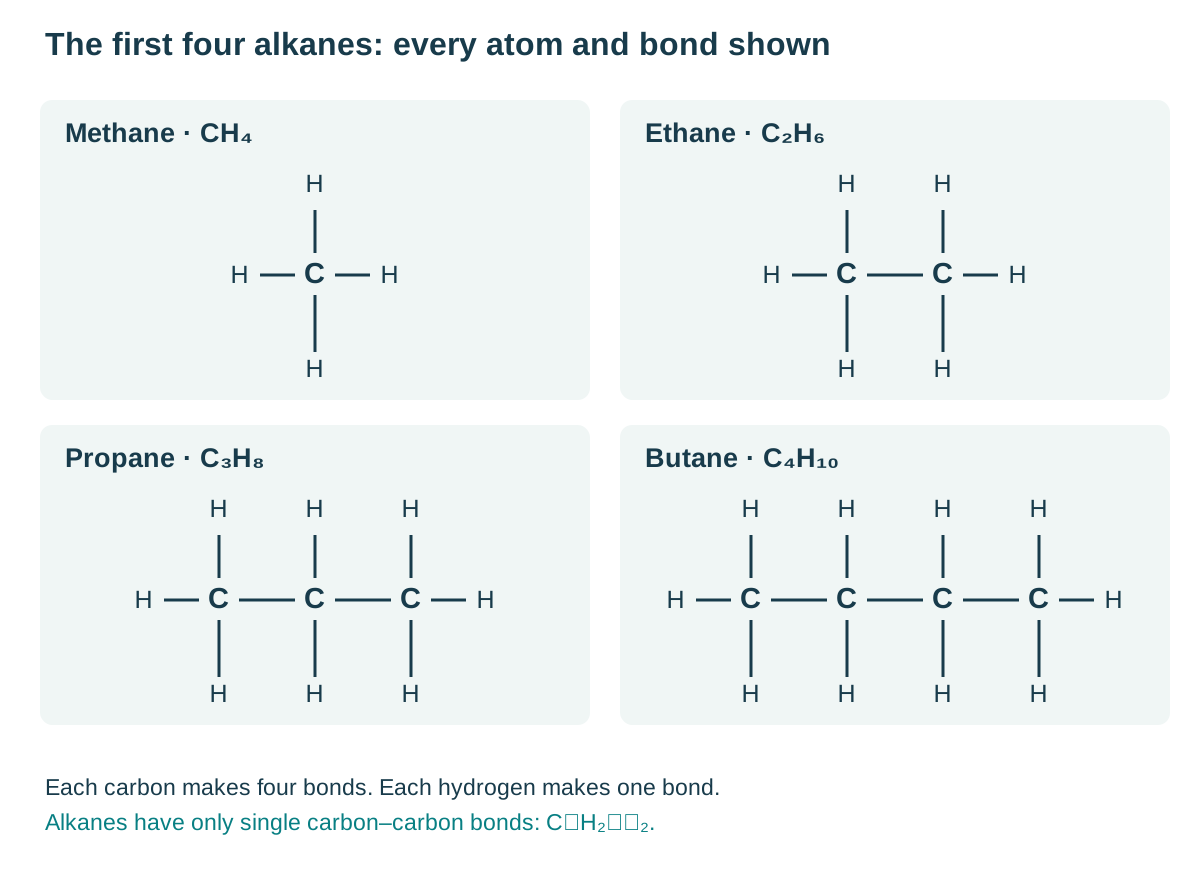
| Name | Carbon atoms | Molecular formula |
|---|---|---|
| Methane | 1 | CH₄ |
| Ethane | 2 | C₂H₆ |
| Propane | 3 | C₃H₈ |
| Butane | 4 | C₄H₁₀ |
A molecular formula tells you the number of each atom. A displayed formula also shows how the atoms are connected. Do not change the number of atoms when switching between them.
Different hydrocarbons boil at different temperatures. In fractional distillation, crude oil is heated so that much of it vaporises. The vapour enters a column that is hot at the bottom and cooler at the top.
As vapours rise, they cool. A hydrocarbon condenses when it reaches a region below its boiling point. Large molecules with higher boiling points condense lower down. Smaller molecules with lower boiling points travel further up before condensing. The smallest remain gases and leave at the top. Heavy residue remains at the bottom.
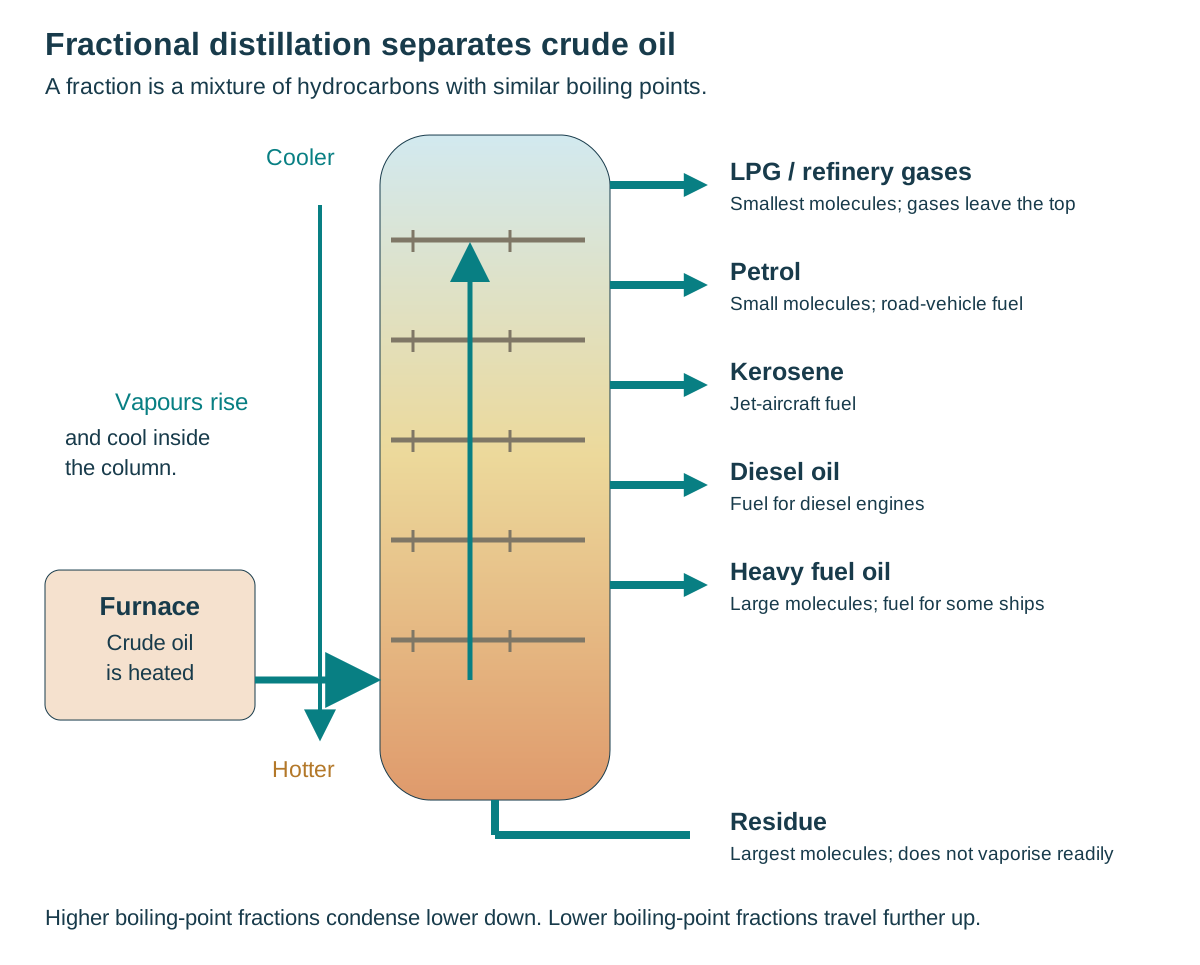
Fractional distillation is a physical separation: molecules are separated, not split apart. Each fraction contains molecules with similar numbers of carbon atoms and similar boiling points.
A fuel is burned to release energy. A feedstock is a starting material used to make other chemicals. The same oil industry supplies both.
| Product | Example use |
|---|---|
| LPG (liquefied petroleum gases) | Heating and cooking fuel |
| Petrol | Fuel for many cars |
| Kerosene | Jet-aircraft fuel |
| Diesel oil | Fuel for diesel engines |
| Heavy fuel oil | Fuel for some ships and industrial heating |
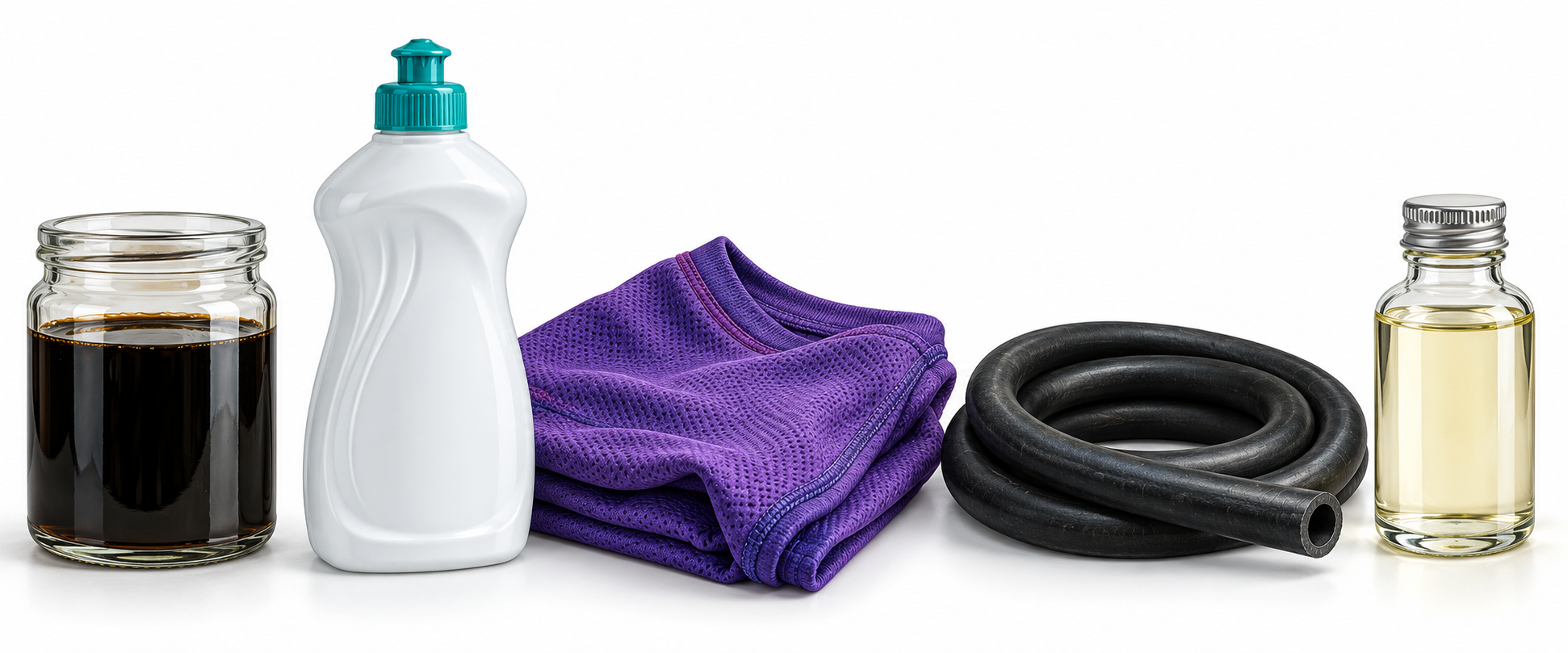
| Petrochemical feedstocks | Making solvents, lubricants, polymers and detergents |
Modern transport, packaging, cleaning and manufacturing use these products. A polymer can be made into a useful material instead of being burned as a fuel. This gives a reason to use finite oil resources carefully.
Viscosity means resistance to flowing. Honey is more viscous than water. Flammability describes how easily a substance catches fire.
| Property | Trend | Why it matters |
|---|---|---|
| Boiling point | Increases | More heating is needed to turn the liquid into vapour. |
| Viscosity | Increases | Longer-chain liquids flow less easily. |
| Flammability | Decreases | They are harder to ignite. |
These trends help explain uses. Small-molecule fuels vaporise and ignite easily. Larger molecules can be useful as lubricants because they are thicker and less easily evaporated. When a liquid boils, attractions between molecules are overcome; the covalent bonds inside each molecule are not broken.
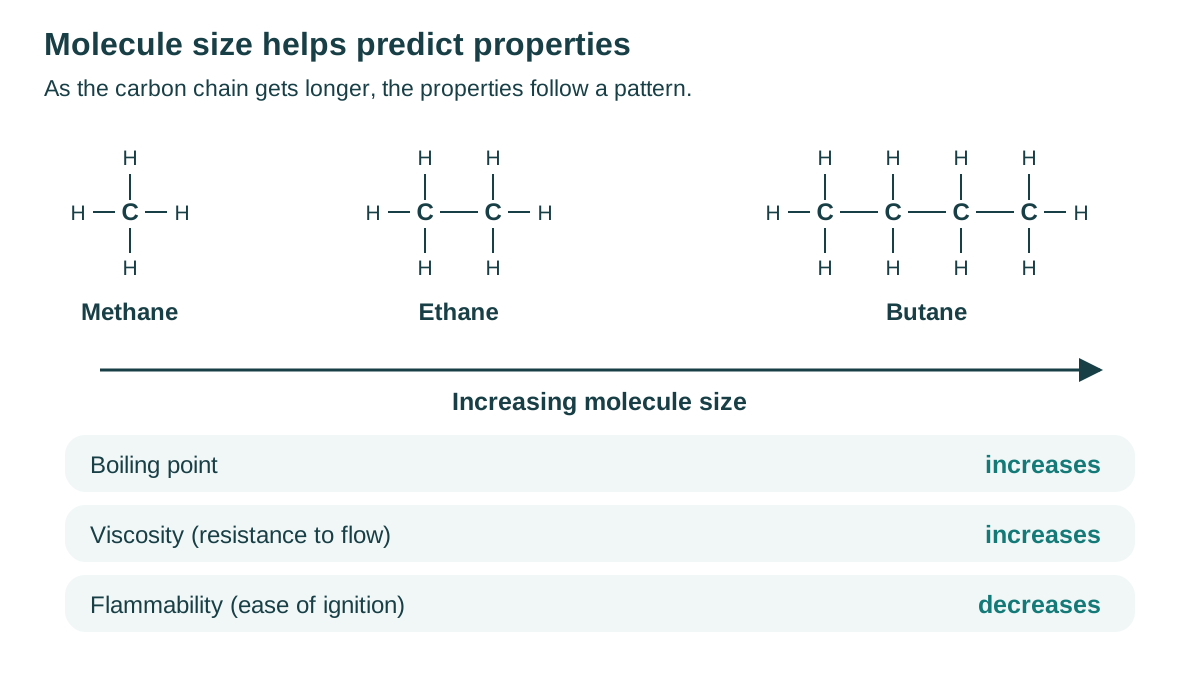
When a hydrocarbon burns in plenty of oxygen, its carbon and hydrogen are oxidised. Complete combustion produces carbon dioxide and water and releases energy to the surroundings.
Hydrocarbon + oxygen → carbon dioxide + water
Water may initially be a vapour because the flame is hot. You cannot identify water only by looking for visible liquid.
For propane: C₃H₈ + 5O₂ → 3CO₂ + 4H₂O. There are 3 carbons and 8 hydrogens, so make 3CO₂ and 4H₂O. These need 10 oxygen atoms: 5O₂.
With too little oxygen, combustion can be incomplete and produce toxic carbon monoxide or soot. This links to Chemistry of the atmosphere. Use proper ventilation and never test fuels casually at home.
Refineries may have more long-chain hydrocarbons than customers need, while demand for smaller fuel molecules is high. Cracking breaks large hydrocarbon molecules into smaller ones. It is a chemical reaction, unlike fractional distillation.
In catalytic cracking, the hydrocarbon is vaporised and passed over a hot catalyst. In steam cracking, hydrocarbon vapour is mixed with steam and heated to a very high temperature. You need these general conditions, not an exact industrial temperature.
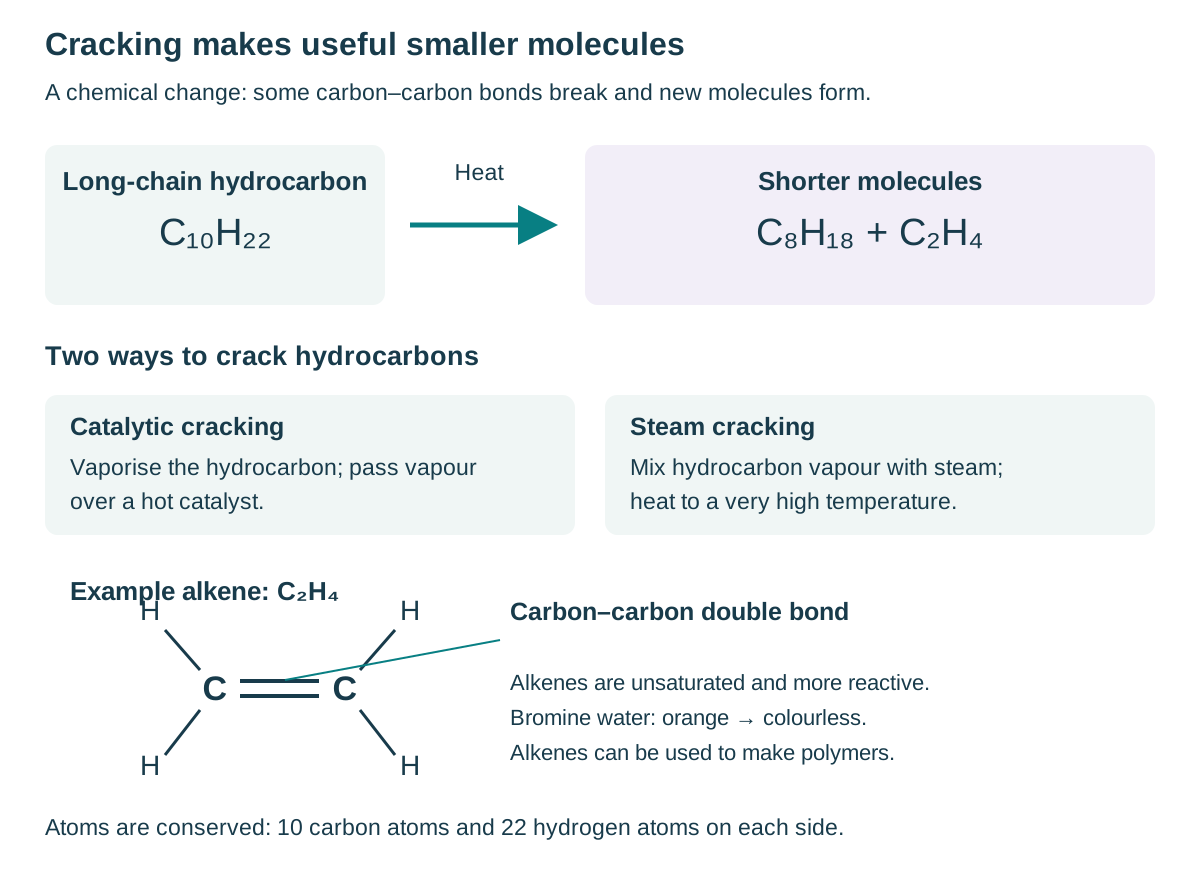
Products include smaller alkanes, useful as fuels, and alkenes, useful for making polymers and many other chemicals. Cracking increases the supply of products in high demand.
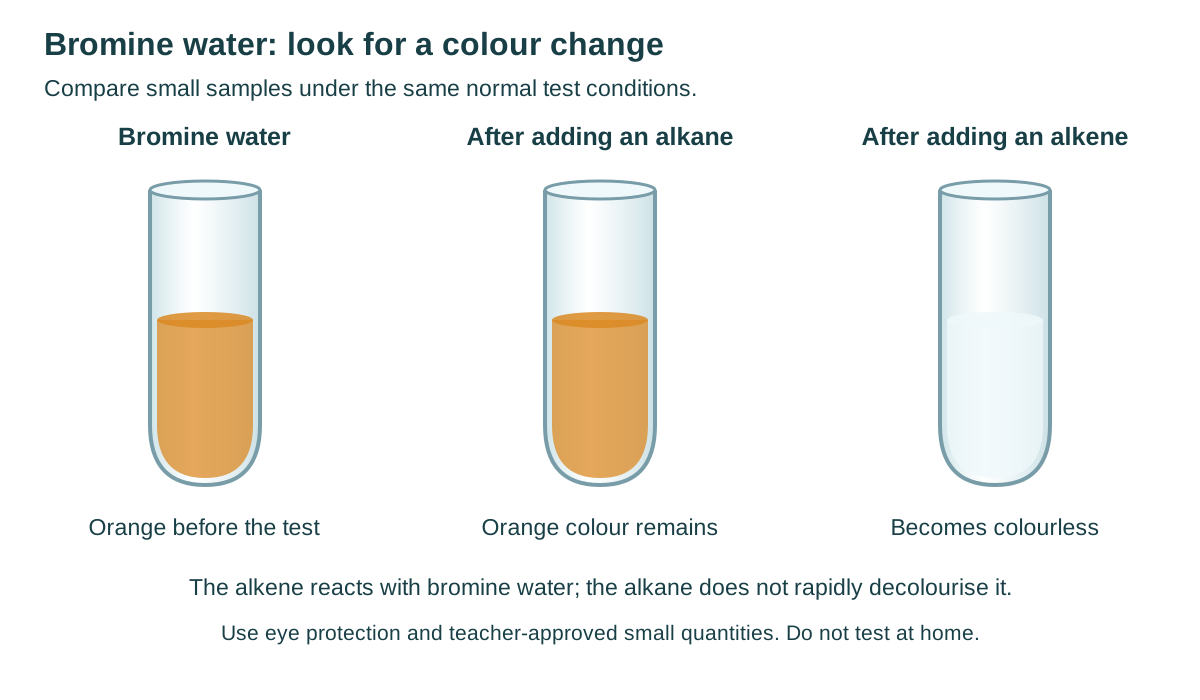
Alkenes contain a carbon–carbon double bond. They are unsaturated and more reactive than alkanes. In a teacher-supervised test, an alkene reacts with bromine water, changing it from orange to colourless. An alkane does not give this rapid colour change under the normal test conditions.
Use small samples and eye protection. Bromine water is harmful, so follow your teacher’s instructions. “Colourless” is the observation: “clear” is not precise because a coloured solution can also be clear.
Always use the values and units given in a data question. For a percentage, divide the part by the whole and multiply by 100.
For a six-mark explanation, connect stages using “because”, “so” and “therefore”. For distillation, link heating, vapour, the temperature gradient, boiling points and condensation. For cracking, explain both how it works and why the products are useful.
There is no separate required practical in topic 5.7. Demonstrations of cracking or fuel properties must follow school safety procedures. All questions here are original exam-style practice. This topic has no Higher-only specification content; the optional challenges ask you to apply the same content with less support.
Start with the 33 main questions. Higher-only questions are labelled. You can complete this topic over several sessions; your answers save as you go. Use a hint if you get stuck, then compare your work with an example answer. Your tutor can mark written answers.
A refinery needs more small-molecule fuels and polymer feedstocks. Explain how fractional distillation and cracking work together. Refer to the diagrams and give two differences between the processes.
Distillation heats the mixture and separates existing hydrocarbons by boiling point. Larger molecules generally condense lower in the column. Cracking chemically breaks some large molecules from surplus fractions into smaller molecules, using high temperature and a catalyst or steam. Smaller alkanes are useful fuels; alkenes are feedstocks for polymers. Distillation changes states and separates molecules; cracking changes the molecules themselves.
This is a diagram and application task. AQA does not specify a separate required practical for Organic chemistry.
When connected with your pupil code, your answers save online for Kevin to see. Click Submit to Kevin when you have finished. Downloads are optional.
Connect with your pupil code above to submit.
Use a scientific idea and a specific example in your reflection.