Inheritance, variation and evolution
Work through one section at a time. Higher-only material is labelled explicitly; optional challenges can also use Foundation content.
 GCSE BIOLOGY · AQA TRILOGYTutor dashboardSaves on this device
Your answers save automatically as you work.
Saved in this browser on this device.
Why do offspring resemble their parents without being identical? Follow genes through generations, explore how species change, and learn to use evidence rather than guesswork.
Supported GCSE version · Clear examples, worked calculations and optional challenges.
Work through one section at a time. Higher-only material is labelled explicitly; optional challenges can also use Foundation content.
A sex cell with one set of chromosomes, such as sperm or an egg.
The joining of two gametes.
Cell division that produces four genetically different cells with half the chromosome number.
An organism with the same genetic information as its parent, apart from new mutations.
The molecule that carries genetic information; two strands form a double helix.
A DNA-containing structure carrying many genes.
A section of DNA coding for a sequence of amino acids in a protein.
All the genetic material of an organism.
A version of a gene.
The alleles an organism has for a characteristic.
A characteristic that develops from genes and their interaction with the environment.
An allele expressed when one copy is present.
In a simple two-allele example, expressed when two recessive copies are present.
Having two identical alleles for a gene.
Having two different alleles for a gene.
An unaffected person with one copy of an allele for a recessive disorder.
A change in DNA; the source of new genetic variants.
Differences between individuals in a population.
Change in inherited characteristics of a population over generations.
Individuals with helpful inherited variants leave more offspring in a particular environment.
Humans choosing parents to produce offspring with wanted inherited characteristics.
Introducing a gene from another organism to change a genome and give a wanted characteristic.
In genetic engineering, a carrier that transfers a gene into a cell.
The loss of every living individual of a species.
A species’ two-part scientific name: genus and species.
An ancestral population from which two or more groups descended.
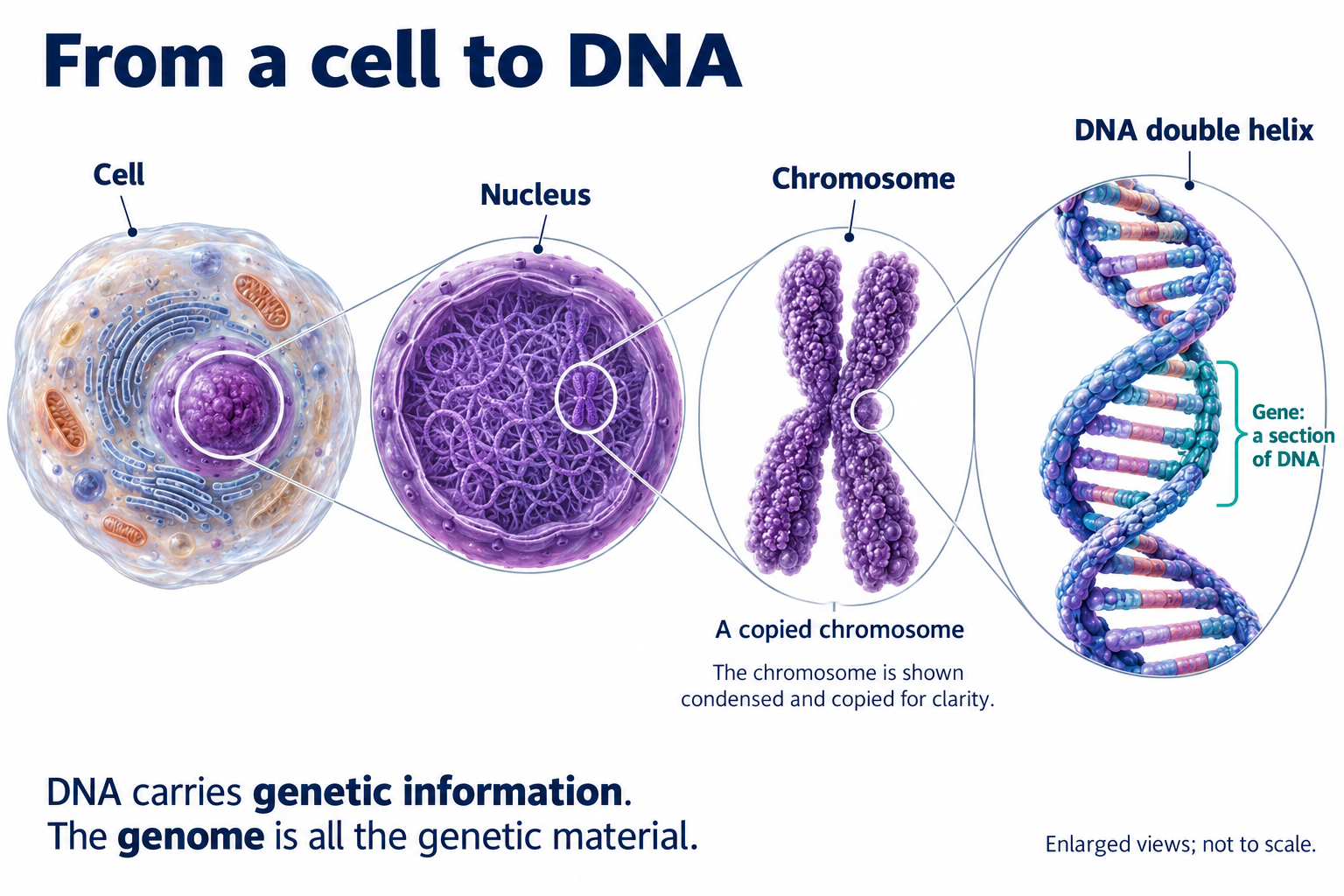
Reproduction makes new organisms. In sexual reproduction, two sex cells called gametes join. This joining is fertilisation. In animals, sperm joins an egg. In flowering plants, the male gamete comes from pollen and joins an egg cell.
Each gamete carries genetic information. Joining gametes mixes information from two parents, so the offspring differ from one another. The gametes are made by a type of cell division called meiosis.
In asexual reproduction, there is one parent and no joining of gametes. Cells divide by mitosis. The offspring have the same genetic information as the parent: they are clones, apart from any new mutations.
| Feature | Sexual | Asexual |
|---|---|---|
| Gametes join? | Yes | No |
| Mixing of genetic information | From two parents | No mixing between parents |
| Offspring | Genetically varied | Genetically identical clones |
| Cell division involved | Meiosis makes gametes; mitosis grows the new organism | Mitosis |
A chromosome is a structure made of DNA. Human body cells normally have 46 chromosomes arranged in 23 pairs. Gametes have one chromosome from each pair: 23 chromosomes.
At fertilisation, a sperm and egg join: 23 + 23 = 46. The first cell of the new organism therefore has the normal number. It divides by mitosis to increase the number of cells. Cells then differentiate — become specialised for different jobs — as the embryo develops.
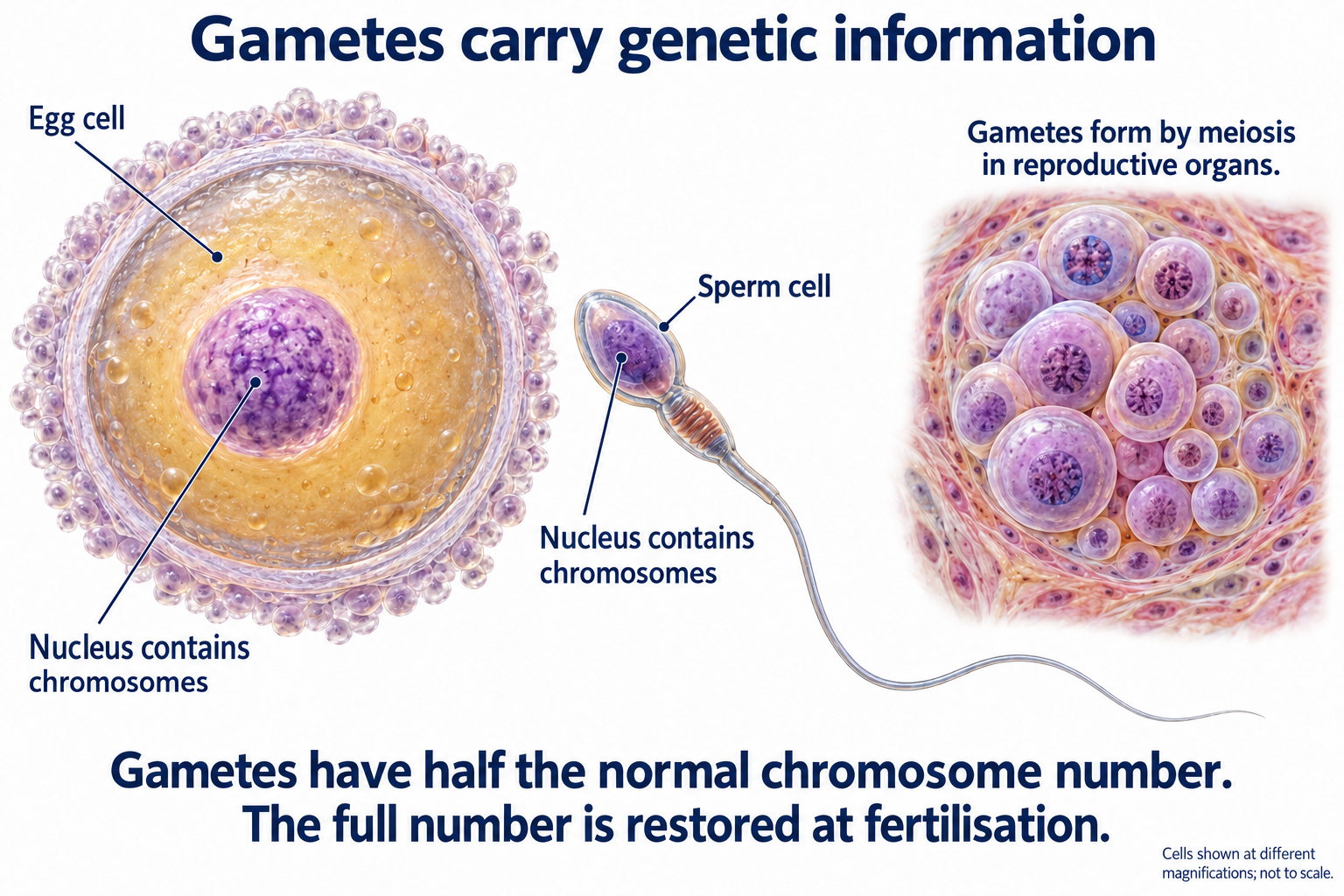
DNA is the chemical that carries genetic information. It is a polymer: a large molecule made from many smaller units joined together. Two strands twist around each other to form a double helix, like a twisted ladder.
In the nucleus, DNA is organised into chromosomes. A gene is a small section of DNA on a chromosome. Each gene codes for a particular sequence of amino acids, which are joined to make a specific protein. Proteins help build the body and carry out jobs such as acting as enzymes.
The genome is all the genetic material of an organism. Think of a gene as one set of instructions and the genome as the complete collection.
Studying the human genome helps scientists:
A genetic result can show increased risk, but it does not always predict whether someone will become ill. Other genes and the environment can also matter.
An allele is a version of a gene. For most genes, you inherit one allele from each parent. Your pair of alleles is your genotype. The characteristic that develops is your phenotype.
For a simple example, suppose a mouse’s fur colour is controlled by one gene. Let B be a dominant allele for black fur and b a recessive allele for brown fur.
| Genotype | Name | Phenotype |
|---|---|---|
| BB | Homozygous dominant: two dominant alleles | Black fur |
| Bb | Heterozygous: two different alleles | Black fur |
| bb | Homozygous recessive: two recessive alleles | Brown fur |
A dominant allele affects the phenotype when just one copy is present. A recessive allele affects the phenotype in this two-allele example only when both copies are recessive.
Homozygous means the two alleles are the same. Heterozygous means they are different.
A Punnett square shows possible allele combinations when gametes join. Each gamete carries just one allele of the gene.
Here, two heterozygous black mice are crossed: Bb × Bb. Each parent can produce B gametes or b gametes. Combine the row and column letters in each box.
| Gametes | B | b |
|---|---|---|
| B | BB | Bb |
| b | Bb | bb |
The four equally likely combinations are BB, Bb, Bb and bb. The genotype ratio is 1 BB : 2 Bb : 1 bb. The phenotype ratio is 3 black : 1 brown.
Probability of brown fur = 1 ÷ 4 = 0.25 = 25%. Out of 80 offspring, the expected number with brown fur is 0.25 × 80 = 20.
This is a prediction, not a guarantee. Each fertilisation is a new event. Four offspring do not have to include exactly three black mice and one brown mouse.
To construct a cross for yourself: choose letters and define the alleles; write both parents’ genotypes; work out their possible gametes; draw and complete the Punnett square; use the boxes to predict a probability or ratio. The questions labelled Higher only ask you to build the cross without a supplied grid.
Some disorders are caused by inherited alleles. Two examples show why dominant and recessive inheritance matter.
| Disorder | Allele pattern | What this means |
|---|---|---|
| Polydactyly | Dominant allele, P | Extra fingers or toes. PP and Pp are affected; pp is not affected. |
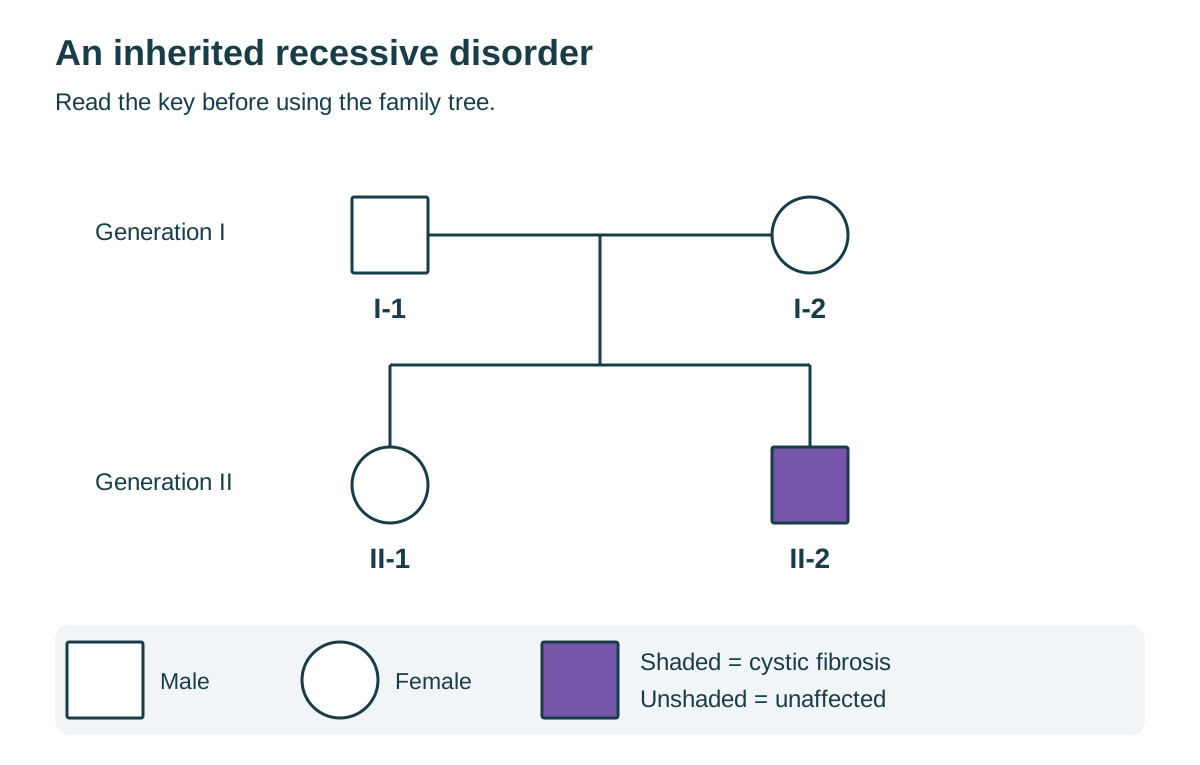
| Cystic fibrosis | Recessive allele, f | A disorder of cell membranes. ff is affected; Ff is an unaffected carrier; FF is unaffected and not a carrier. |
A carrier has one copy of a recessive disorder allele. They do not have that disorder but can pass the allele to a child. Two carriers of cystic fibrosis can have an affected child if each passes on f.
A family tree shows how a characteristic appears across generations. Read its key before drawing conclusions. In this example, shaded symbols show cystic fibrosis.
Embryo screening checks embryos for particular genetic conditions before an embryo is selected for transfer to a uterus during IVF. It can reduce the chance of a child inheriting a tested disorder. It does not guarantee a child will have no health problems.
Decisions involve evidence and values. Families may consider the severity of a disorder, emotional effects, cost and access to treatment. Some people object to selecting embryos or to embryos not being used. A fair evaluation explains both potential benefits and concerns without assuming everyone will make the same choice.
Human body cells normally have 23 pairs of chromosomes. One pair is the sex chromosomes. In the usual pattern, females have XX and males have XY.
An egg carries X. A sperm carries X or Y. The cross below shows the usual inheritance pattern.
| Egg / sperm | X sperm | Y sperm |
|---|---|---|
| X egg | XX | XY |
| X egg | XX | XY |
Half the boxes are XX and half are XY: a 1 : 1 ratio and approximately 50% probability of each for each fertilisation. This does not mean every family has equal numbers of boys and girls, or that earlier births change the probability of the next.
Variation means differences between individuals in a population. There is usually a lot of genetic variation within a species.
| Cause | Example | Why it varies |
|---|---|---|
| Inherited genes | Blood group | Different inherited alleles |
| Environment | A scar | An injury during life |
| Genes and environment | Human height | Many genes affect growth, along with factors such as nutrition |
The genome interacts with the environment to influence the phenotype. For example, plants with the same genes may grow to different heights if one receives less light.
Mutations are changes in DNA. They happen continually and are the original source of new genetic variants. Most variants have no effect on the phenotype, some influence it, and very few determine it.
A mutation does not happen because an organism needs it. Very rarely, a new phenotype is helpful when the environment changes. The individuals with that phenotype may then leave more offspring.
Evolution is a change in the inherited characteristics of a population over generations. Natural selection can cause that change.
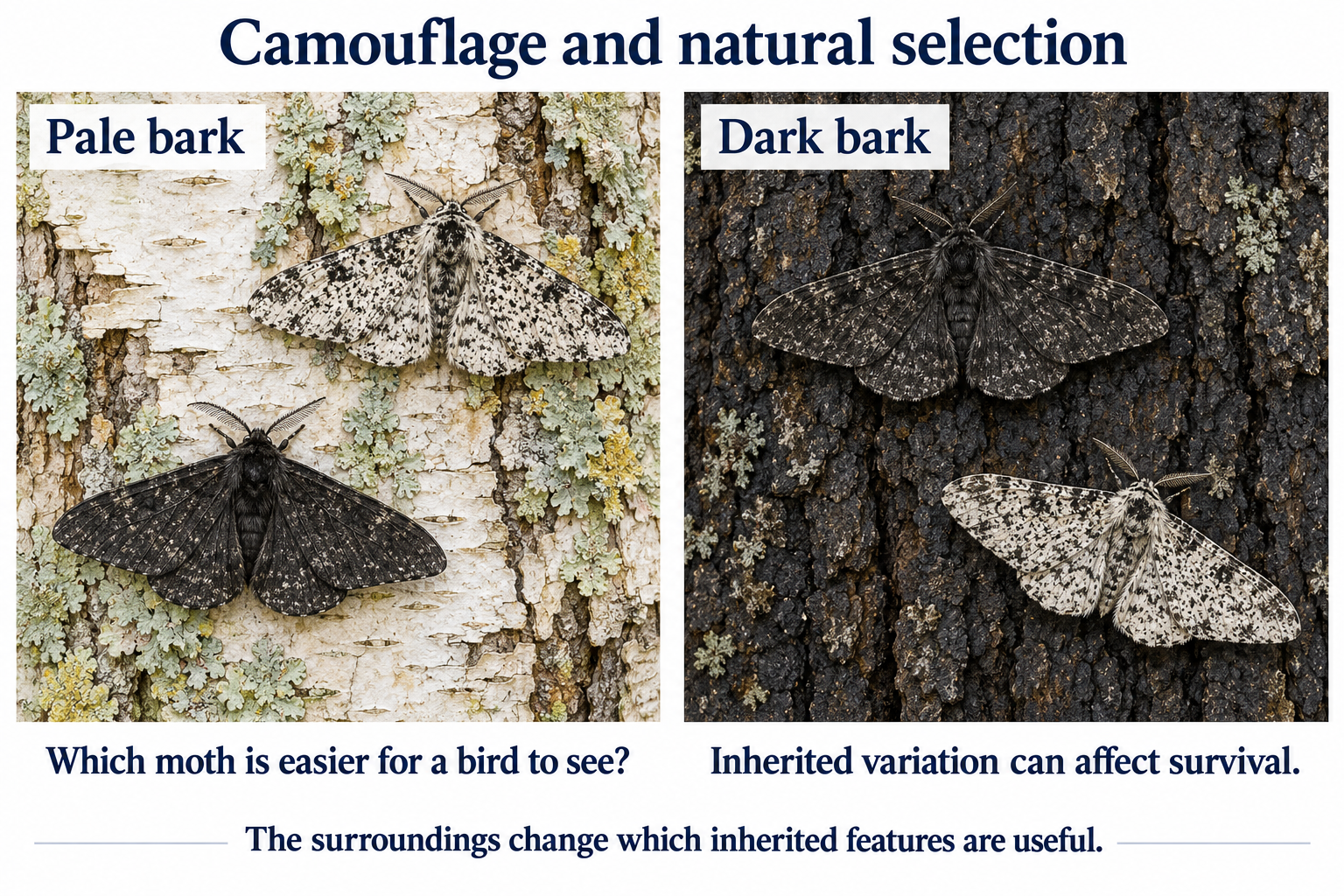
Imagine light and dark moths. On dark bark, dark moths may be harder for birds to see. More may survive to breed, so the dark-colour allele becomes more common.
The theory of evolution by natural selection explains how living species evolved from simple life forms more than three billion years ago. If populations become so different that they can no longer interbreed to produce fertile offspring, they are different species.
In selective breeding, humans choose which organisms reproduce because they want a particular inherited characteristic. It is also called artificial selection.
Examples include disease-resistant crops, animals that produce more milk or meat, dogs with a gentle nature, and plants with large or unusual flowers. People have used selective breeding for thousands of years.
Benefits depend on the aim: more food, fewer losses to disease or a suitable temperament. But repeatedly using closely related parents causes inbreeding. Harmful recessive alleles can meet more often, making some breeds more likely to have inherited disorders. Reduced genetic variety can also make a population vulnerable to a new disease.
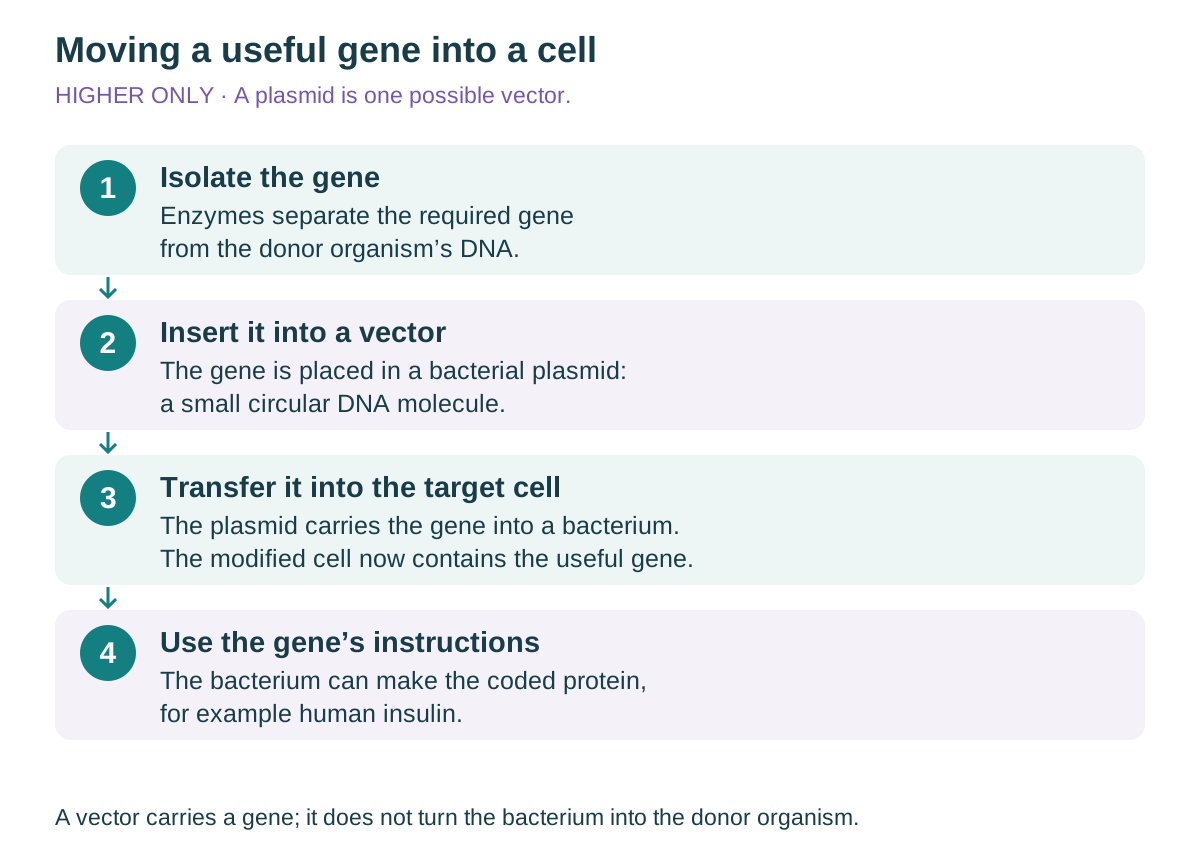
Genetic engineering changes an organism’s genome by introducing a gene from another organism to give a wanted characteristic.
A useful example is putting the human insulin gene into bacteria. The bacteria can then make human insulin, which is collected and purified for use as a medicine. The bacteria do not become human: they have received a particular gene.
Genetically modified (GM) crops may resist insect attack, disease or a herbicide. Some are developed to give larger or better-quality fruit. Yields can increase because fewer plants are damaged or because weeds can be controlled.
Possible concerns depend on the crop and how it is grown. For example, reducing wild flowers may reduce food for insects. A useful evaluation weighs evidence about yield, cost, wildlife and health rather than assuming every GM crop has the same effects. Some people feel that possible long-term effects of eating GM food need further investigation.
Researchers are also investigating genetic modification to treat some inherited disorders. A possible benefit is tackling the genetic cause; reliable delivery and safety must be checked.
Enzymes isolate the required gene. The gene is put into a vector — a carrier, often a bacterial plasmid or a virus. The vector carries the gene into the target cells. For animals and plants, genes are introduced early in development so the organism develops with the wanted characteristic.
Scientific explanations are tested against evidence. Several lines of evidence support evolution by natural selection:
These independent sources of evidence support one another. Evidence for inherited characteristics and the fossil record helped Darwin’s theory become widely accepted. Scientists continue to refine explanations when new evidence is found.
A fossil is a preserved remain or trace of an organism from the past, often millions of years old. Fossils can form in several ways:
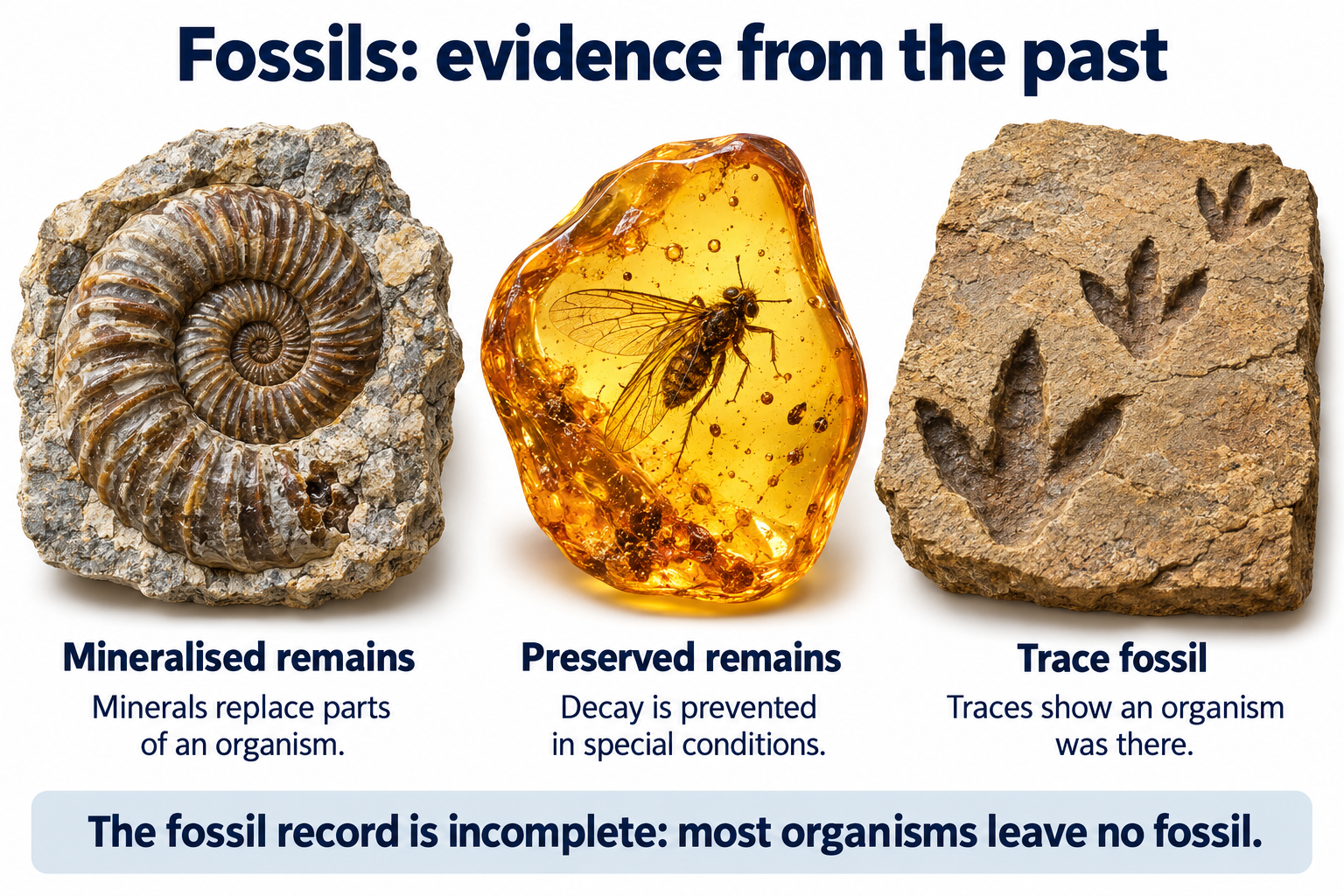
The fossil record is incomplete. Many early organisms were soft-bodied and left few traces. Other traces were destroyed by geological activity such as heat, pressure or erosion. Scientists therefore cannot be certain exactly how life first began.
Fossils can show how much organisms have changed or stayed similar. When you compare fossil data, check both the features and the ages. A gap in the record does not show that no organisms lived during that time.
A species is extinct when no individuals remain alive anywhere. A population disappearing from one place is not necessarily global extinction.
Possible causes include rapid environmental change, a new predator, a new disease, stronger competitors or a catastrophic event. Human actions such as hunting and habitat destruction can add pressure.
Link the cause to survival and reproduction. For example, if a wetland dries out, an animal may lose its food and breeding sites. If too few survive and reproduce, its population may fall to zero.
Bacteria reproduce quickly, so their populations can change over many generations in a short time. A random mutation may give a bacterium resistance to an antibiotic.
MRSA is an example of antibiotic-resistant bacteria. Resistance makes infections harder to treat. New antibiotics take time and money to develop, so development may not keep pace with resistant strains.
Unnecessary antibiotic use creates more opportunities for resistant strains to be selected. Antibiotics should not be used for viral infections or other situations where they are not appropriate. Patients should follow the prescribed course and advice, rather than stopping or changing treatment themselves. Agricultural use should also be restricted.
Classification groups organisms using similarities and differences. Carl Linnaeus developed a system based on their structures and characteristics.
The groups run from broad to specific: kingdom → phylum → class → order → family → genus → species.
The binomial system gives each species a two-part scientific name: its genus and species. In Homo sapiens, Homo is the genus. The genus starts with a capital letter; the second word is lower case.
Organisms in the same genus are in the same family, but organisms in the same family need not be in the same genus. Classification helps people communicate clearly even when common names differ between countries.
| Example rank | Human classification |
|---|---|
| Kingdom | Animalia |
| Phylum | Chordata |
| Class | Mammalia |
| Order | Primates |
| Family | Hominidae |
| Genus | Homo |
| Species name | Homo sapiens |
Better microscopes revealed more internal detail. Studies of chemical processes and genetic material gave scientists new evidence about relationships. Classification systems changed as a result.
Carl Woese developed a three-domain system using chemical evidence, including comparisons of genetic material. A domain is a very broad group.
| Domain | Examples and features |
|---|---|
| Archaea | Microorganisms without a nucleus; many live in extreme environments. They are distinct from Bacteria. |
| Bacteria | Bacterial organisms, also without a nucleus. |
| Eukaryota | Organisms whose cells have a nucleus: protists, fungi, plants and animals. |
Similar appearance alone can be misleading. Chemical and genetic evidence can reveal relationships that were not obvious from the outside.
An evolutionary tree shows a scientific explanation of how groups are related. A branching point represents a shared ancestor. Groups that share a more recent common ancestor are more closely related.
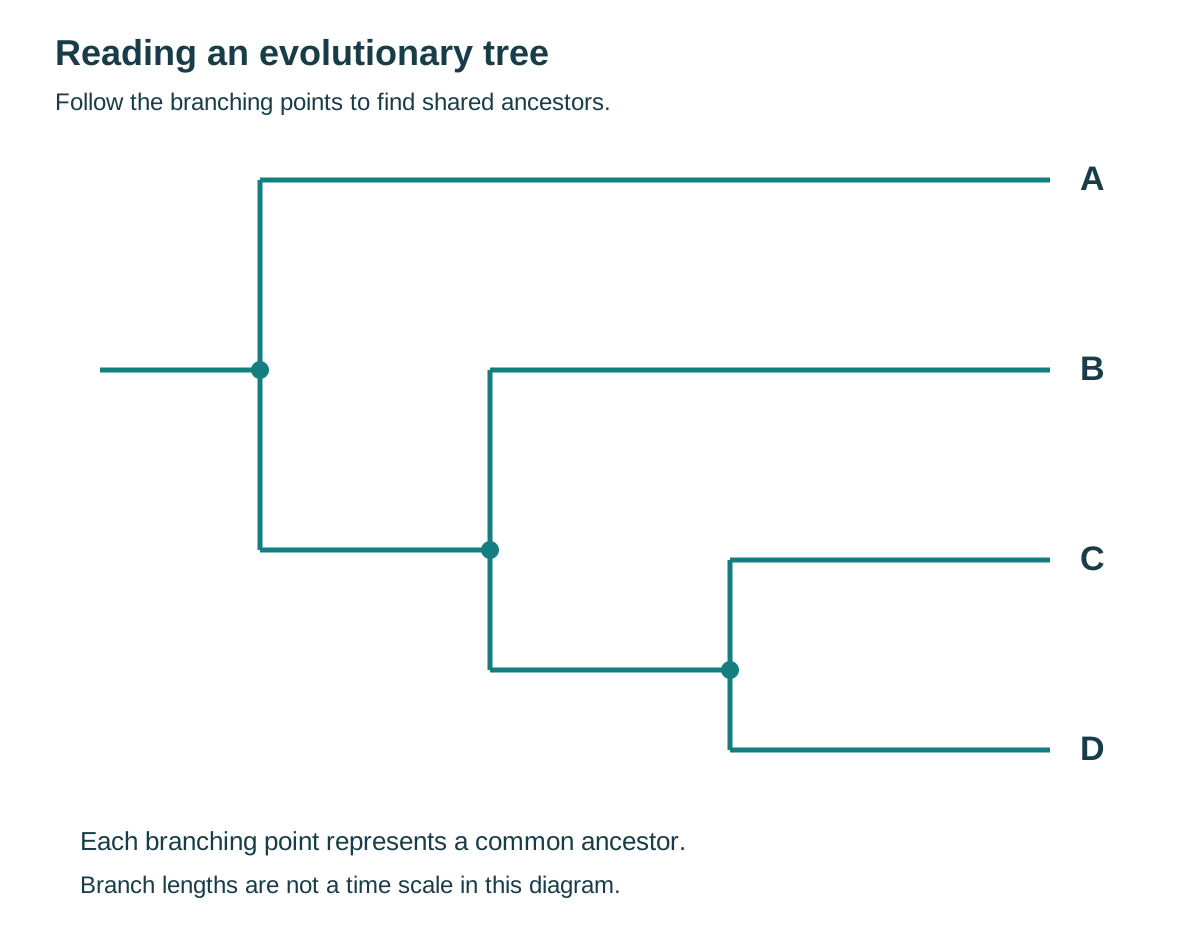
Trees are built using current classification information, genetic and chemical comparisons, and fossils of extinct organisms. New evidence may lead to a revised tree.
Do not decide relatedness from how close the names sit on the page. Follow the branches back to the most recent shared branching point. Living species at the tips are not shown as ancestors of the other living species.
Start with the 57 main questions. Higher-only questions are labelled. You can complete this topic over several sessions; your answers save as you go. Use a hint if you get stuck, then compare your work with an example answer. Your tutor can mark written answers.
In this example, B for black fur is dominant to b for brown fur. Two Bb mice have 80 offspring: 58 black and 22 brown. A Punnett square predicts a 3:1 phenotype ratio.
| Gametes | B | b |
|---|---|---|
| B | BB | Bb |
| b | Bb | bb |
Expected black: 3/4 ×80=60; expected brown: 1/4 ×80=20. The observed numbers differ by two in each group. Fertilisation is random, so a small sample does not have to match the ratio exactly. These results are close to the prediction and do not, by themselves, rule it out. More offspring would give a better test of the predicted proportion.
Use the key, identify affected individuals and work back to the alleles their parents must have supplied. An unaffected phenotype does not always reveal a unique genotype.
When connected with your pupil code, your answers save online for Kevin to see. Click Submit to Kevin when you have finished. Downloads are optional.
Connect with your pupil code above to submit.
Use a scientific idea and a specific example in your reflection.