Forces
Work through one section at a time. Higher-only material is labelled explicitly; optional challenges can also use Foundation content.
 GCSE PHYSICS · AQA TRILOGYTutor dashboardSaves on this device
Your answers save automatically as you work.
Saved in this browser on this device.
Explore pushes and pulls, springs, motion and stopping safely. Use diagrams, worked examples and practical evidence to explain how forces change motion. Higher-only ideas are clearly labelled.
Supported GCSE version · Clear examples, worked calculations and optional challenges.
Work through one section at a time. Higher-only material is labelled explicitly; optional challenges can also use Foundation content.
A quantity with size only, such as mass or time.
A quantity with both size and direction, such as force or velocity.
The single force with the same effect as all the forces together.
The gravitational force on an object, measured in newtons.
The amount of matter in an object, measured in kilograms.
The point through which the weight can be considered to act.
Distance in a stated direction from start to finish.
Speed in a stated direction.
Change in velocity per second, measured in m/s².
Energy transferred by a force acting through a distance.
Increase in length compared with the unloaded length.
A change of shape that is reversed when forces are removed.
A change of shape that remains after forces are removed.
Force needed per metre of extension within the proportional range; measured in N/m.
The point beyond which force and extension are no longer directly proportional.
Constant velocity reached when resistance balances weight during a fall.
The tendency to stay at rest or at constant velocity.
A measure of how difficult velocity is to change; resultant force divided by acceleration.
Distance travelled during the driver’s reaction time.
Distance travelled from the brakes acting until the vehicle stops.
Mass multiplied by velocity, measured in kg m/s.
A system with no resultant external force, so its total momentum is conserved.
A force is a push or pull caused by objects interacting. Forces can change an object’s motion or shape. We measure them in newtons (N).
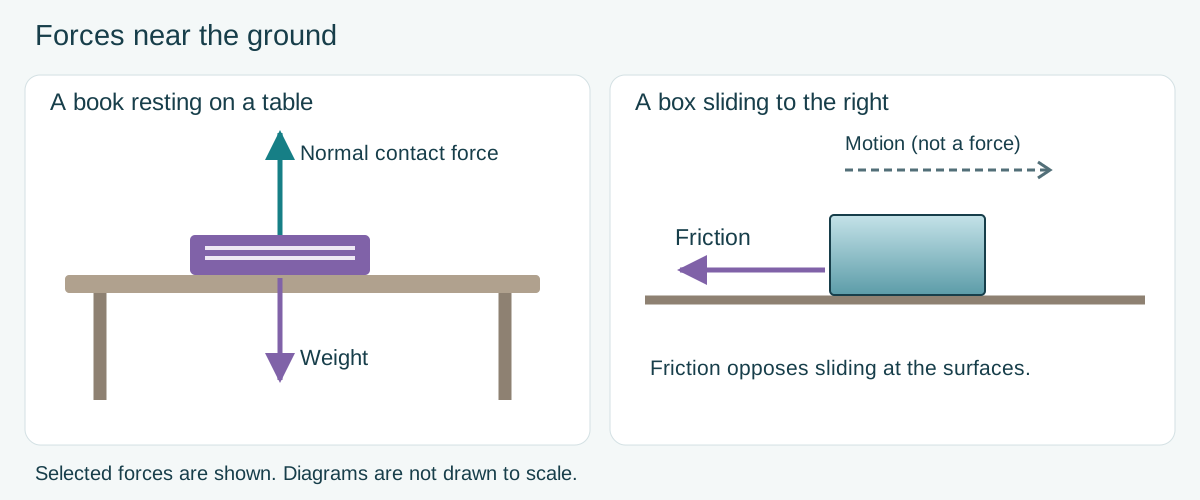
| Force | What it does | Direction or example |
|---|---|---|
| Weight (gravity) Non-contact | The gravitational pull on an object. | Towards the centre of Earth — usually drawn downwards. Mass is measured in kg; weight is a force in N. |
| Normal contact force Contact | A surface pushes back on an object pressing against it. Also called the support force or normal reaction. | A table pushes up on a book, at right angles to the tabletop. |
| Friction Contact | Opposes sliding, or the tendency to slide, between surfaces. | Acts along the surfaces. It can also provide grip: the road pushes a driven tyre forwards. |
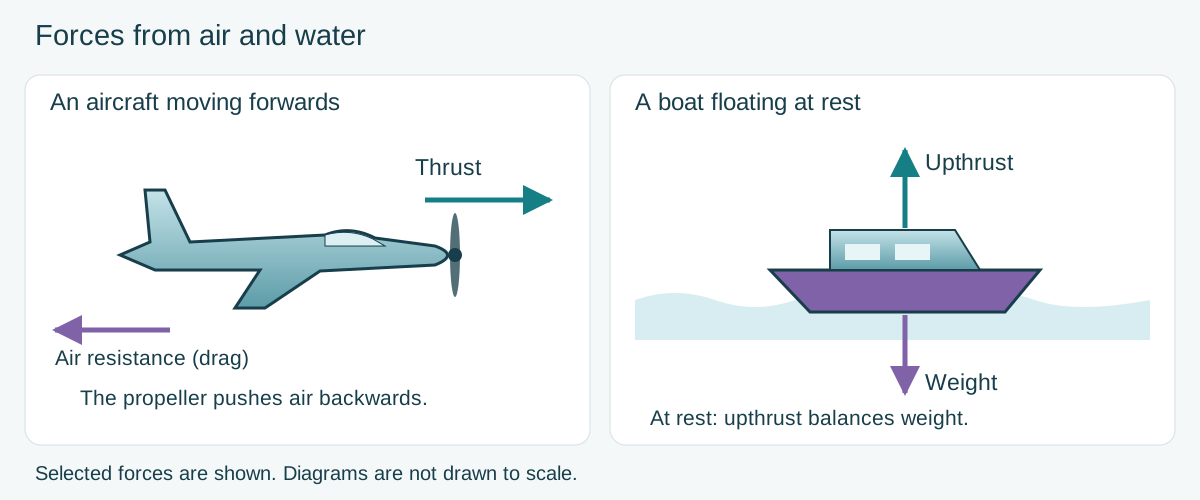
| Force | What it does | Direction or example |
|---|---|---|
| Air resistance / water resistance (drag) Contact | A fluid resists an object moving through it. | Opposes motion relative to the air or water. Air resistance acts upwards on a ball falling through still air. |
| Thrust / driving force Contact | A force that propels an object. | An aircraft’s propeller pushes air backwards; the air pushes the aircraft forwards. On a car, the road provides the forward driving force on the tyres. |
| Upthrust Contact | An upward force from a fluid on an object in it. | Water pushes up on a boat. Floating at rest means upthrust balances weight; sinking objects still experience upthrust. |
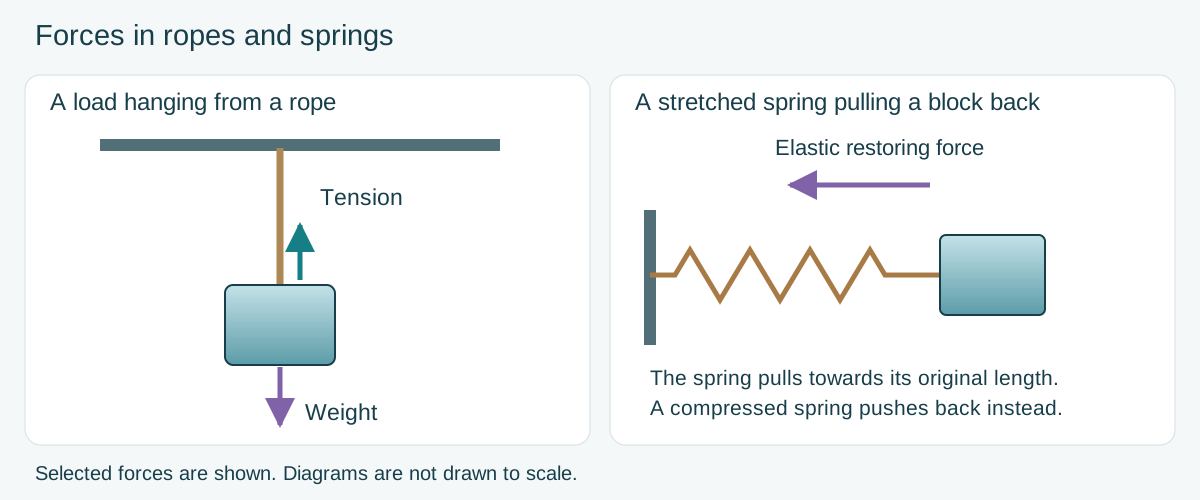
| Force | What it does | Direction or example |
|---|---|---|
| Tension Contact | A pulling force transmitted through a taut rope, string or cable. | Acts along the rope, away from the attached object. An ordinary rope cannot push. |
| Elastic force / spring force Contact | A stretched or compressed elastic object pushes or pulls back. | Towards its original shape: a stretched spring pulls its ends together; a compressed spring pushes them apart. |
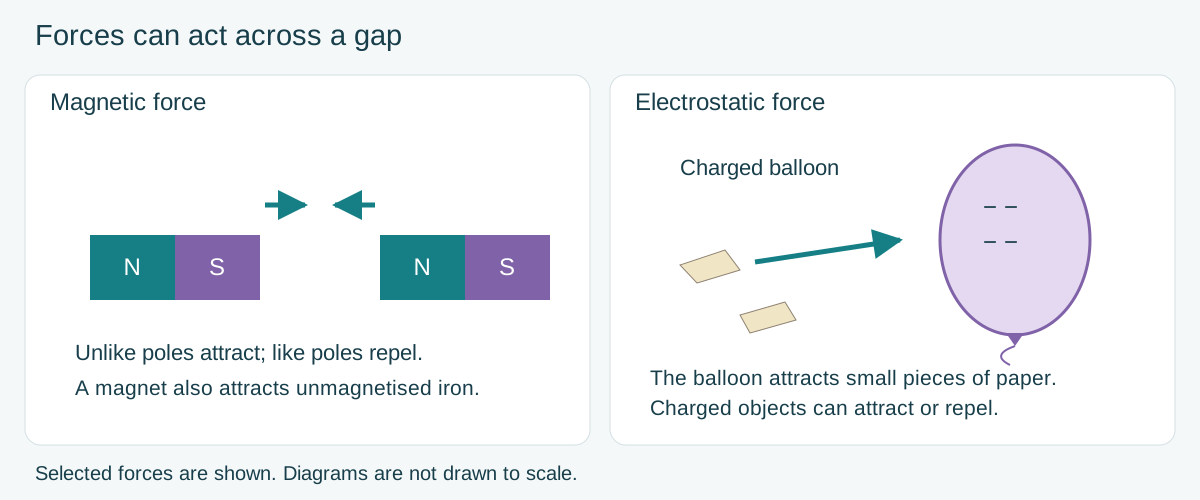
| Force | What it does | Direction or example |
|---|---|---|
| Magnetic force Non-contact | Attraction or repulsion involving magnets; attraction between a magnet and magnetic material. | Unlike poles attract; like poles repel. A magnet attracts iron even if the iron was not already a permanent magnet. |
| Electrostatic force Non-contact | Attraction or repulsion involving electric charges. | Unlike charges attract; like charges repel. A charged object can also attract neutral objects, such as small paper pieces. |
A force is a push or pull caused by an interaction between objects. Force is measured in newtons, N.
| Scalar: size only | Vector: size and direction |
|---|---|
| Mass, time, distance, speed, energy | Force, displacement, velocity, acceleration, momentum |
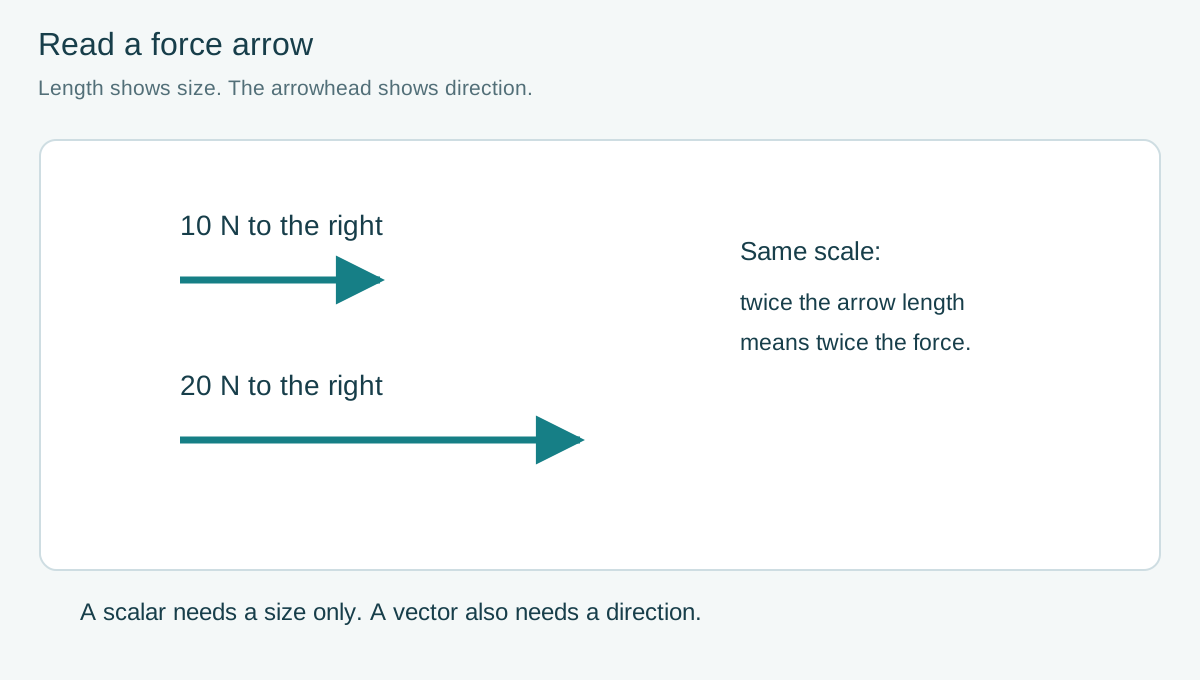
Magnitude means size. “20 N” gives the magnitude; “20 N east” also gives the direction.
| Contact forces | Non-contact forces |
|---|---|
| Friction, air resistance, tension in a rope, normal contact force from a surface | Gravity, electrostatic force, magnetic force |
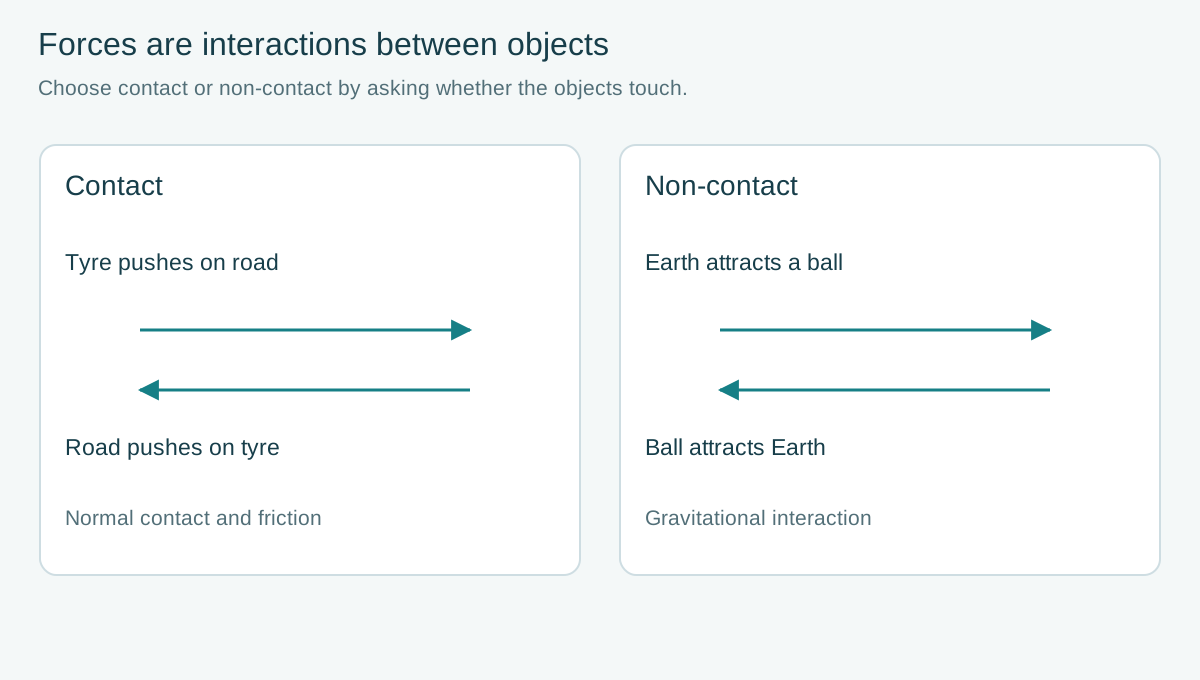
Normal contact force acts at right angles to a surface. Tension is a pulling force transmitted through a stretched rope or cable. Identify both objects in an interaction, not just one.
Mass is measured in kilograms. Weight is the gravitational force on an object, measured in newtons. A gravitational field is a region where a mass experiences a force.
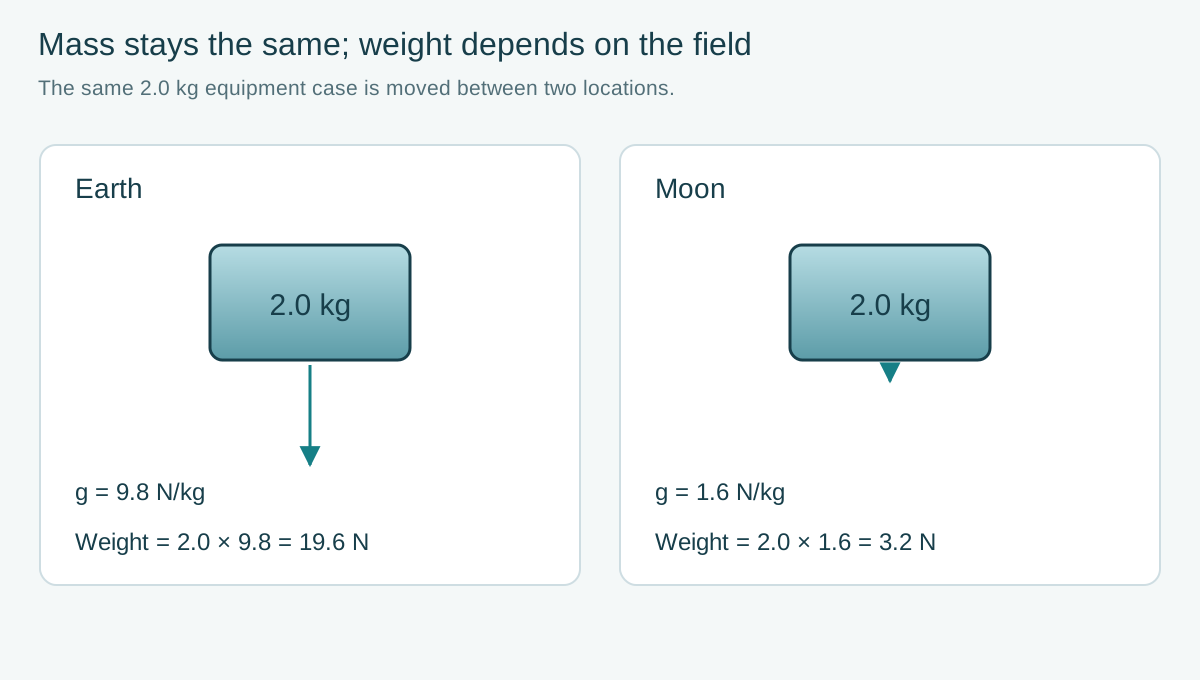
Rearrange: m = W ÷ g. For W = 49 N and g = 9.8 N/kg, m = 5.0 kg.
The resultant force is one force with the same effect as all the forces on an object together.
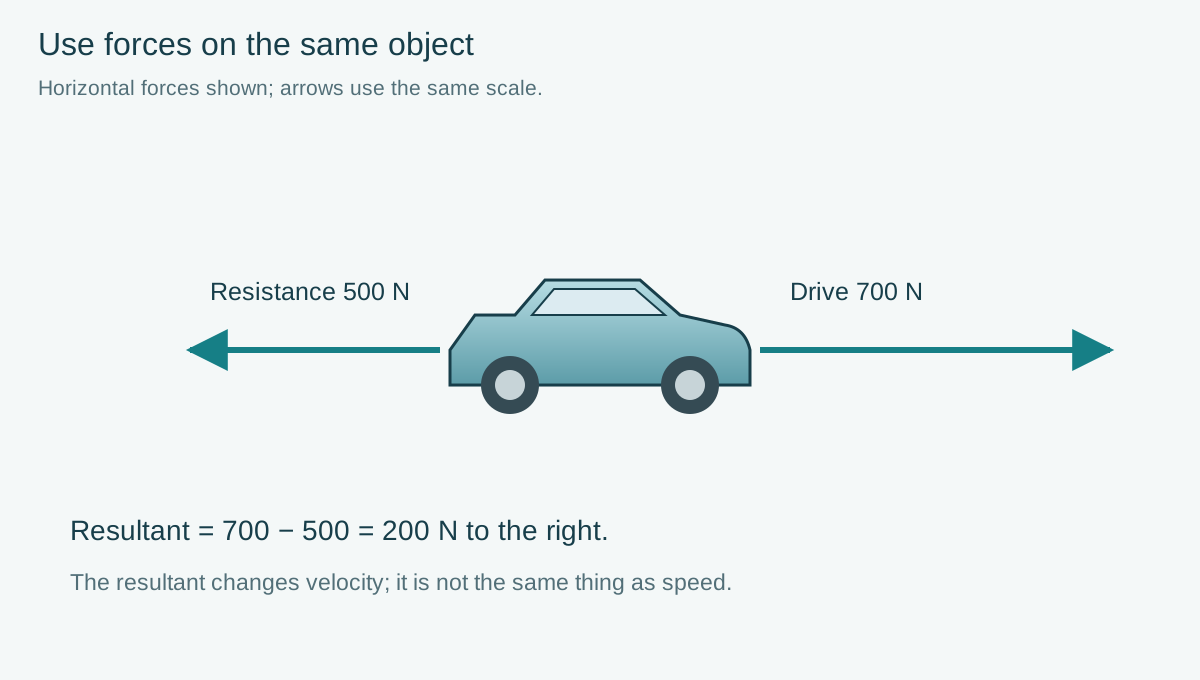
A free-body diagram shows only the forces acting on the chosen object. Replace the object with a dot or simple outline; label each force and its direction.
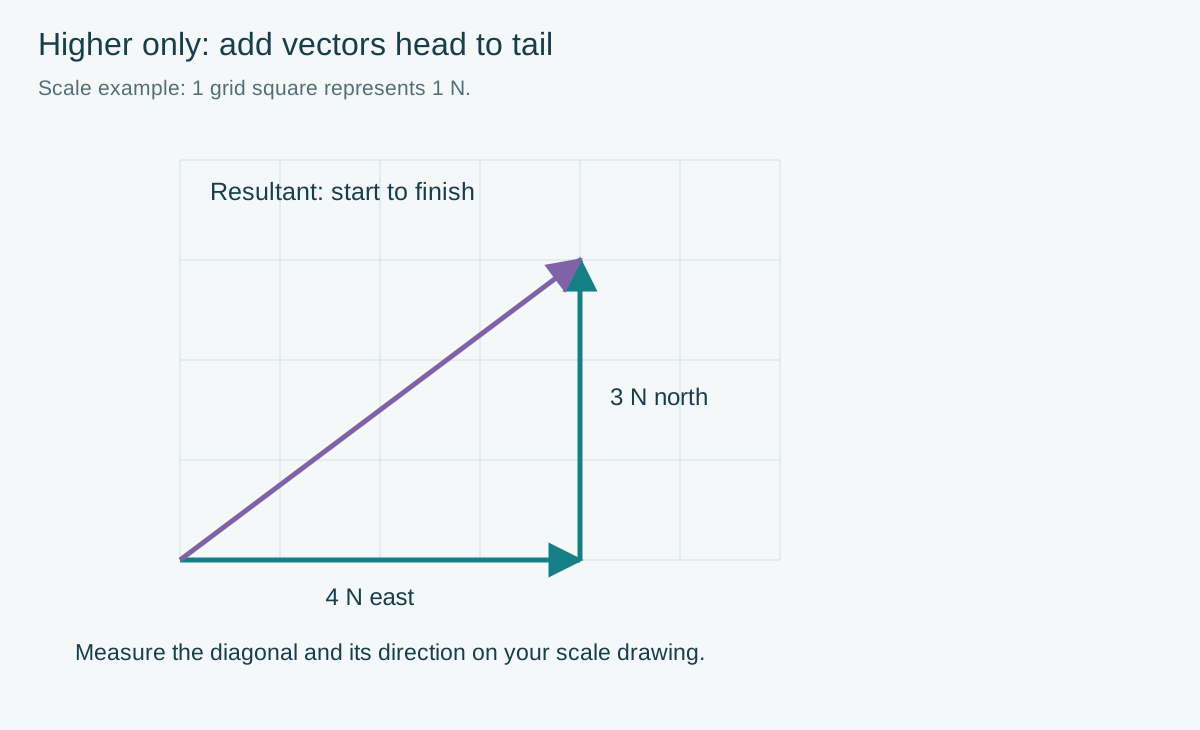
Resolving does the reverse: replace one force with two perpendicular components. Draw a rectangle with the original arrow as its diagonal. The two sides show forces with the same combined effect.
For equilibrium, the resultant is zero. A force polygon drawn head to tail closes.
Work done is energy transferred by a force moving an object. The distance must be measured along the force’s line of action.
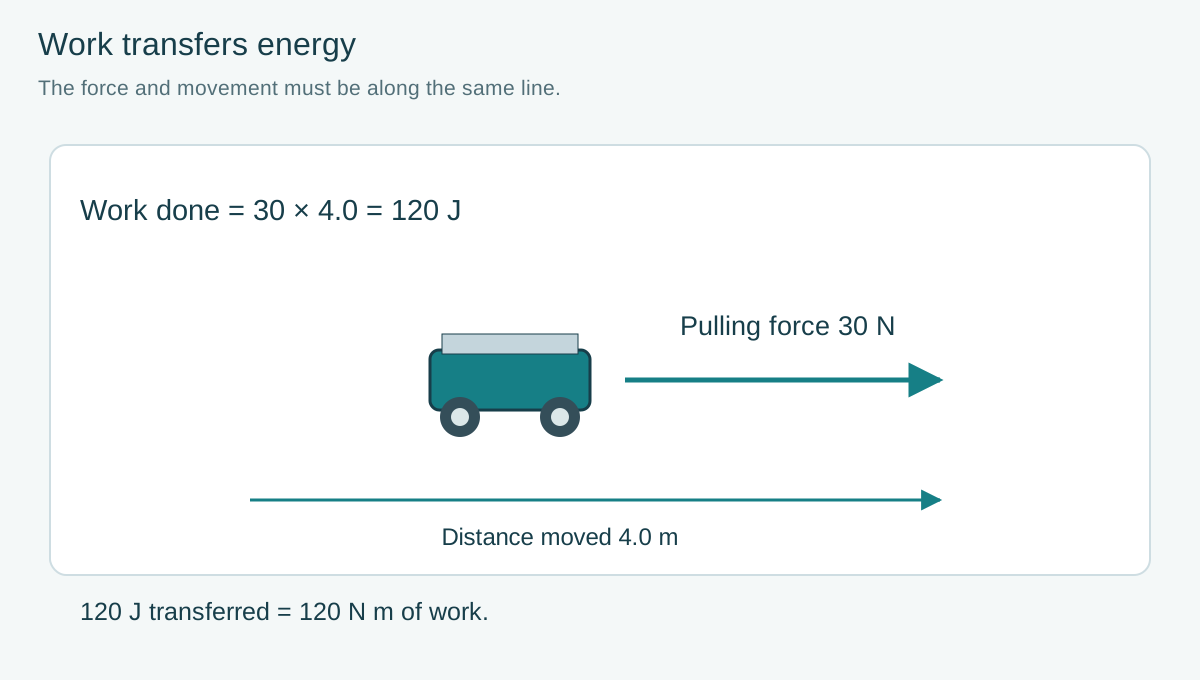
Rearrange: F = W ÷ s and s = W ÷ F. Convert centimetres to metres first. Friction transfers energy to thermal stores, increasing the temperature of objects and surroundings.
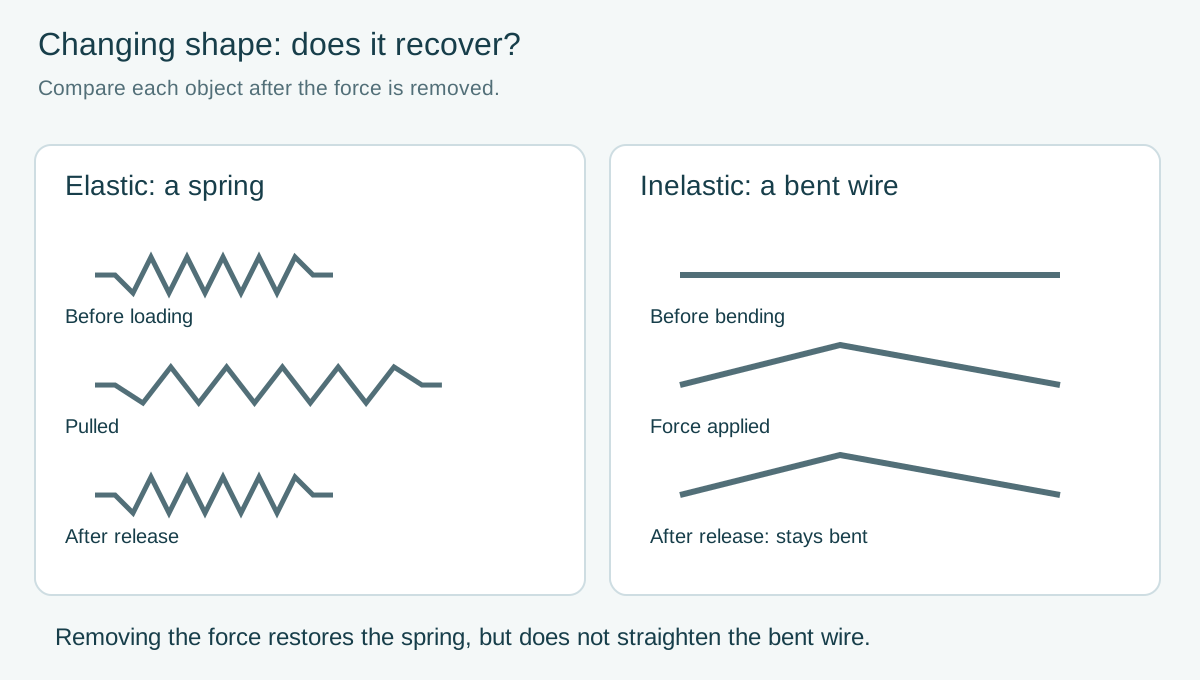
Changing an object’s shape is deformation. A stationary object needs forces at more than one point: pulling both ends of a spring, pressing both ends of a foam block, or supporting a ruler while pushing its middle.
| Elastic deformation | Inelastic deformation |
|---|---|
| The object returns to its original shape when forces are removed. | A permanent change of shape remains when forces are removed. |
Up to its limit of proportionality, extension is directly proportional to force. A graph of force against extension is a straight line through the origin.
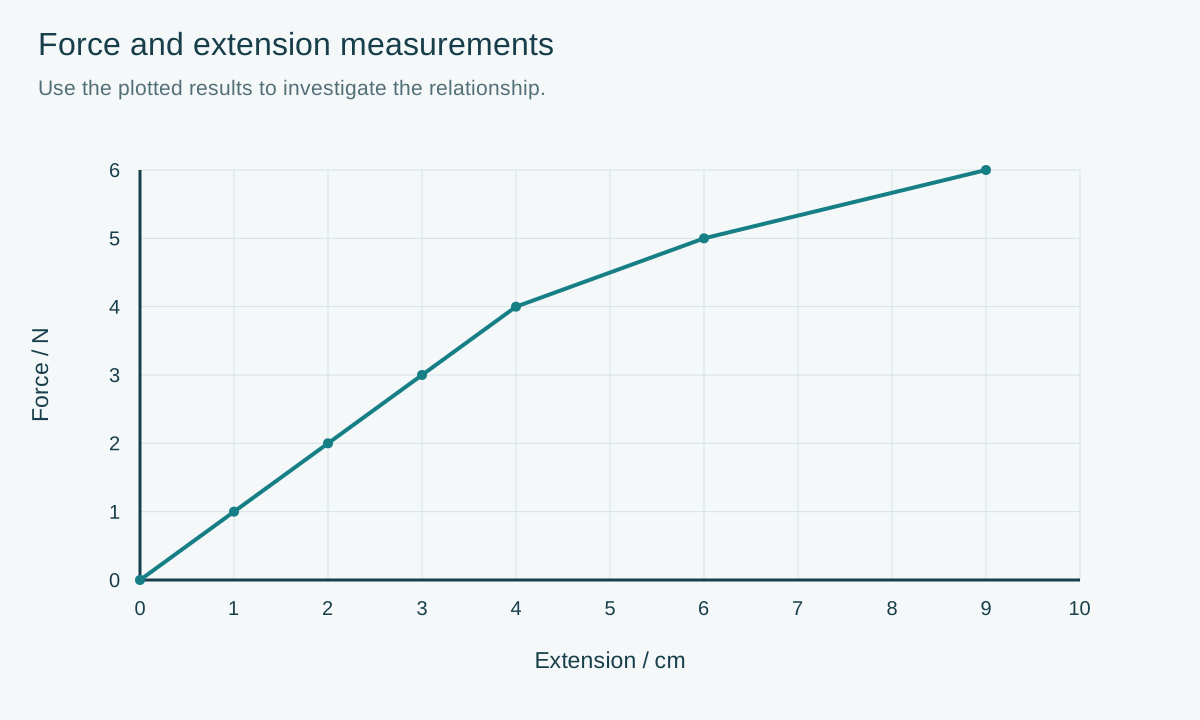
Worked example: F = 6.0 N and e = 0.030 m. Then k = F ÷ e = 200 N/m. A larger spring constant means more force is needed for the same extension.
A stretching force does work and stores elastic potential energy. If the object is not permanently deformed, the work done equals the energy stored.
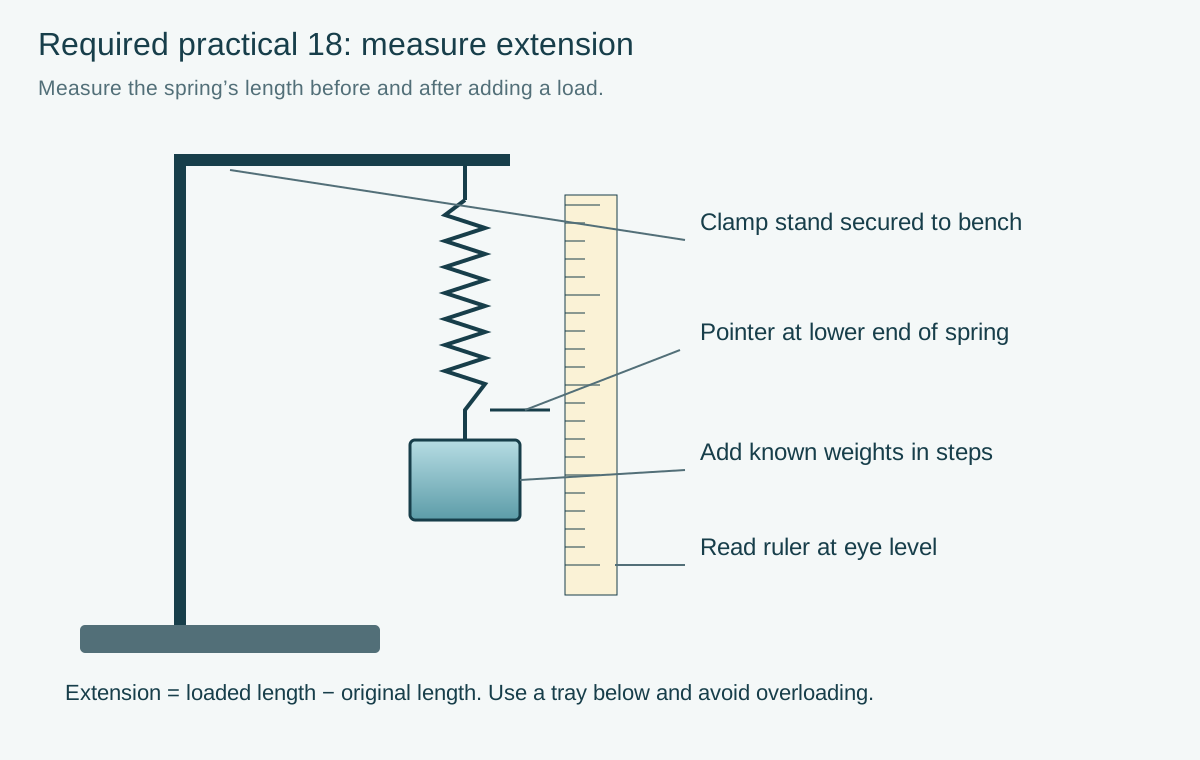
Keep the spring and ruler position the same. Secure the stand, place a tray below the masses and avoid stretching the spring so far that it breaks.
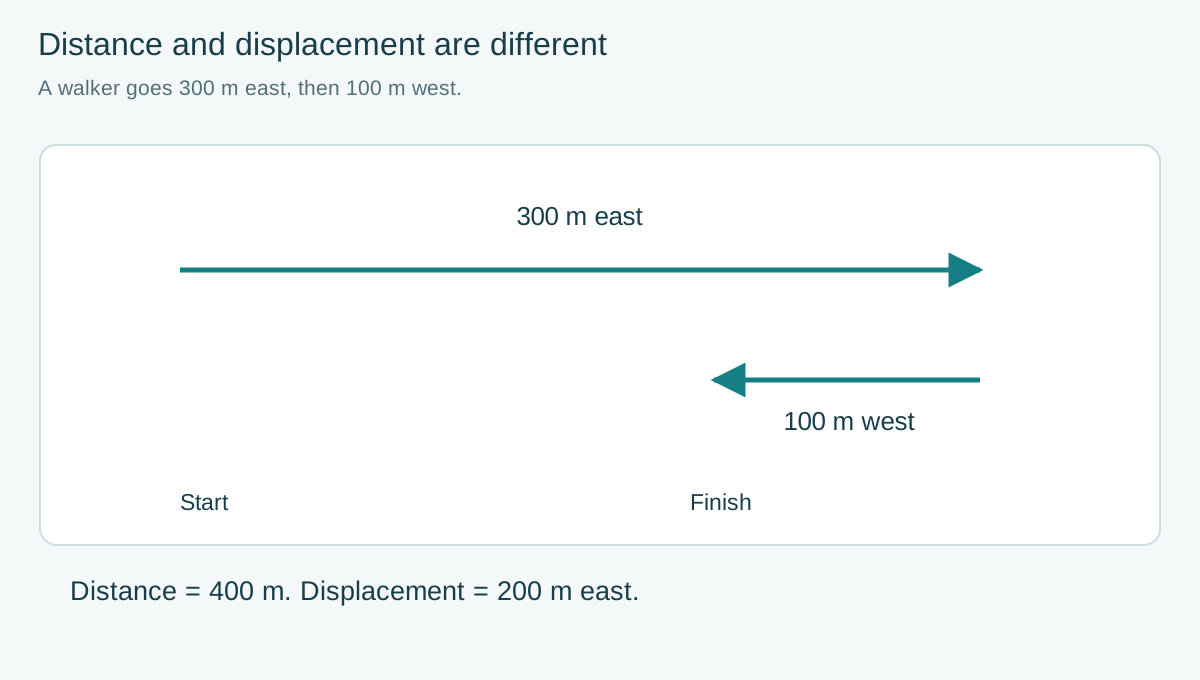
Distance is the total path travelled. Displacement is the straight-line change of position, with a direction. A completed lap has a distance greater than zero but zero displacement.
| Typical movement | Approximate speed |
|---|---|
| Walking | 1.5 m/s |
| Running | 3 m/s |
| Cycling | 6 m/s |
| Car in urban traffic | About 13 m/s (roughly 30 mph) |
| Train | About 50 m/s; services vary |
| Sound in air | About 330 m/s |
Age, fitness, terrain and distance affect a person’s speed. Vehicle, wind and sound speeds also vary with conditions.
Worked example: 600 m in 5.0 min means 600 ÷ 300 = 2.0 m/s. To convert km/h to m/s, multiply by 1000 then divide by 3600.
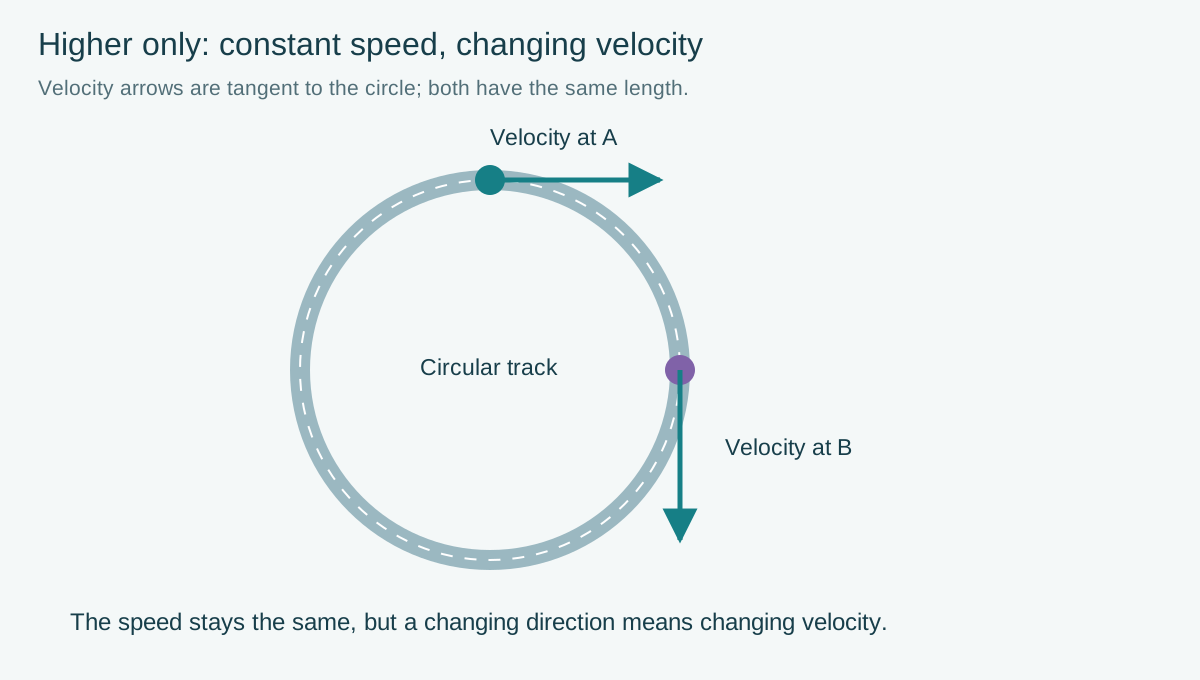
Velocity is speed in a stated direction: for example, 8 m/s north. Two cyclists can have the same speed but different velocities if they travel in opposite directions.
| Graph feature | Meaning |
|---|---|
| Straight rising line | Constant speed |
| Horizontal line | Stationary |
| Steeper rising line | Greater speed |
| Curve getting steeper | Speed increasing |
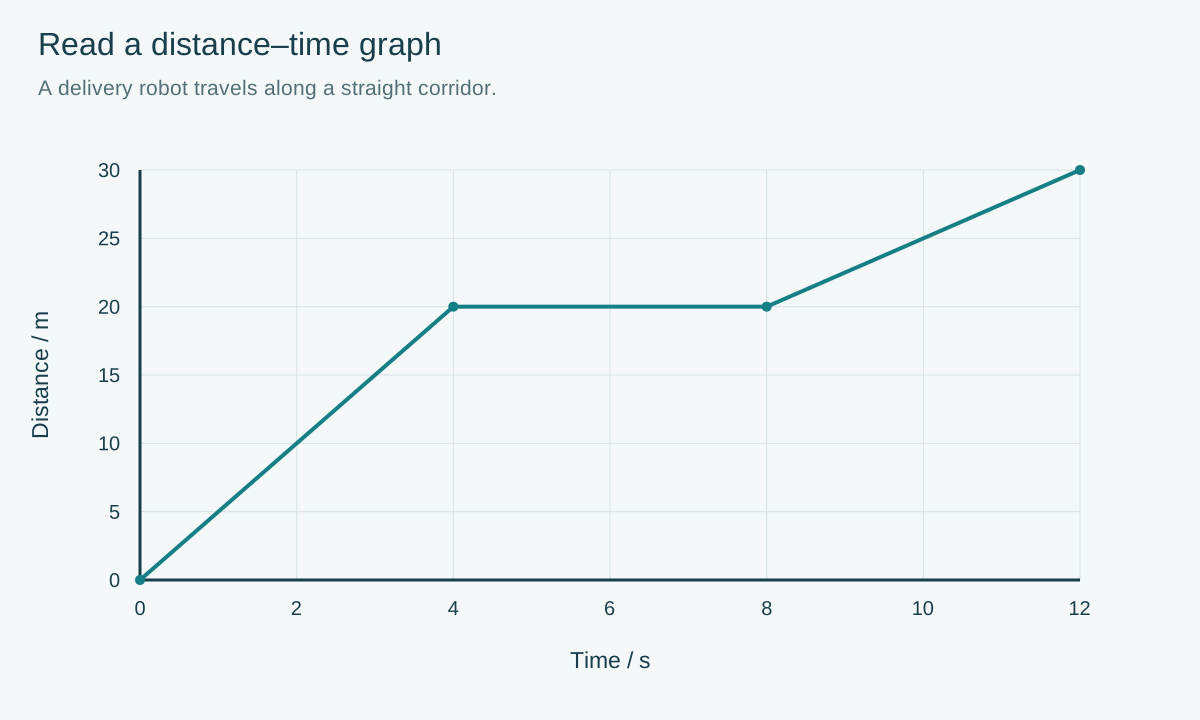
Speed = gradient = change in distance ÷ change in time. For the first section: 20 ÷ 4 = 5.0 m/s. Use two well-separated points on a straight line.
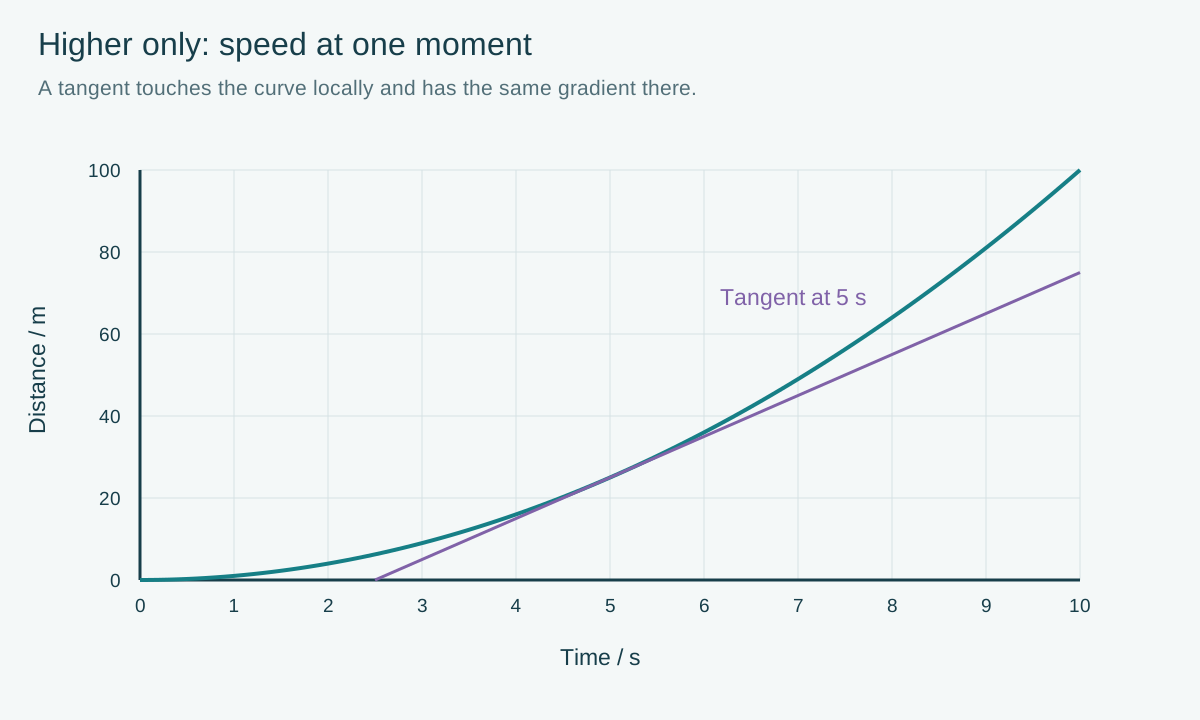
For the illustrated tangent, (75 − 0) ÷ (10 − 2.5) = 10 m/s. Using the start and finish of the curved journey gives an average instead.
Acceleration is change in velocity per second. Deceleration means slowing down. A positive/negative sign depends on the direction you chose as positive.
A car reaching 20 m/s in 10 s accelerates at about 2 m/s². Free fall close to Earth, without air resistance, is about 9.8 m/s².
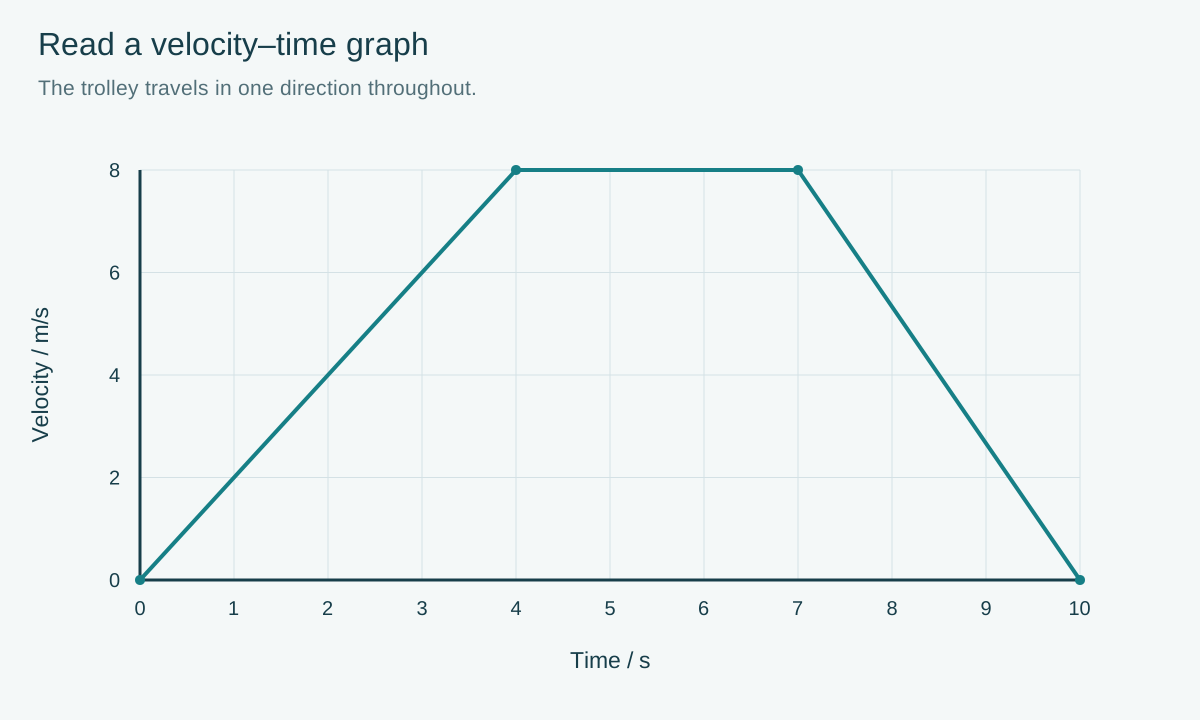
Higher only: the area under a velocity–time graph gives displacement. If motion stays in one direction, this is also distance. Split the area into rectangles and triangles or count grid squares. If velocity becomes negative, calculate signed areas for displacement and add the magnitudes for distance.
For uniform (constant) acceleration, use:
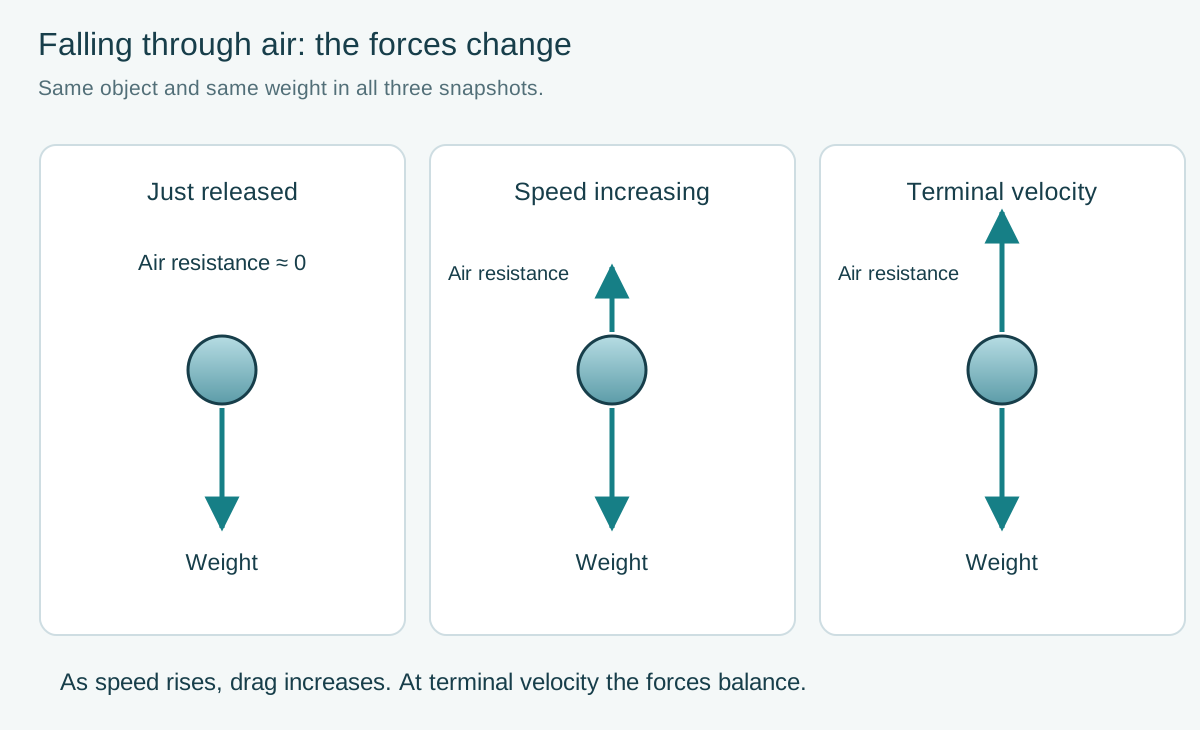
The same idea applies to falling through a liquid: the resisting force increases with speed.
| First law | Second law |
|---|---|
| Zero resultant force: stay at rest or continue at constant velocity. | A resultant force causes acceleration: F = ma. |
Higher only: inertia is the tendency to remain at rest or at constant velocity. Inertial mass measures how difficult velocity is to change: m = F ÷ a.
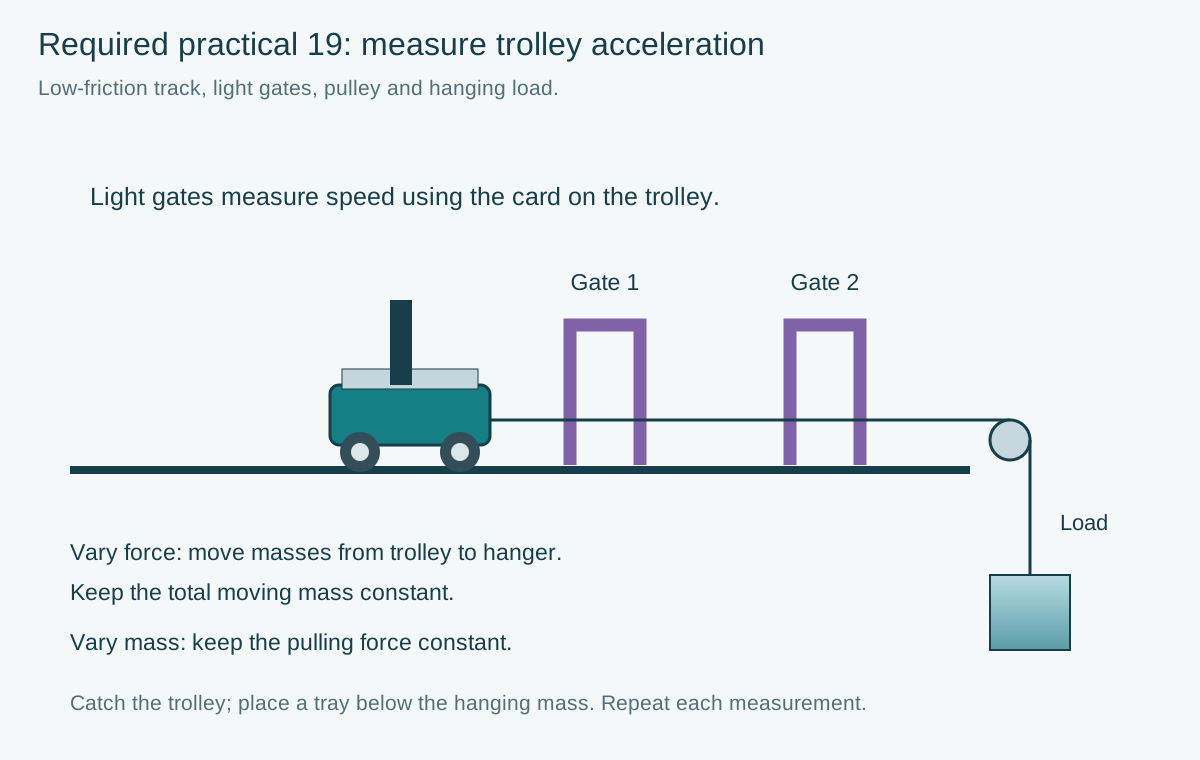
| Investigate force | Investigate mass |
|---|---|
| Move slotted masses from trolley to hanger. Pulling weight increases while total moving mass stays constant. | Keep the hanger load constant and add masses to the trolley. Pulling force stays approximately constant. |
Use a catch tray and a trolley stop. Keep the hanging mass from striking the floor during measurement.
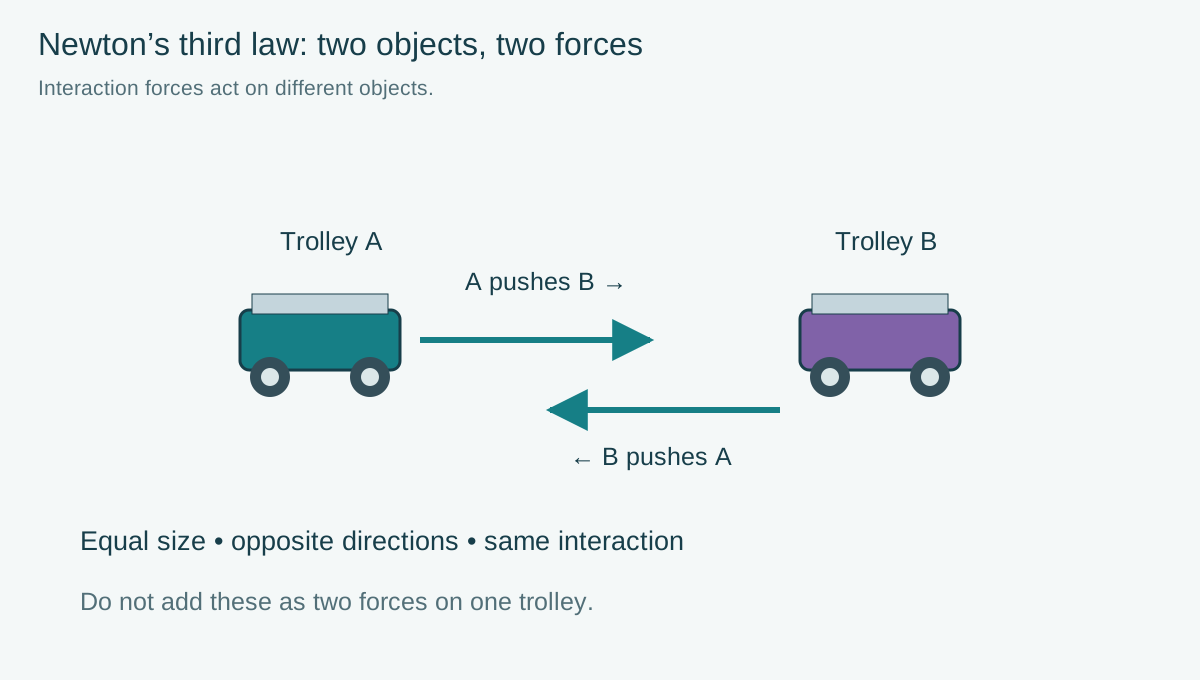
Whenever two objects interact, the forces they exert on each other are equal in magnitude and opposite in direction. They are the same type of force and act on different objects.
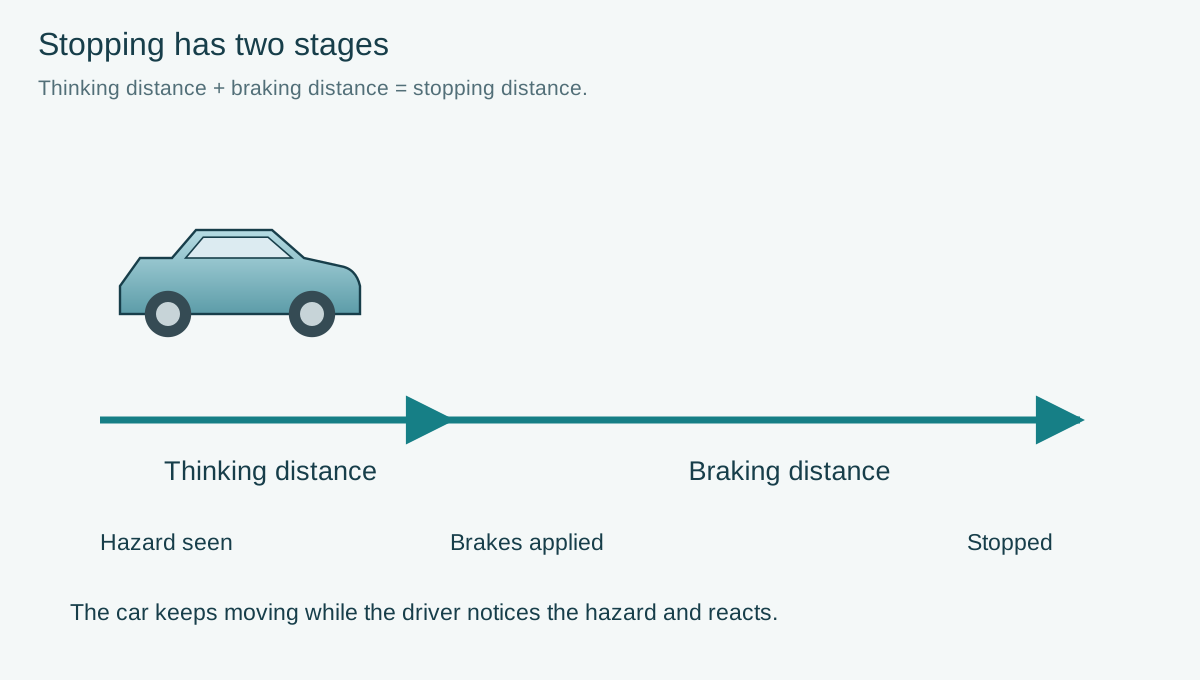
| Thinking distance | Braking distance |
|---|---|
| Distance moved during the driver’s reaction time. At steady speed: speed × reaction time. | Distance moved after brakes begin acting until the vehicle stops. |
| Increases with speed, tiredness, alcohol, some drugs and distraction. | Increases with speed, poor tyres/brakes, and wet or icy roads. |
Example: at 20 m/s with a 0.70 s reaction time, thinking distance = 14 m. Add a 25 m braking distance to get a 39 m stopping distance.
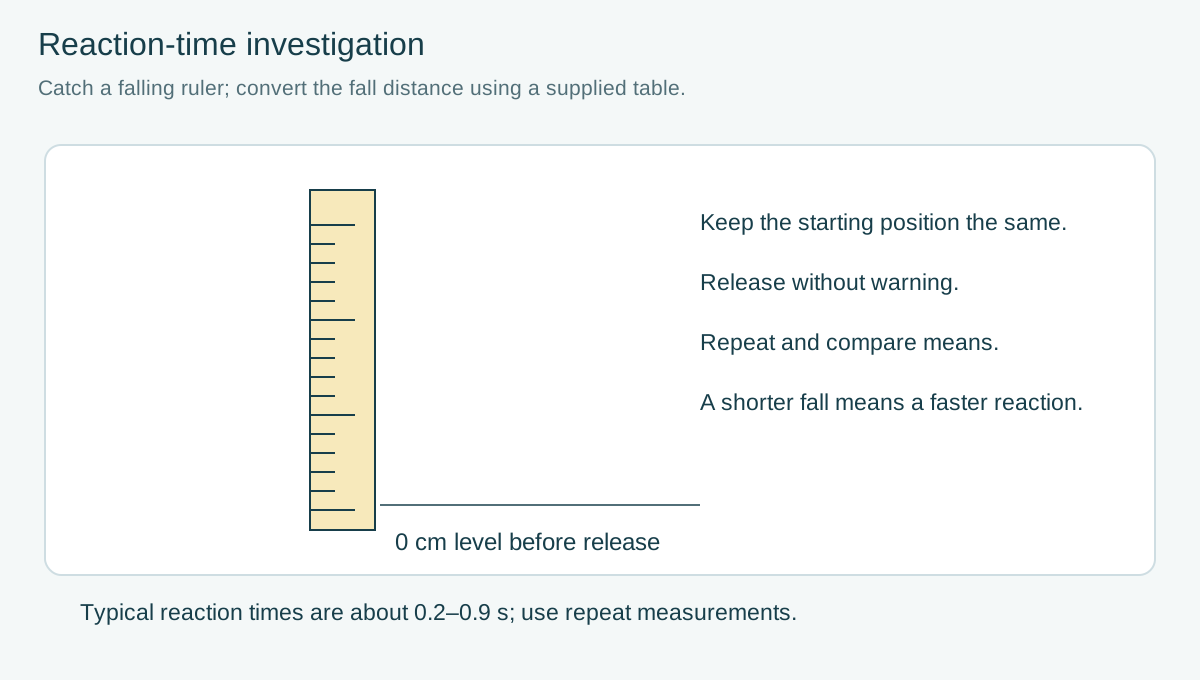
A partner holds a ruler with zero level with the top of your thumb. They release it without warning; you catch it. Read the fall distance and use a conversion table to find reaction time. Repeat and calculate a mean.
| Fall distance / cm | Reaction time / s |
|---|---|
| 10 | 0.14 |
| 20 | 0.20 |
| 30 | 0.25 |
| 40 | 0.29 |
| 50 | 0.32 |
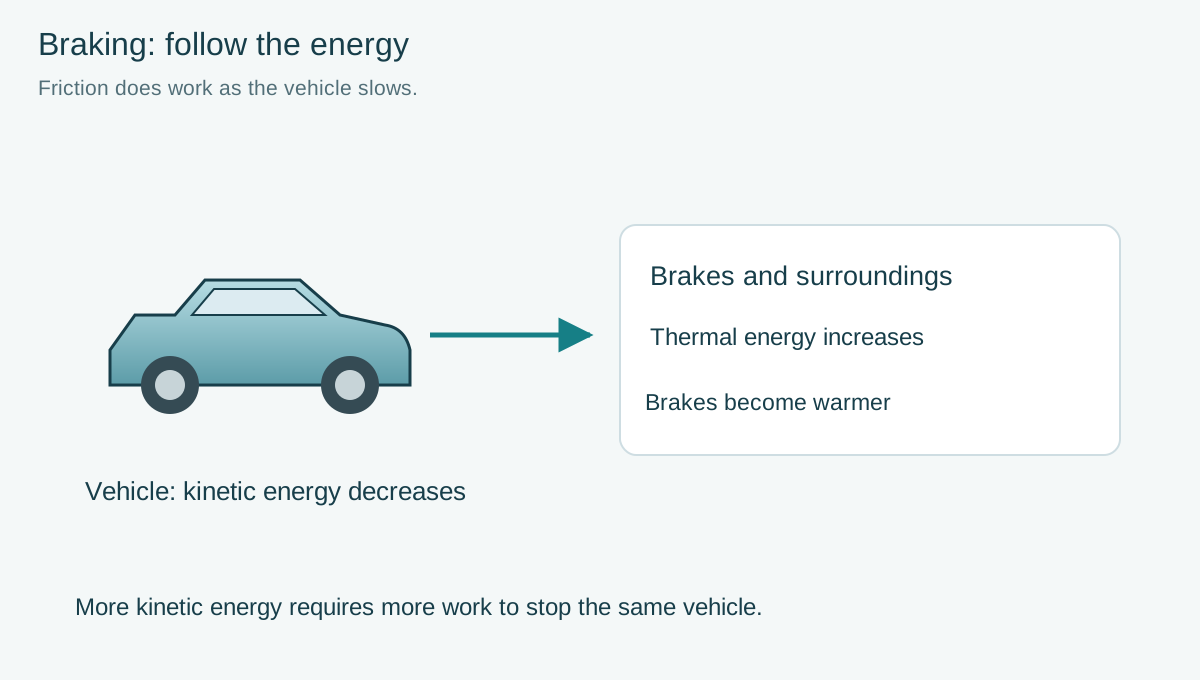
Friction in the brakes does work, reducing the vehicle’s kinetic energy and warming the brakes. Road–tyre grip also limits the braking force.
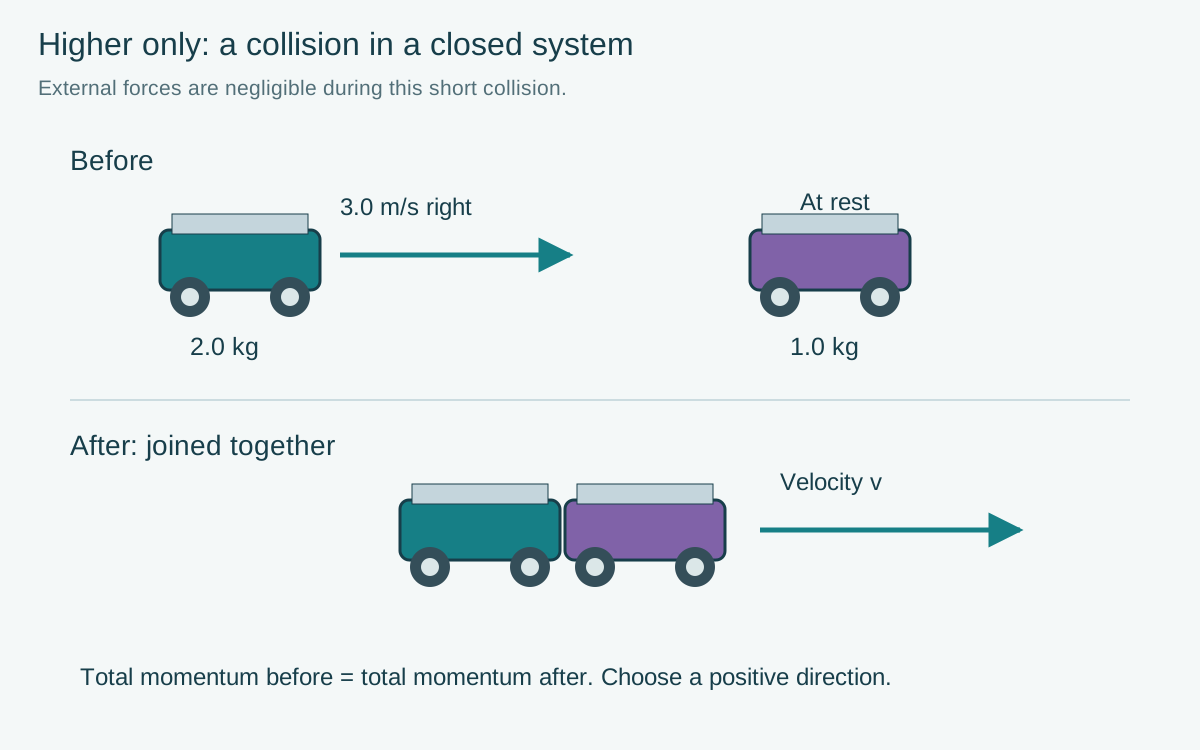
Momentum = mass × velocity: p = mv, in kg m/s. Momentum has a direction.
Start with the 78 main questions. Higher-only questions are labelled. You can complete this topic over several sessions; your answers save as you go. Use a hint if you get stuck, then compare your work with an example answer. Your tutor can mark written answers.
Read the graph: identify its proportional region. Choose two points in that region and calculate the spring constant in N/m. Explain why you must not use the whole graph as one straight line.
Identify when the robot is stationary. Compare the speeds in the two sloping sections. Use distances and times from the axes to support your answer.
Identify acceleration, constant velocity and deceleration. Explain why a horizontal line has a different meaning on these two graphs.
Higher only: divide the area under the velocity–time graph into simple shapes to find the distance travelled.
Draw the two forces on squared paper using the stated scale. Measure the resultant’s size and direction. Explain why adding 4 + 3 does not give its magnitude. Enter your measured result in the notebook.
Use the figures above to record or plan the spring investigation and both trolley investigations. You can also record your force-arrow and graph observations here.
When connected with your pupil code, your answers save online for Kevin to see. Click Submit to Kevin when you have finished. Downloads are optional.
Connect with your pupil code above to submit.
Use a scientific idea and a specific example in your reflection.