Energy changes
Work through one section at a time. Higher-only material is labelled explicitly; optional challenges can also use Foundation content.
 GCSE CHEMISTRY · AQA TRILOGYTutor dashboardSaves on this device
Your answers save automatically as you work.
Saved in this browser on this device.
Why does a hand warmer heat up while an instant cold pack cools down? Follow energy transfers, read reaction profiles and investigate temperature changes.
Supported GCSE version · Clear examples, worked calculations and optional challenges.
Work through one section at a time. Higher-only material is labelled explicitly; optional challenges can also use Foundation content.
Everything around the reacting chemicals, such as the solution, cup and air.
A reaction that transfers energy to the surroundings.
A reaction that takes in energy from the surroundings.
Breaking a substance down by heating it.
The total stays the same; energy is transferred rather than created or destroyed.
A diagram of reactant energy, product energy and the barrier between them.
The minimum energy particles need to react when they collide.
The difference between a later temperature and the starting temperature.
A factor kept the same to make a fair comparison.
Energy needed to break one mole of a specified bond.
When chemicals react, atoms rearrange to make new substances. Energy can move between the reacting chemicals and their surroundings: the solution, container and nearby air. The total amount of energy is conserved.
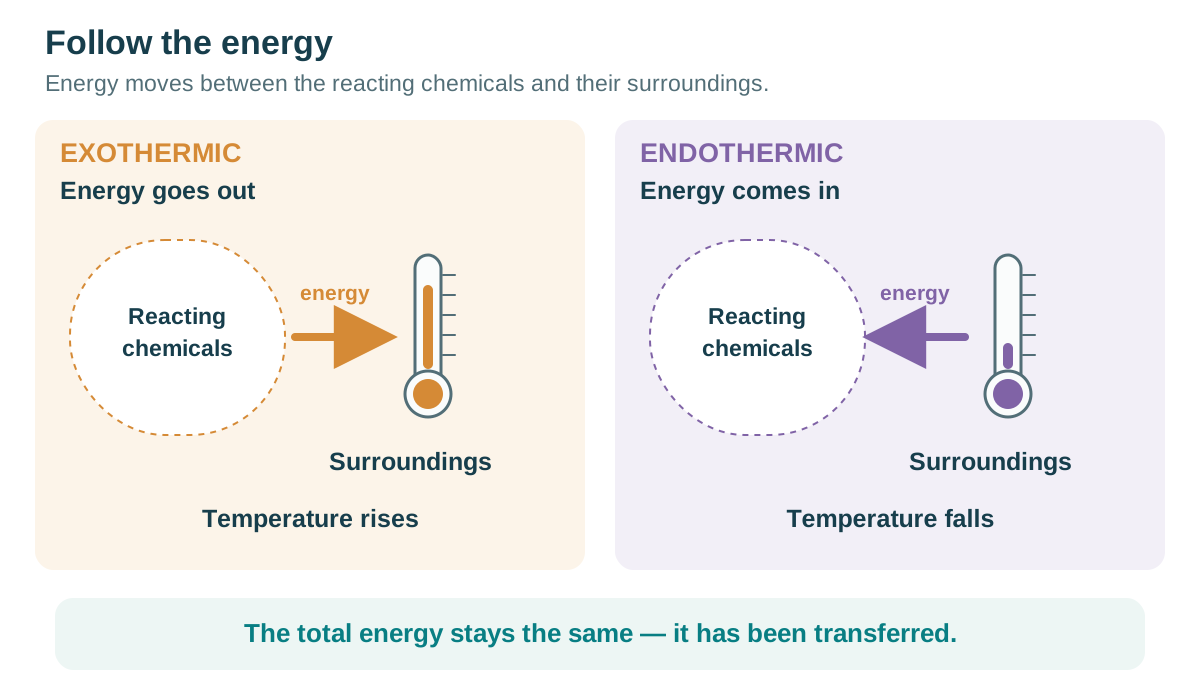
If energy leaves the reacting chemicals, it goes somewhere else. If the chemicals gain energy, the surroundings supply it. A thermometer tells us about a temperature change; it does not directly measure the total energy transferred.
An exothermic reaction transfers energy to its surroundings. The surroundings get warmer. Burning a fuel, many oxidation reactions and neutralisation are examples.
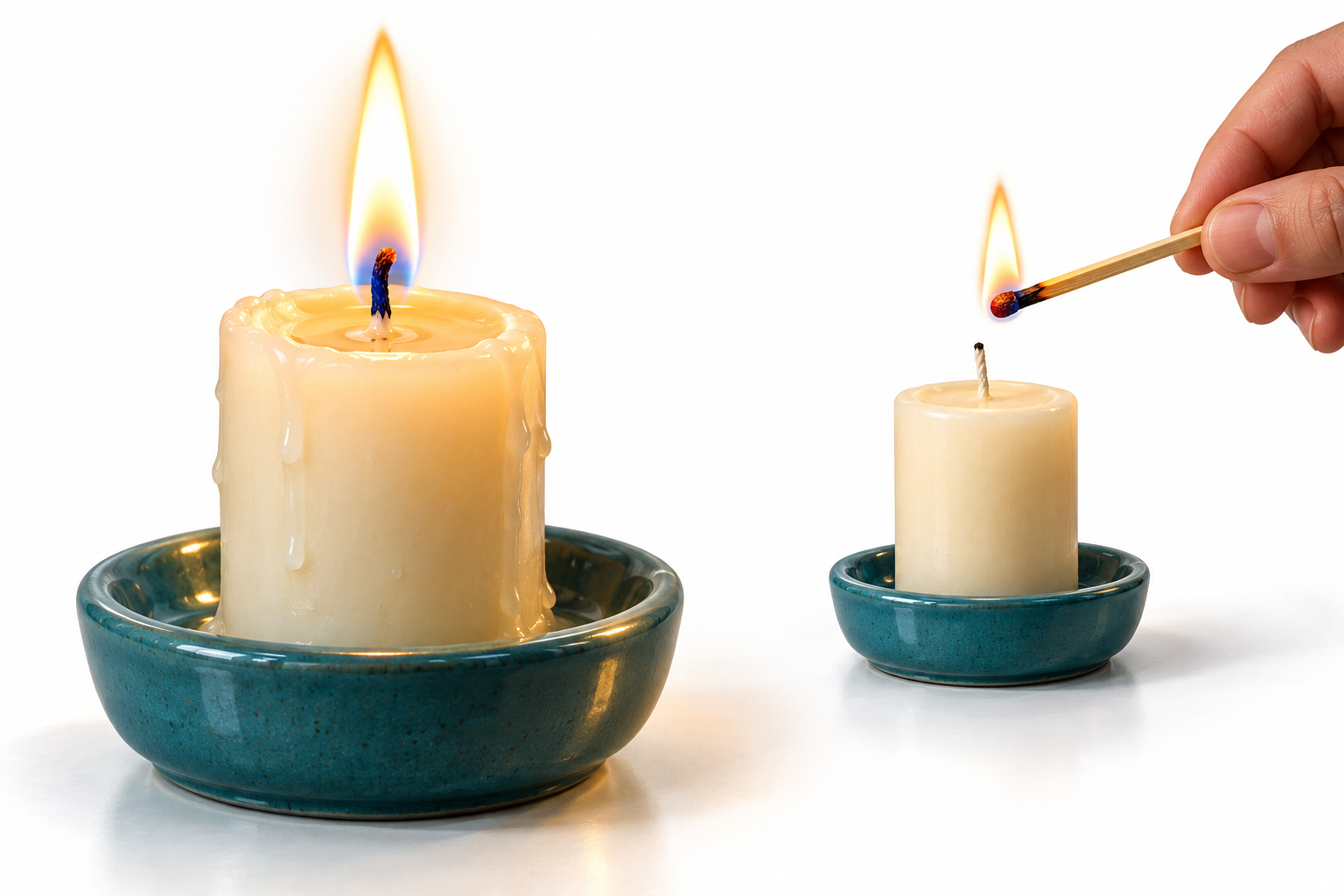
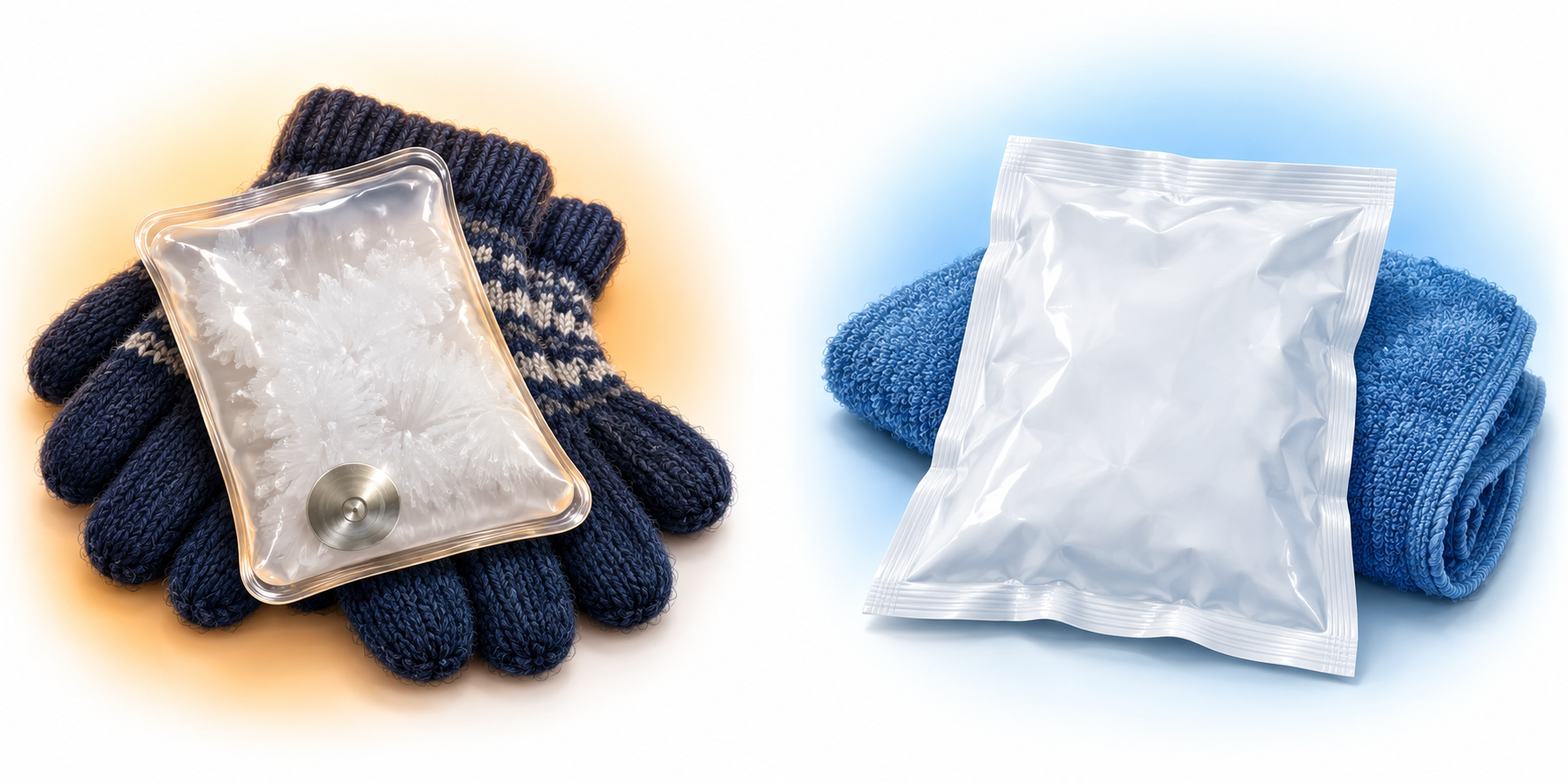
Iron powder in some hand warmers reacts with oxygen. The reaction transfers energy to the pouch and your hands. A self-heating food container uses a chemical reaction in a separate compartment, so the reactants do not mix with the food.
The products have less stored chemical energy than the reactants. The difference has been transferred to the surroundings; it has not disappeared.
An endothermic reaction takes in energy from its surroundings. The surroundings become cooler. Examples include thermal decomposition and the reaction between citric acid and sodium hydrogencarbonate.
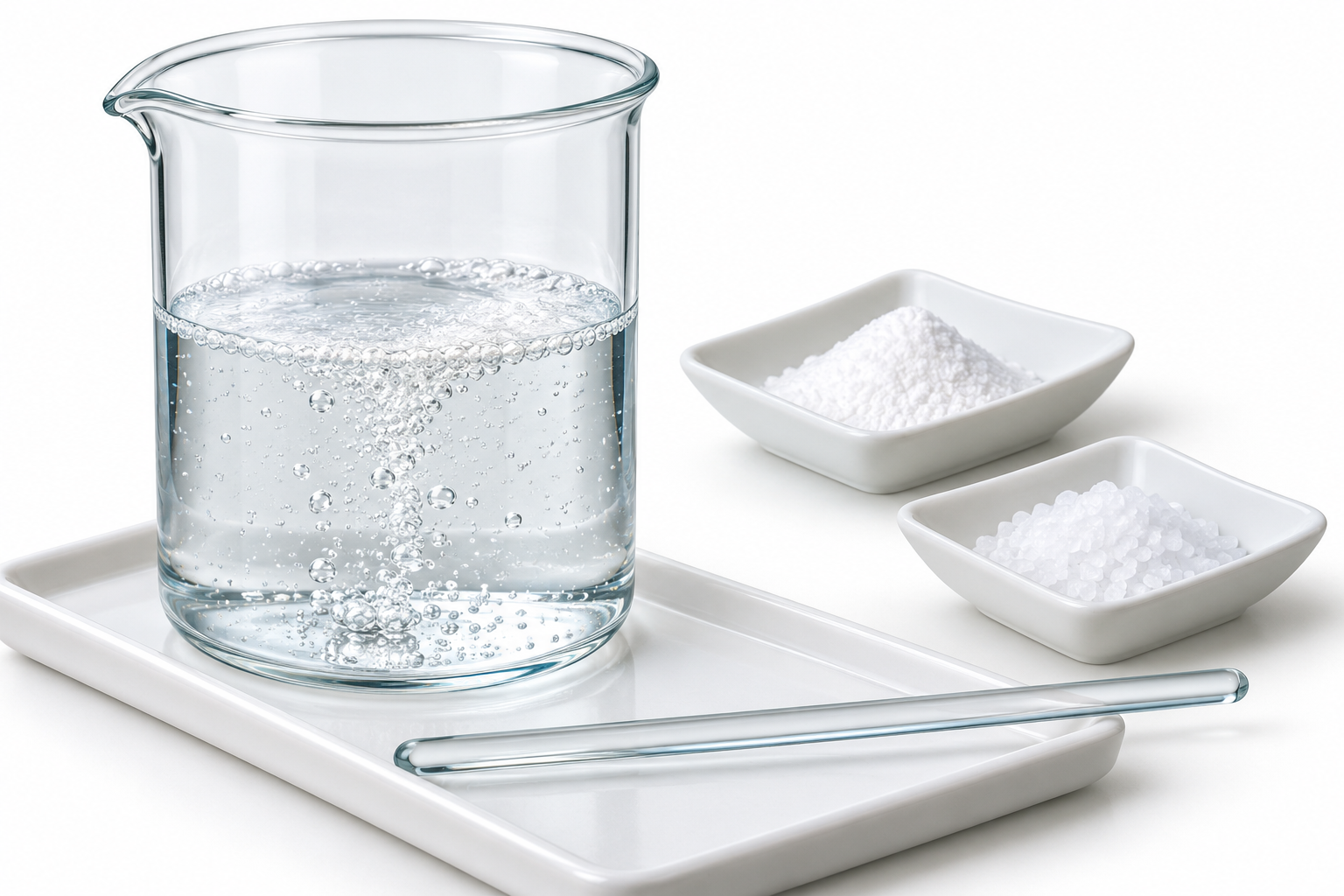
Thermal decomposition breaks down a substance by heating it. Calcium carbonate can break down to calcium oxide and carbon dioxide: CaCO₃ → CaO + CO₂. Energy must be supplied.
Some instant injury packs cool when chemicals mix and take in energy. Some packs involve dissolving rather than a chemical reaction; the important evidence for an endothermic process is energy being taken from the surroundings. Products of an endothermic reaction have more energy than the reactants.
Measure the initial temperature before mixing. Then monitor the temperature to find the highest value for an exothermic reaction, or the lowest value for an endothermic reaction. Stir gently so the thermometer measures a well-mixed solution.
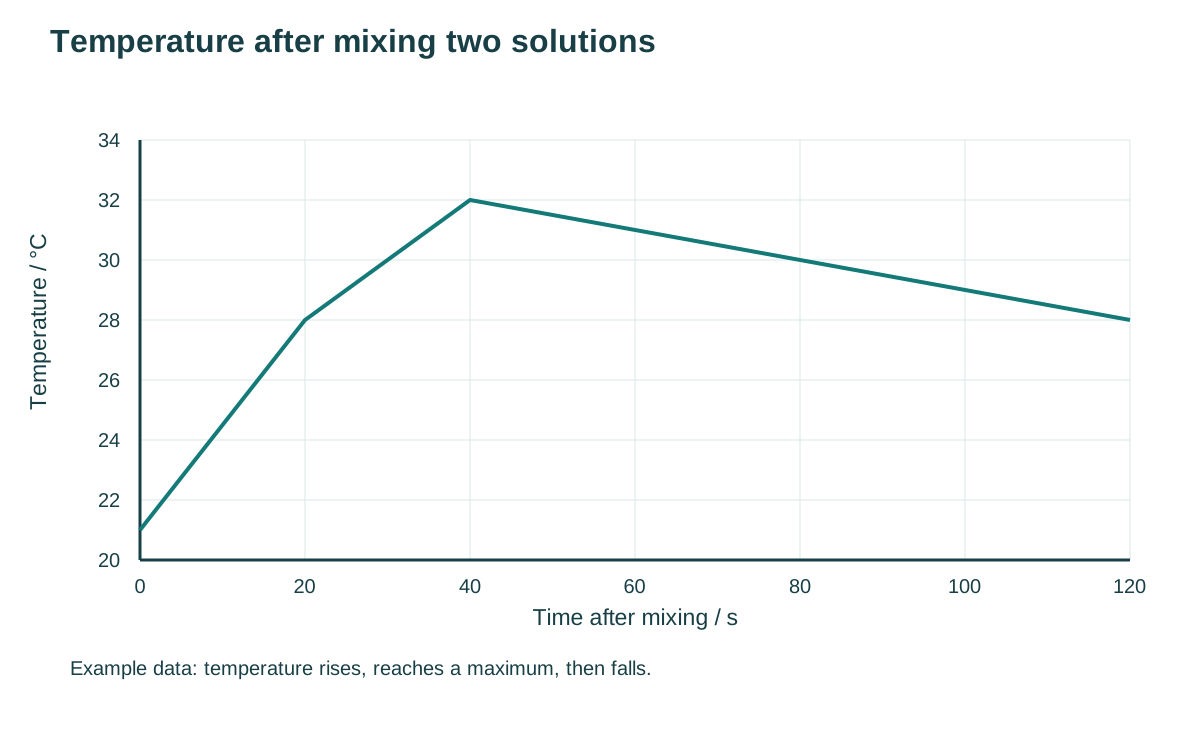
After the maximum, a warm solution cools as it transfers energy to the room. That does not turn the original reaction into an endothermic one. Always say which time interval or stage you are describing.
Aim: investigate a variable that affects the temperature change when solutions react. One suitable example is changing the concentration of hydrochloric acid while reacting equal volumes with sodium hydroxide.
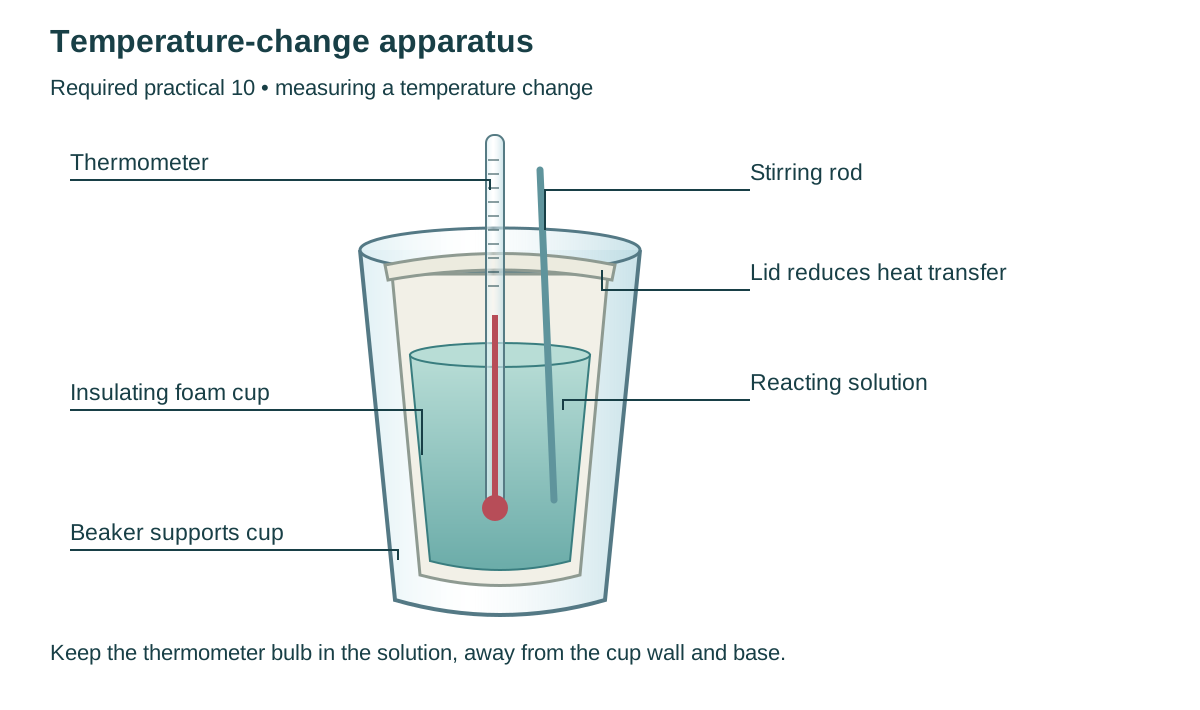
The independent variable is acid concentration. The dependent variable is temperature change. Other possible investigations include acid plus a metal, acid plus a carbonate, or displacement reactions. Choose conditions that change one factor at a time.
A lid and insulation reduce unwanted energy transfer. Use the same total volume so the amount of solution being warmed is comparable. Keep initial temperatures equal and use the same thermometer and stirring method. Do not let the bulb touch the cup wall or base.
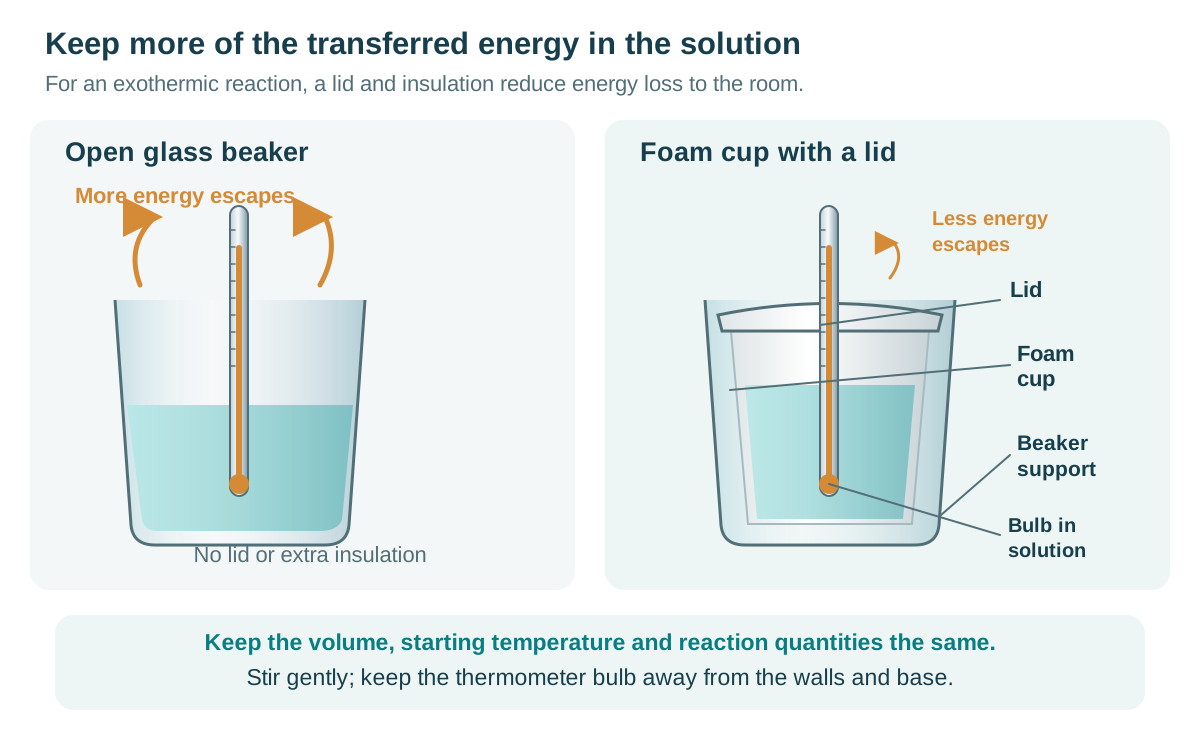
Take repeats to find variation and calculate a mean. An unusual result should be investigated and, if appropriate, repeated; do not delete a result just because it does not fit a prediction. An identified leak or incorrect volume is a reason to repeat a trial.
A digital temperature probe can record frequent readings, reducing the chance of missing the maximum. Even with a probe, some energy warms the cup or escapes to the room. For this topic you need to measure and interpret temperature changes; a calorimetry equation such as q = mcΔT is not required.
When evaluating a pack, use the needs in the question. For a hand warmer, consider the temperature reached, how long it stays warm, how it starts, cost, waste and whether it can be reused. A pack that gets dangerously hot is not automatically the best.
For a cold pack, consider cooling effect, duration, storage and safety. A reusable pack may create less waste but need a freezer. An instant pack may work away from electricity but create single-use waste. A good conclusion explains which option best meets the stated needs.
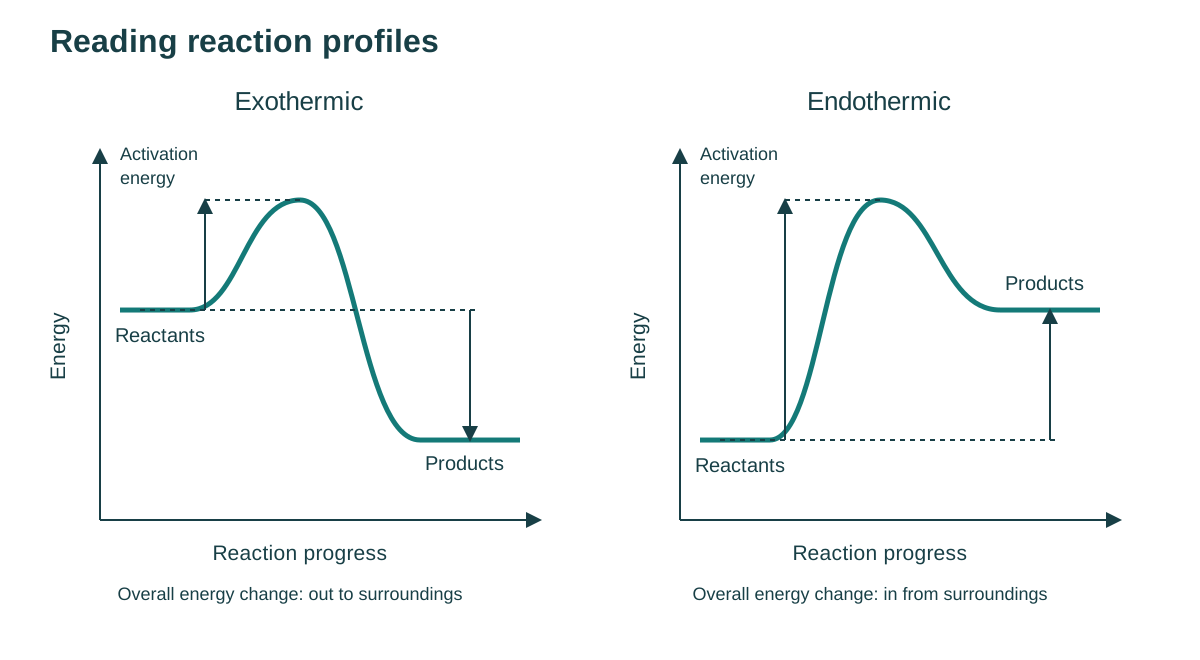
A reaction profile is a map of energy during a reaction. First find the reactant and product levels. Products lower than reactants: exothermic. Products higher than reactants: endothermic.
The curve rises to a peak because particles need enough energy to start reacting. The activation energy is the energy difference from the reactant level up to the peak. The overall energy change is the difference between the reactant and product levels. They are different measurements.
To sketch a profile, label both axes, draw a reactant level, a curved rise and fall, and a product level. Show activation energy with an arrow from the reactant level to the peak, and the overall change between the two levels. In the online questions, describe the sketch in words; you can also practise drawing it on paper.
Reacting particles must collide with enough energy to react. The minimum energy needed is the activation energy. A fuel may release energy overall, but a spark can still be needed to start it. The spark supplies enough energy for some particles to overcome the activation-energy barrier.
A reaction profile is not a temperature-versus-time graph. A high peak means a large energy barrier; it does not mean the reaction takes a longer time simply because the curve is wider.
Higher only. Energy is needed to break bonds in reactant molecules. Energy is released when new bonds form in product molecules. Remember: breaking takes in; making gives out.
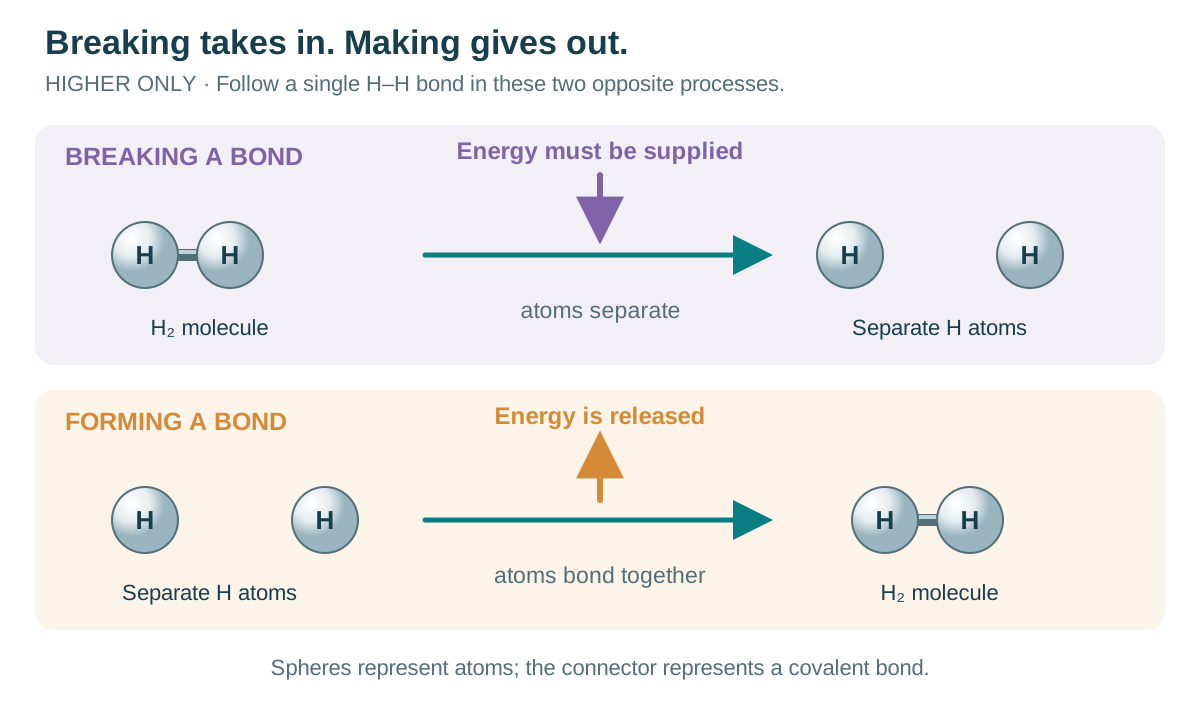
Use the whole balanced equation to count bonds, including the numbers before each formula. In an exothermic reaction, making the product bonds releases more energy than breaking the reactant bonds needs. In an endothermic reaction, breaking bonds needs more energy than forming bonds releases.
Higher only. Consider H₂ + Cl₂ → 2HCl. We break one H–H bond and one Cl–Cl bond; we form two H–Cl bonds.
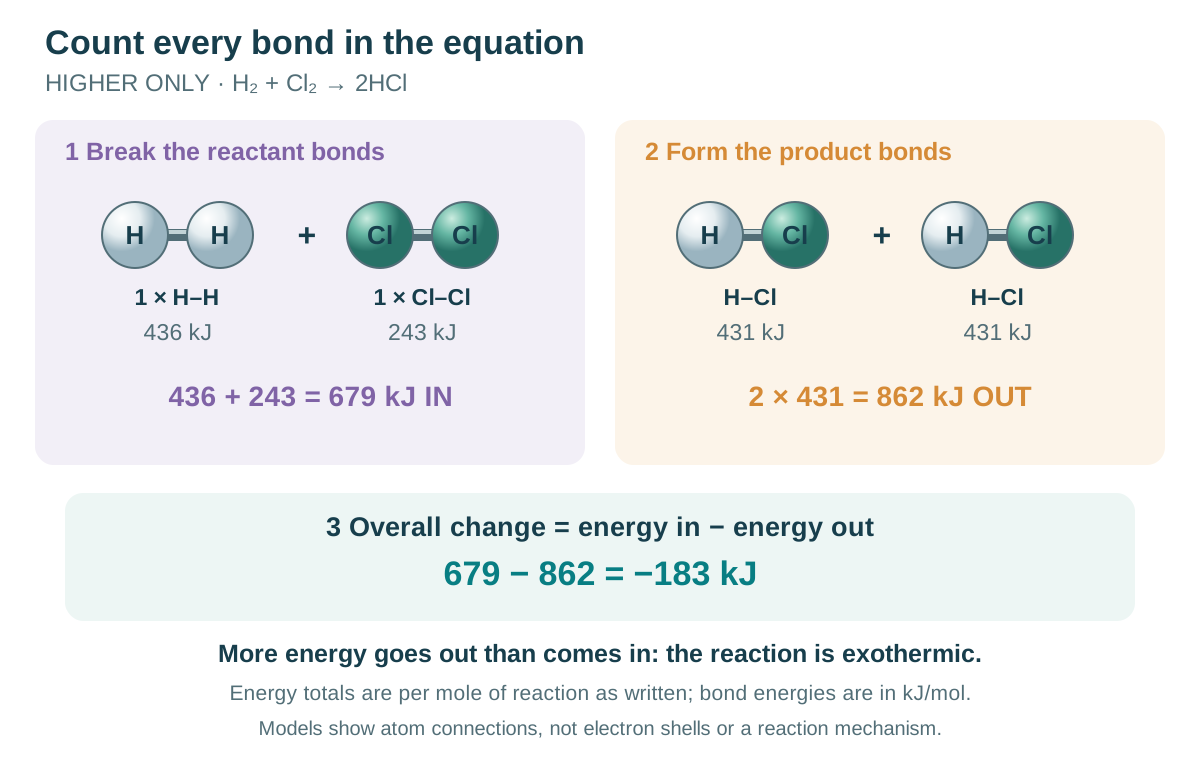
| Bond | Bond energy / kJ/mol |
|---|---|
| H–H | 436 |
| Cl–Cl | 243 |
| H–Cl | 431 |
The negative result means energy is transferred to the surroundings. Reversing this reaction would require the same amount of energy overall: +183 kJ per mole of the reverse reaction as written.
If a bond energy is unknown, rearrange the equation. For example, if breaking bonds needs 900 kJ and the overall change is −120 kJ, bond formation releases 900 − (−120) = 1020 kJ.
Start with the 32 main questions. Higher-only questions are labelled. You can complete this topic over several sessions; your answers save as you go. Use a hint if you get stuck, then compare your work with an example answer. Your tutor can mark written answers.
| Acid concentration / mol/dm³ | Temperature increases / °C |
|---|---|
| 0.25 | 2.0, 2.2, 2.1 |
| 0.50 | 4.1, 4.3, 4.2 |
| 0.75 | 6.2, 6.3, 6.4 |
All experiments use 25 cm³ of acid and 25 cm³ of the same alkali, with alkali in excess. Calculate the mean increase at each concentration. Describe the trend, explain two controls and suggest an improvement to temperature measurement.
Means are 2.1, 4.2 and 6.3 °C. Over this range, doubling concentration doubles the mean increase. Keep total volume and starting temperature fixed so the comparison is fair. A lid and a recording probe help reduce heat loss and identify the maximum. The trend cannot be assumed to continue once the alkali is no longer in excess.
When connected with your pupil code, your answers save online for Kevin to see. Click Submit to Kevin when you have finished. Downloads are optional.
Connect with your pupil code above to submit.
Use a scientific idea and a specific example in your reflection.