Ecology
Work through one section at a time. Higher-only material is labelled explicitly; optional challenges can also use Foundation content.
 GCSE BIOLOGY · AQA TRILOGYTutor dashboardSaves on this device
Your answers save automatically as you work.
Saved in this browser on this device.
Discover how living things depend on each other, investigate a habitat and explore how we can protect biodiversity.
Supported GCSE version · Clear examples, worked calculations and optional challenges.
Work through one section at a time. Higher-only material is labelled explicitly; optional challenges can also use Foundation content.
One living thing.
All organisms of one species in an area.
Populations of different species living together.
A community interacting with its non-living surroundings.
The place where an organism lives.
Species depending on each other for resources or services.
Organisms needing the same limited resource.
A non-living environmental factor, such as temperature.
A factor involving living organisms, such as predators.
A feature that helps survival and reproduction in an environment.
An organism suited to conditions extreme for most life.
An organism that makes biological molecules, usually by photosynthesis.
The material making up living organisms.
An organism that eats other organisms.
An animal that kills and eats another animal.
An animal eaten by a predator.
How many organisms are present.
Where organisms are found.
A frame of known area used for sampling.
A line across a habitat used to investigate changes.
Choosing positions by chance to reduce selection bias.
The total of the values divided by the number of values.
The middle value when values are in order.
The value that occurs most often.
An organism, such as a bacterium or fungus, that breaks down dead material and waste.
The variety of different species in an area or on Earth.
Partly decayed plant material built up in waterlogged conditions.
Removing forests.
Protecting species, habitats and other natural resources.
An organism is one living thing. A population is all the organisms of one species in an area. A community includes the populations of different species living there. An ecosystem includes this community and its interactions with the non-living surroundings.
For example, one frog is an organism; all the frogs of that species in a pond form a population. Frogs, reeds, algae, insects and microorganisms form part of the community. The community interacting with water, light, soil and temperature forms the ecosystem. A habitat is the place where an organism lives.
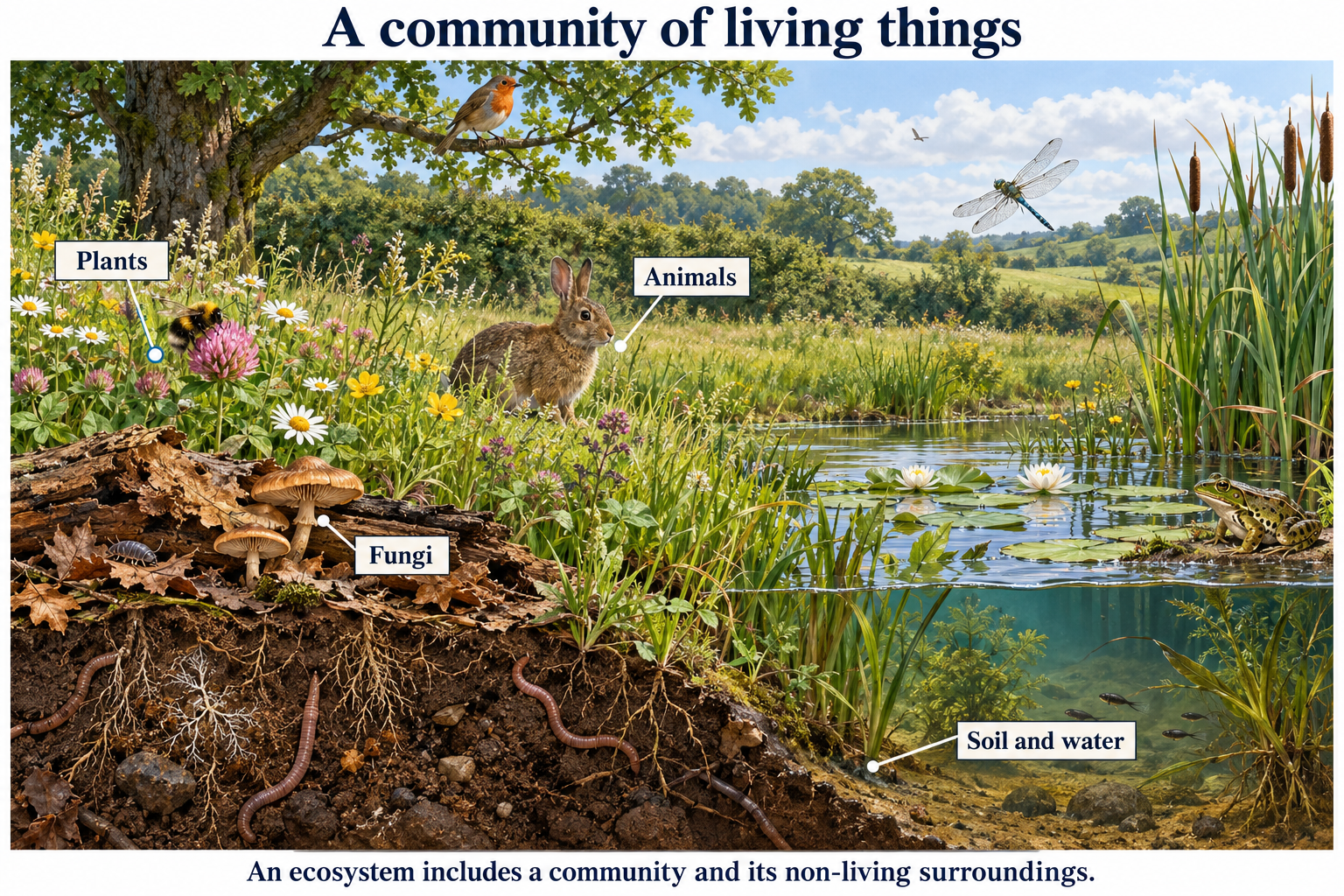
Interdependence means species depend on each other. Bees get food from flowers and help pollinate them. Birds can spread seeds. Trees provide shelter. Removing one species can affect many others.
In a stable community, species and environmental factors are in balance. Population sizes stay fairly constant over time, although they can fluctuate. Stable does not mean that every individual survives or that numbers never change.
Competition happens when organisms need the same limited resource. Plants often compete for light, space, water and mineral ions. Animals often compete for food, mates and territory — an area they defend.
A crowded seedling may receive less light because taller plants shade it. A bird may defend a feeding area from other birds. Competition can happen within a species or between different species.
Abiotic factors are non-living conditions. Biotic factors involve living organisms. Both can change where a species lives and how many individuals survive.
| Abiotic factor | How a change could matter |
|---|---|
| Light intensity | Less light can reduce photosynthesis and plant growth. |
| Temperature | Changes affect enzyme activity; very high or low temperatures may limit survival. |
| Moisture | Dry soil may limit plant growth. |
| Soil pH and mineral content | Some plants grow better in particular pH ranges; mineral shortages limit growth. |
| Wind intensity and direction | Wind affects water loss and where seeds land. |
| Carbon dioxide available to plants | A shortage can limit photosynthesis. |
| Oxygen dissolved in water | Aquatic animals need oxygen for aerobic respiration. |
| Biotic change | Possible effect |
|---|---|
| Less food | Fewer animals may survive or reproduce. |
| A new predator | More prey may be eaten. |
| A new pathogen | Disease may reduce a population. |
| A stronger competitor | One species may become so scarce that individuals cannot find mates. |
These are possible effects, not rules that apply equally everywhere. Use the data and the organism in the question. A correlation — two things changing together — does not on its own prove that one caused the other.
An adaptation is a feature that helps an organism survive and reproduce in its usual environment.
| Type | Meaning | Example |
|---|---|---|
| Structural | A feature of the body | A cactus has a waxy outer surface that reduces water loss. |
| Behavioural | Something the organism does | A desert animal is active at night, when it is cooler. |
| Functional | How a body process works | A desert mammal produces concentrated urine, losing less water. |
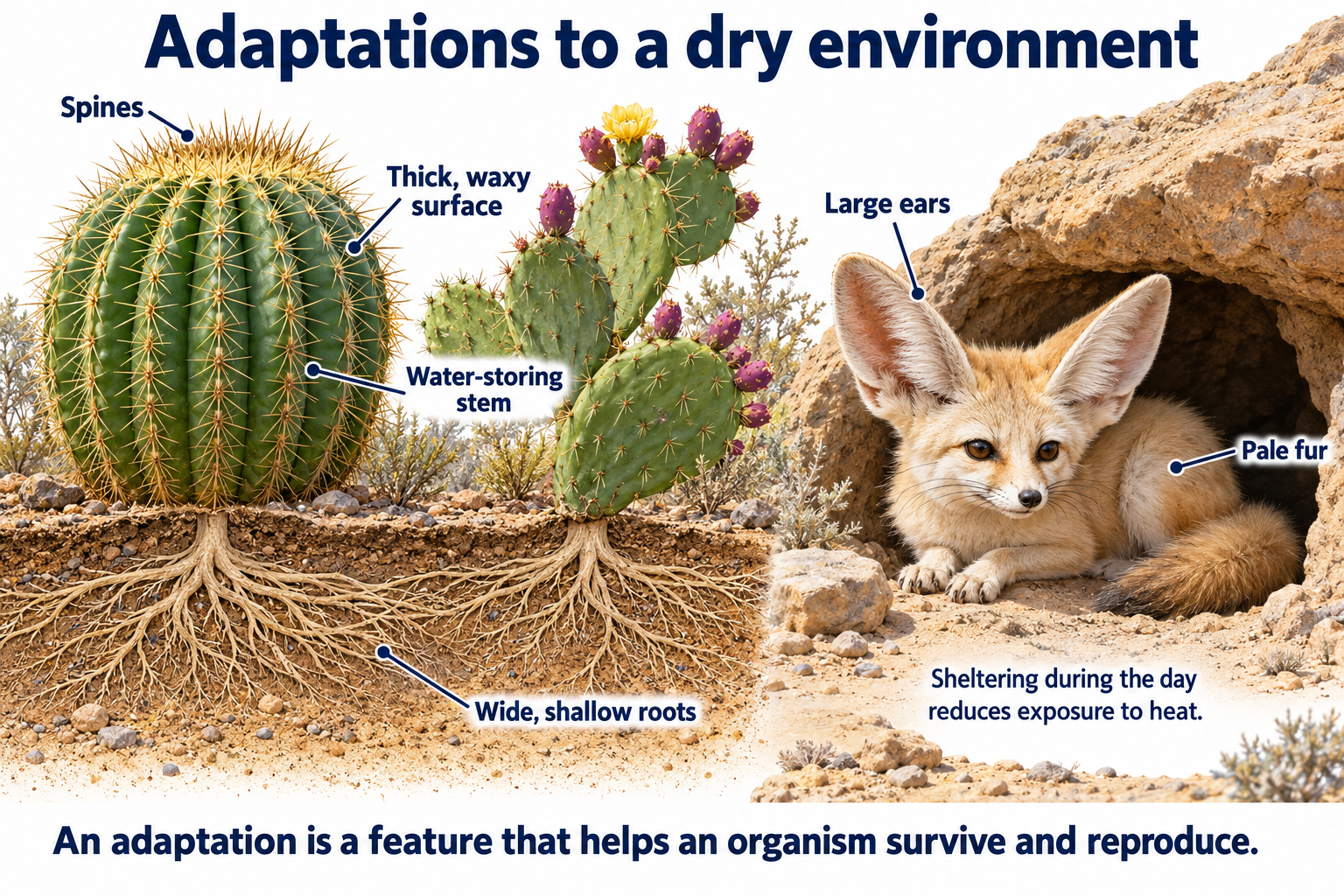
A cactus stores water in a thick stem. Its spines have a small surface area and help protect it from being eaten. Large ears can help a desert fox transfer heat to its surroundings. By contrast, an Arctic animal may have thick fur, fat and small ears that reduce heat loss.
Extremophiles live in conditions that are extreme for most organisms, such as high temperature, high pressure or high salt concentration. Some bacteria live near deep-sea vents. Their cell processes work under those conditions. Organisms do not choose to develop adaptations because they need them.
A producer makes biological molecules from simpler substances. Most food chains start with a green plant or alga, which makes glucose by photosynthesis. Producers make biomass — the material in living organisms — on which consumers depend.
A consumer eats other organisms. A primary consumer eats a producer; a secondary consumer eats a primary consumer; a tertiary consumer eats a secondary consumer. A predator kills and eats another animal. The animal it eats is its prey.
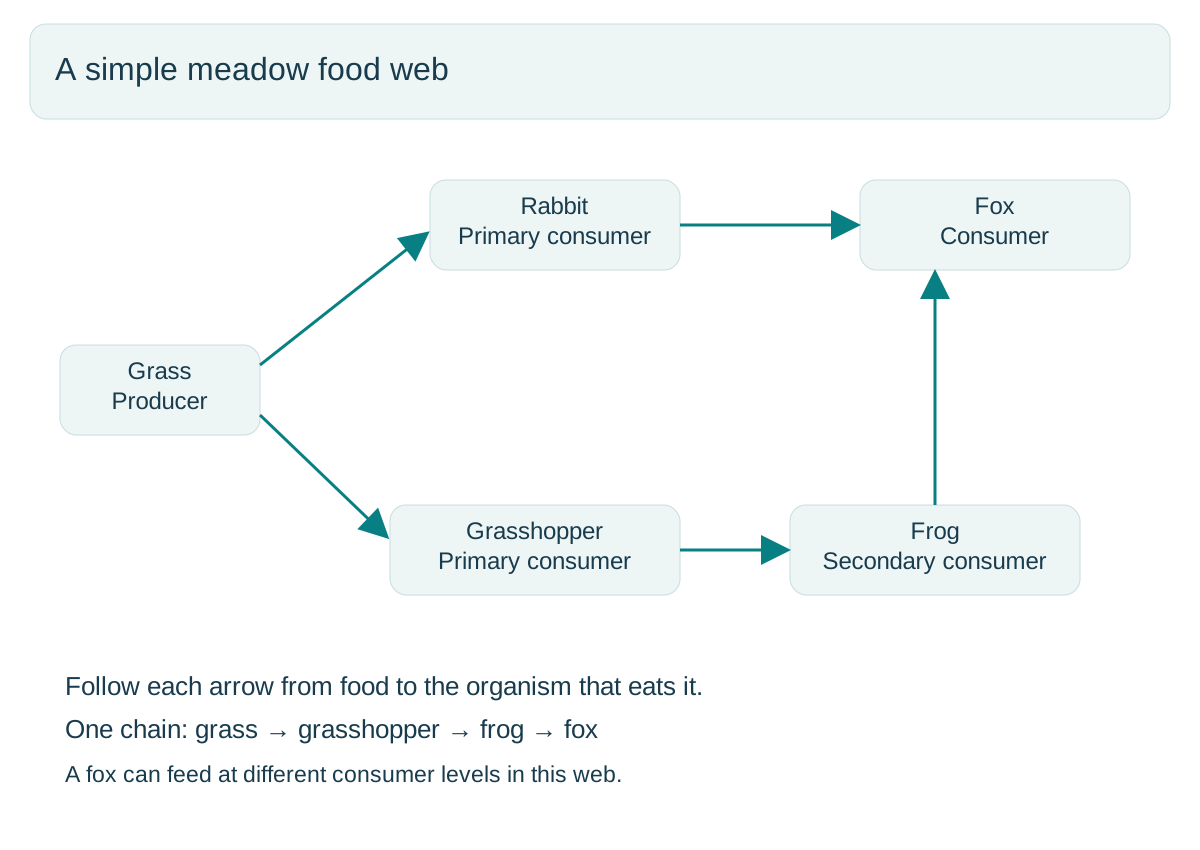
A food web links food chains. If grasshopper numbers fall, frogs may have less food. A predator with more than one prey species may be less dependent on a single food source.
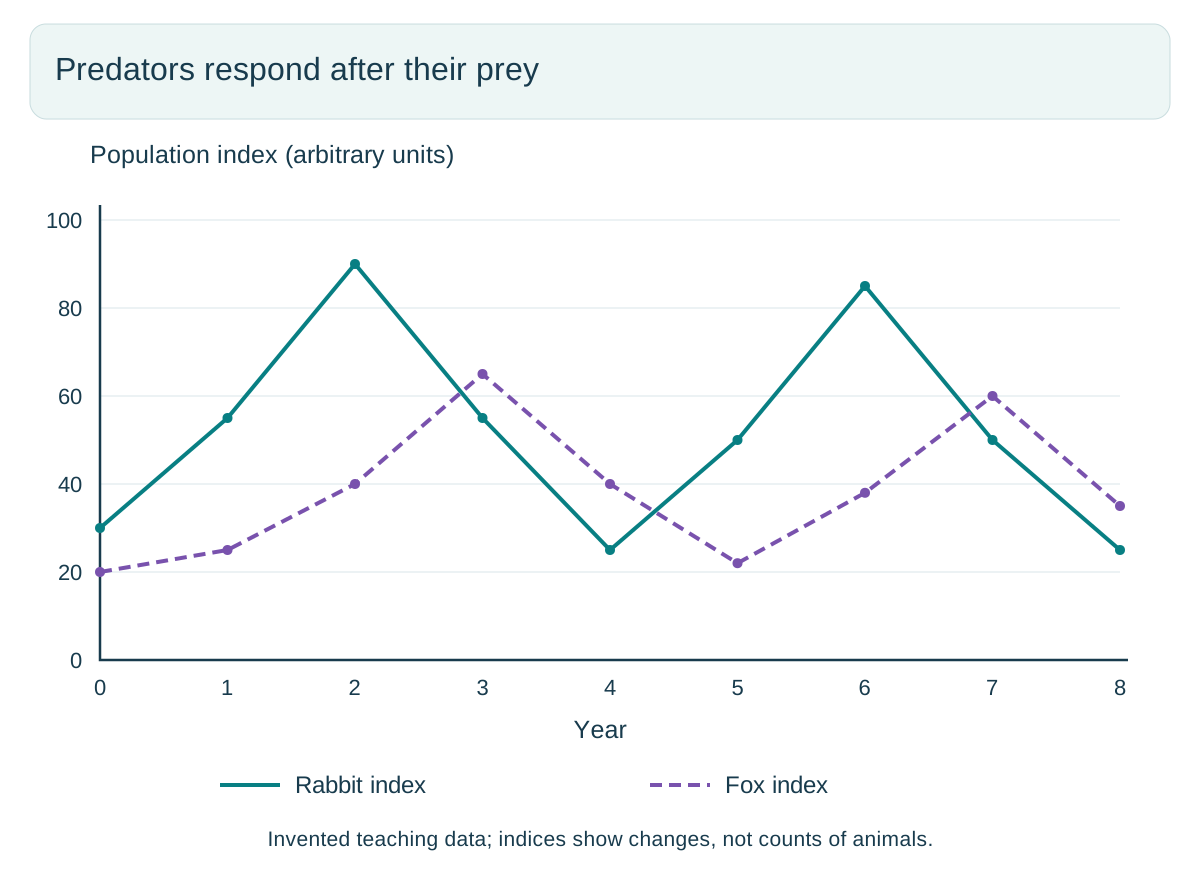
In a simple stable predator–prey system, more prey provide more food. More predators survive and reproduce. The larger predator population eats more prey, so prey numbers fall. With less food, predator numbers then fall. Fewer predators allow prey numbers to recover.
The predator peak usually comes after the prey peak: survival and reproduction take time. Real populations also respond to weather, disease, migration and other food sources, so the pattern may be less regular.
Counting every daisy in a field would take a long time. Sampling means studying a smaller part and using it to estimate the whole. A quadrat is a frame with a known area. Use it for plants or slow-moving organisms.
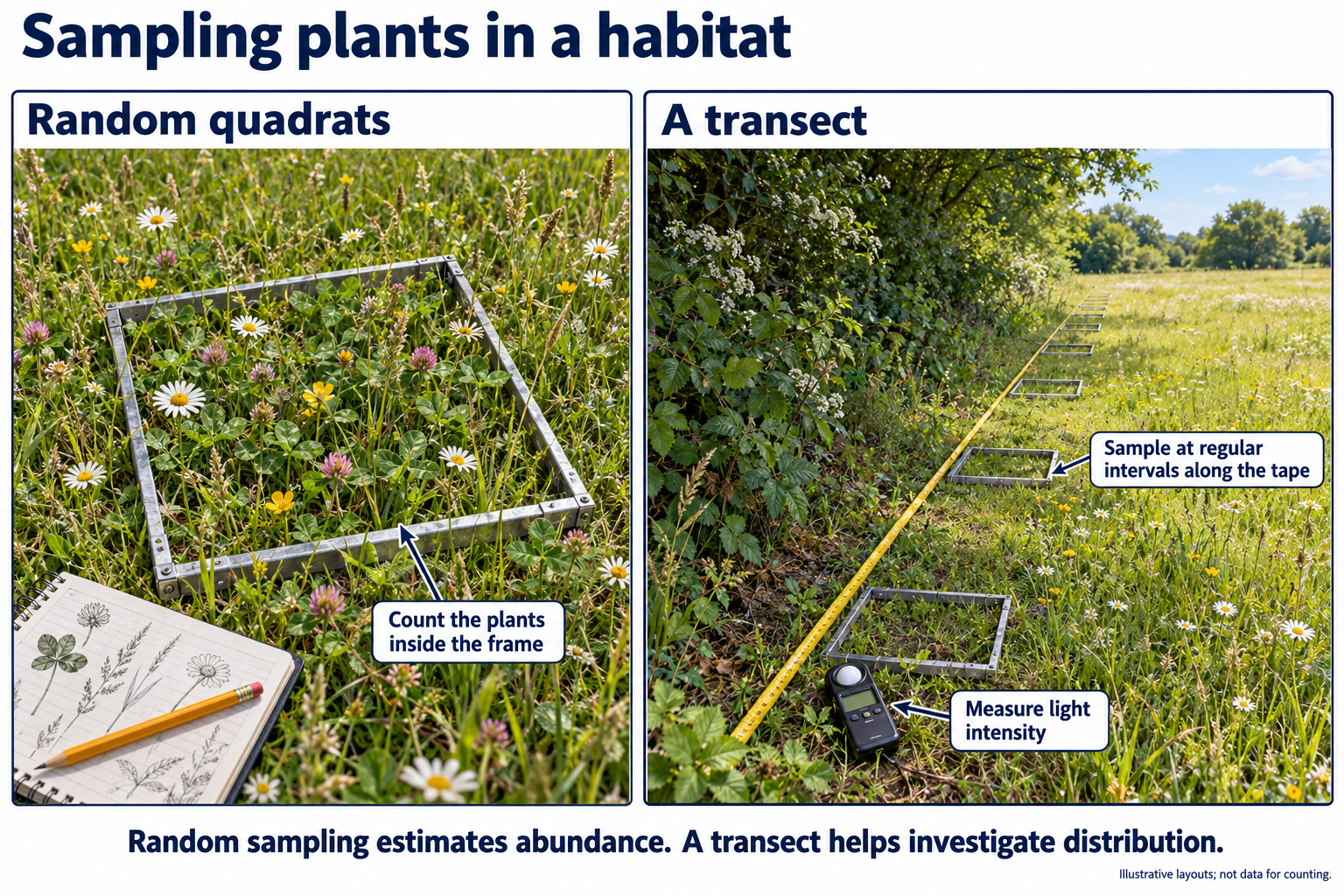
Keep consistent: quadrat size, species identification, counting rule and survey method. Increase the number of quadrats to reduce the influence of an unusual patch. Random sampling reduces selection bias, but an estimate is still uncertain if plants are very patchy or the area is poorly represented.
Care and safety: check the site for hazards, avoid deep water and steep ground, cover cuts and wash hands afterwards. Wear suitable footwear. Do not damage plants or disturb nesting animals. Leave organisms where you found them.
A square quadrat measuring 0.5 m by 0.5 m has an area of 0.25 m². Five random quadrat counts are 2, 4, 4, 6 and 9 daisies.
The median is the middle value when counts are ordered: 4. The mode is the most frequent value: also 4. The mean uses every value and is affected by very large or small counts.
For a 50 cm square, first convert 50 cm to 0.5 m. Do not treat 50 × 50 = 2500 cm² as 2500 m². Remember that 1 m² = 10,000 cm².
This estimate assumes the sampled area represents the whole habitat. State the unit and avoid claiming that an estimate is an exact count.
Abundance means how many organisms are present. Distribution means where they are found. A transect is a line across a habitat used to investigate changes along it.
Distance along the tape is a position, not the biological cause itself. Measuring light intensity helps test whether shade is linked to distribution. An outdoor survey cannot perfectly control every other factor, so a pattern alone does not prove cause.
| Distance from hedge / m | Light intensity / lux | Daisies per 0.25 m² |
|---|---|---|
| 0 | 120 | 0 |
| 2 | 300 | 1 |
| 4 | 650 | 3 |
| 6 | 900 | 5 |
| 8 | 1100 | 6 |
Light intensity and daisy count both rise away from this hedge. Repeating the survey helps show whether this pattern is typical. Keep unusual valid results; investigate suspected recording mistakes rather than deleting results just because they do not fit.
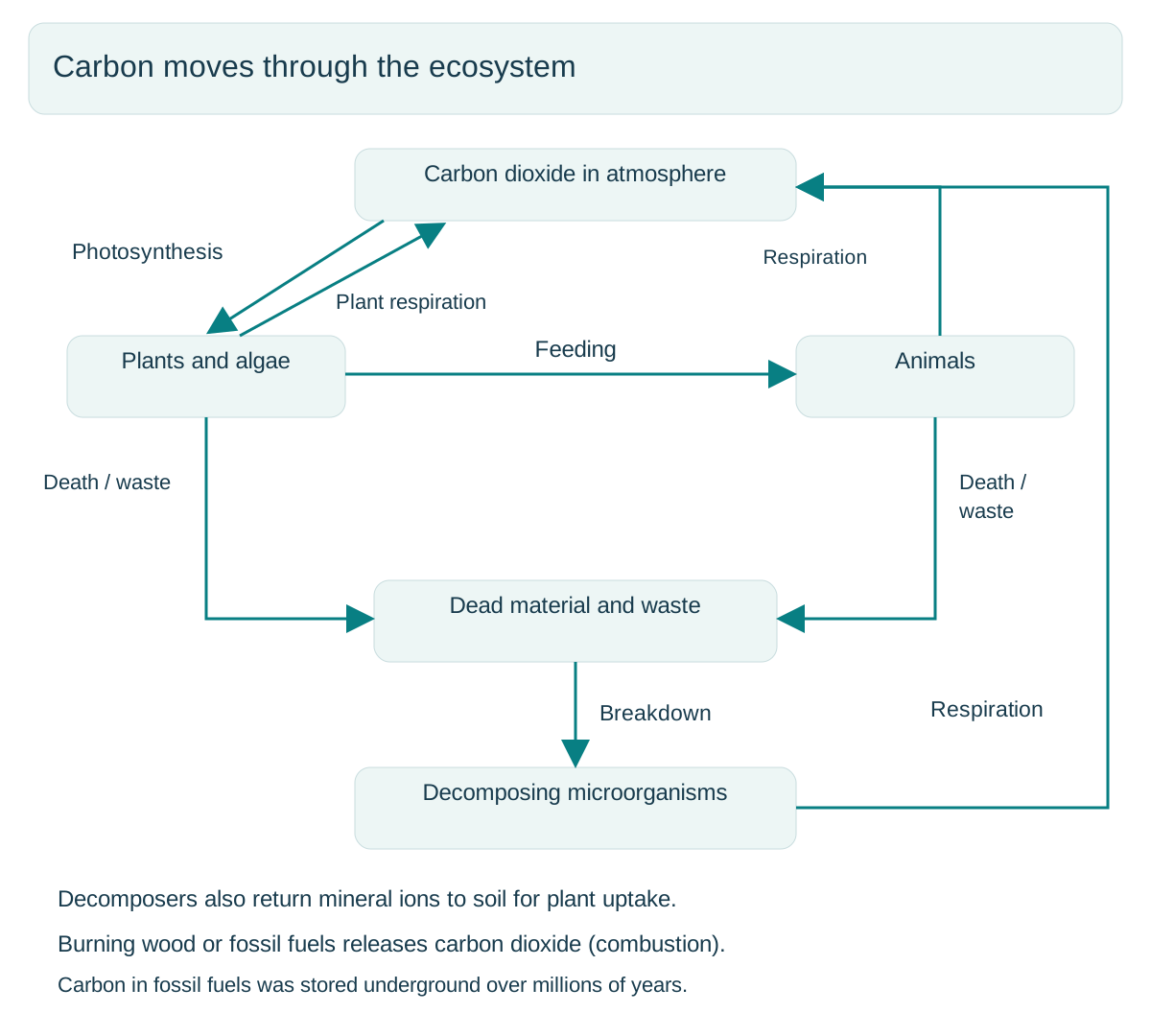
Carbon atoms are needed to make carbohydrates, proteins and fats. They move between organisms and the non-living environment; they are not used up or made from energy.
Water is needed for cell reactions, transport and photosynthesis. The water cycle provides fresh water on land.
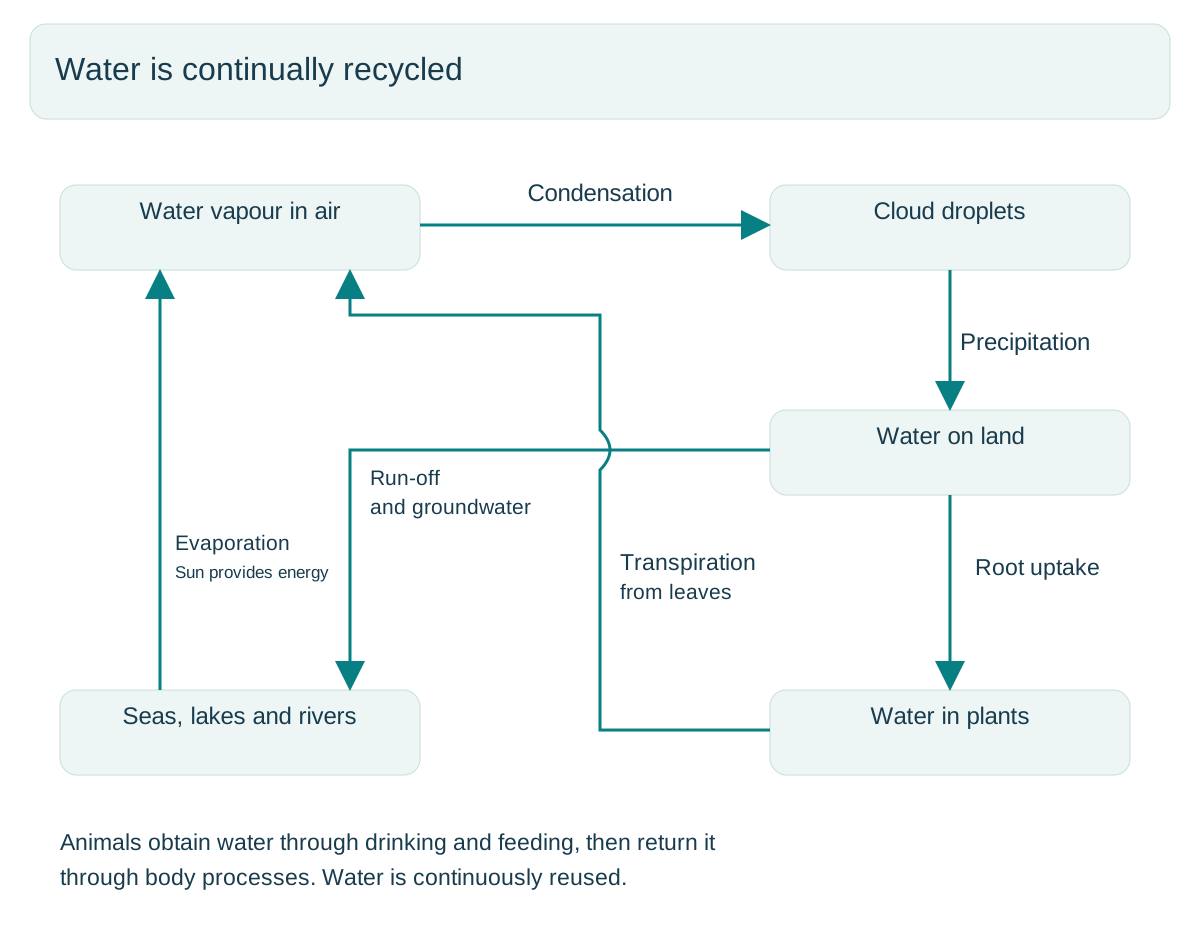
The Sun provides energy for evaporation from seas, lakes and soil. Water vapour cools and condenses into tiny droplets that form clouds. Water falls as precipitation, such as rain or snow.
Water runs over the surface or soaks into the ground. Streams, rivers and groundwater return water towards the sea. Plant roots absorb water. Water vapour leaves leaves by transpiration. Animals obtain water by drinking and feeding and return it through their body processes.
Biodiversity is the variety of different species on Earth or within an ecosystem. A habitat with many species generally offers more alternative food sources and other relationships. This reduces the dependence of one species on just one other species and can help make the ecosystem more stable.
Humans rely on ecosystems for food, clean water, pollination and other resources. Protecting biodiversity helps maintain these services. A larger number of individuals of just one species does not necessarily mean greater biodiversity.
A growing human population and higher standards of living can increase resource use and waste production. If waste is poorly managed, pollution can harm organisms and reduce biodiversity.
| Where pollution happens | Examples | Possible effect |
|---|---|---|
| Water | Sewage, fertiliser and toxic chemicals | Toxic chemicals can poison organisms. Sewage decomposition uses dissolved oxygen, so aquatic animals may die. |
| Air | Smoke and acidic gases | Smoke can damage health; acidic pollution can harm plants and aquatic habitats. |
| Land | Landfill and toxic chemicals | Habitats are lost, and leaking chemicals can damage soil or nearby water. |
Fertiliser washed into water can encourage rapid algal growth. When organisms die, decomposing microorganisms use oxygen in respiration. Less oxygen is then available to aquatic animals. Follow the cause-and-effect chain rather than saying only “pollution is bad”.
Building, quarrying, farming and dumping waste leave less habitat for other species. Habitat loss can remove food, shelter and breeding places.
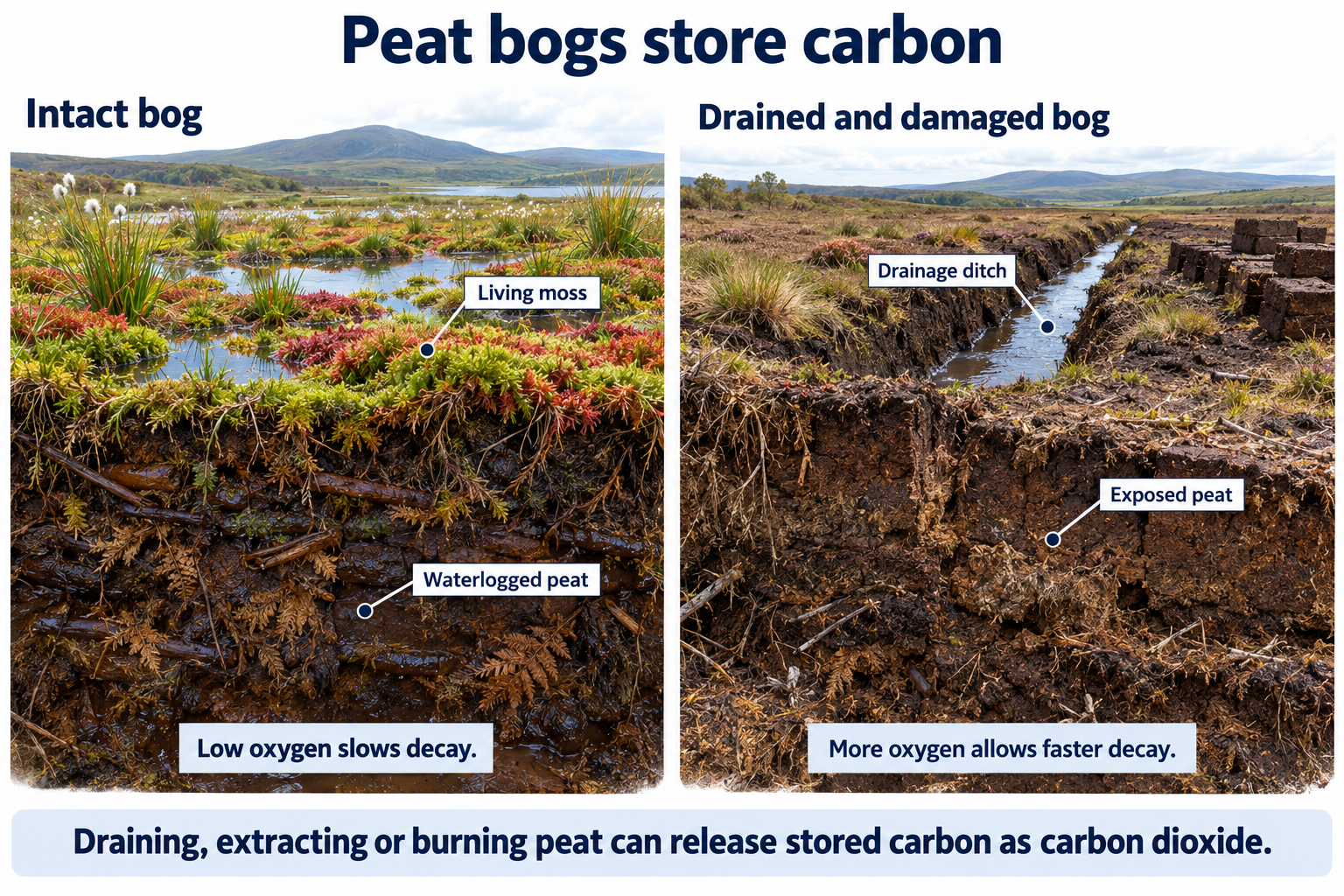
Peat forms when dead plant material builds up in waterlogged ground because it does not fully decay. A peat bog can support specialised plants, animals and microorganisms and store carbon for a long time.
Removing peat for garden compost destroys habitat. Draining peat lets more oxygen enter, so microorganisms can break it down more quickly. Decay and burning release carbon dioxide.
There is a conflict: growers want affordable compost to grow food and plants, while conservation protects habitats and limits carbon dioxide release. Peat-free compost and restoring wet conditions can help, but alternatives must be assessed for cost, performance and their own environmental effects.
Deforestation means removing forests. Tropical forests have been cleared for cattle grazing, rice fields and crops used to make biofuels.
Clearing trees removes habitats and can reduce biodiversity. Fewer trees remain to absorb carbon dioxide in photosynthesis. Burning wood or allowing it to decay releases carbon dioxide. Cattle and flooded rice fields can also be sources of methane.
Land may provide food, jobs and income. An evaluation should weigh these benefits against loss of habitats, carbon storage and other ecosystem services. Growing a fuel crop is not automatically environmentally harmless.
Increasing carbon dioxide and methane levels strengthen the greenhouse effect and contribute to global warming, a rise in Earth’s average temperature. Climate change also includes changes in rainfall and other long-term weather patterns.
Biological consequences can include changes in where species can live, loss of habitats, altered migration and breeding times, and changes in food availability. If flowers open before their pollinators are active, both may be affected. Some organisms may spread to new areas; others may not adapt or move quickly enough.
The scientific consensus comes from systematic reviews of thousands of peer-reviewed studies, not one hot day. The overall warming trend is well supported, while the exact effect on a particular habitat can be uncertain because many factors interact. Scientists use more observations and improved models to refine predictions.
People can reduce damage and help ecosystems recover.
| Action | How it can help | A limitation or trade-off |
|---|---|---|
| Breeding endangered species | Increases numbers and may support reintroduction. | Needs suitable habitat and enough genetic diversity. |
| Protect and restore rare habitats | Maintains food, shelter and breeding sites. | Costs money and can restrict other land uses. |
| Restore hedgerows and field margins | Provides habitats and links between patches of habitat. | Uses some land that could grow crops. |
| Reduce deforestation and carbon dioxide emissions | Protects habitats and helps limit warming. | Can involve changes to jobs, transport and energy use. |
| Recycle materials | Reduces demand for new resources and the amount dumped. | Collection and processing still use resources and energy. |
A strong evaluation uses evidence, considers different groups and gives a justified conclusion. For example, a farmer may lose some crop area when planting a hedge but gain pollinators and natural predators of crop pests. Monitoring species over time helps judge whether a conservation scheme works.
Start with the 48 main questions. Higher-only questions are labelled. You can complete this topic over several sessions; your answers save as you go. Use a hint if you get stuck, then compare your work with an example answer. Your tutor can mark written answers.
You are comparing daisies near a hedge with daisies in the centre of a field. First estimate the whole-field population using random quadrats. Then use repeated transects to investigate the relationship with light intensity.
| Random quadrat | 1 | 2 | 3 | 4 | 5 | 6 |
|---|---|---|---|---|---|---|
| Daisy count | 3 | 5 | 4 | 8 | 5 | 5 |
Total=30, mean=30÷6=5 daisies per quadrat. Density=5÷0.25=20 daisies per m². Estimated population=20×200=4000. Lay a tape from shade into the open; count daisies in equal quadrats at regular intervals and measure light at each. Use the same counting rule and light-meter position, and repeat parallel transects. Plot mean count against light intensity. Soil moisture or other factors may also vary, so correlation does not prove that light alone caused the pattern.
Practical reminder: these pages prepare you to plan and interpret practical work. Actual fieldwork needs an appropriate site and your teacher’s supervision.
When connected with your pupil code, your answers save online for Kevin to see. Click Submit to Kevin when you have finished. Downloads are optional.
Connect with your pupil code above to submit.
Use a scientific idea and a specific example in your reflection.