Bonding, structure and properties of matter
Work through one section at a time. Higher-only material is labelled explicitly; optional challenges can also use Foundation content.
 GCSE CHEMISTRY · AQA TRILOGYTutor dashboardSaves on this device
Your answers save automatically as you work.
Saved in this browser on this device.
Why does graphite write, copper carry current and salt form crystals? Explore the particles and bonds behind the materials you use every day.
Supported GCSE version · Clear examples, worked calculations and optional challenges.
Work through one section at a time. Higher-only material is labelled explicitly; optional challenges can also use Foundation content.
Attraction between opposite electric charges.
An atom or group of atoms with an overall electric charge.
An extended repeating arrangement of positive and negative ions.
A shared pair of electrons attracted to the nuclei of both bonded atoms.
A pair of outer-shell electrons not shared in a covalent bond.
A separate group of atoms held together by covalent bonds, such as one H₂O molecule.
An attraction between separate molecules.
An electron that can move through a structure instead of being tied to one atom or bond.
Attraction between positive metal ions and delocalised electrons.
A substance made of very large molecules with repeating units.
A huge, continuous network of atoms joined by strong covalent bonds.
A mixture containing a metal and one or more other elements.
Melted into the liquid state.
Dissolved in water, shown by (aq).
The simplest whole-number ratio of atoms or ions of each type.
A hollow molecule made of carbon atoms arranged in rings.
A pencil writes, a copper wire carries current and table salt forms crystals. Why do these materials behave differently? The answer starts with their particles and the forces holding them together.
A chemical bond is a strong attraction that holds particles together. Opposite electric charges attract: positive attracts negative. The scientific name for this is electrostatic attraction.
| Bonding | Usually found in | What holds it together? |
|---|---|---|
| Ionic | A metal combined with a non-metal | Attraction between positive and negative ions |
| Covalent | Non-metal elements and compounds of non-metals | Shared electron pairs attracted to both bonded nuclei |
| Metallic | Metals and alloys | Attraction between positive metal ions and delocalised electrons |
Imagine tracking the outer electrons as a metal reacts with a non-metal. The metal atoms lose electrons; the non-metal atoms gain electrons. The atoms become charged particles called ions.
| Group | Electron change | Ion charge | Example |
|---|---|---|---|
| 1 | Loses 1 | +1 | Na⁺ |
| 2 | Loses 2 | +2 | Mg²⁺ |
| 6 | Gains 2 | −2 | O²⁻ |
| 7 | Gains 1 | −1 | Cl⁻ |
The ions formed have a full outer shell, like a noble gas. Sodium changes from 2,8,1 to 2,8. Chlorine changes from 2,8,7 to 2,8,8.
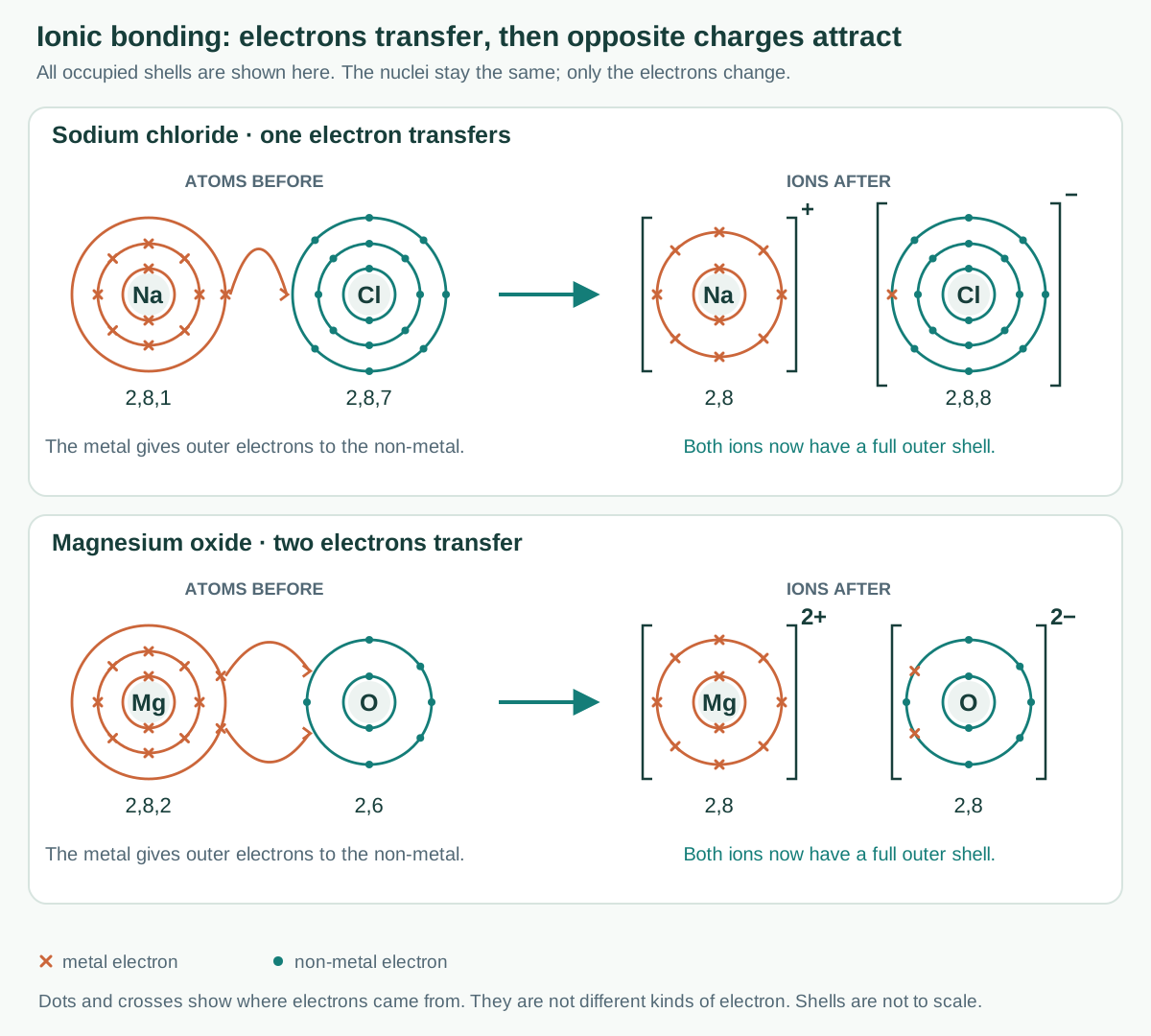
When drawing an ion, put square brackets around it and write its charge at the top right, outside the brackets. Show the gained electrons in the non-metal ion’s full outer shell.
Step 1: magnesium forms Mg²⁺ by losing two electrons.
Step 2: each chlorine atom gains one electron and forms Cl⁻. So two chlorine atoms are needed.
Step 3: check the charges: +2 + 2(−1) = 0. The formula is MgCl₂.
For calcium oxide, Ca²⁺ and O²⁻ balance in a 1:1 ratio, so the formula is CaO. For sodium oxide, two Na⁺ ions balance one O²⁻ ion, so the formula is Na₂O.
An ionic formula gives the simplest whole-number ratio of ions. This is called the empirical formula. It does not describe a separate molecule.
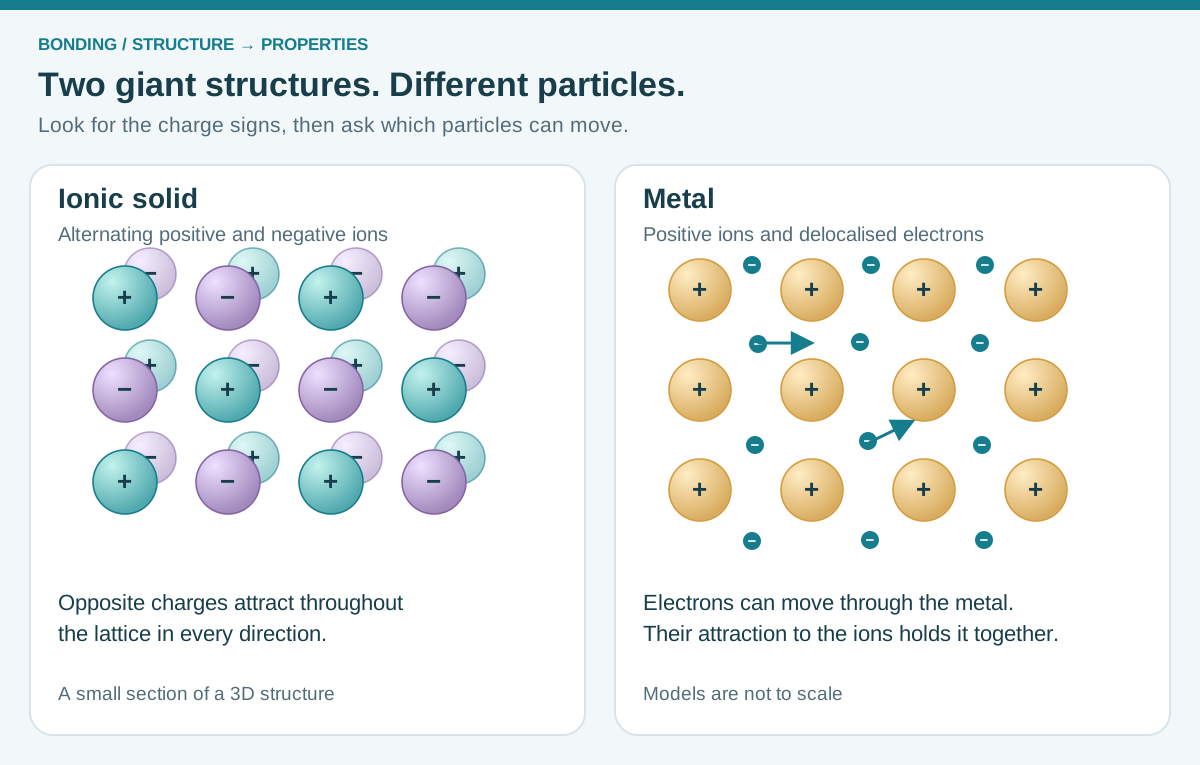
Table salt is not made of separate sodium chloride molecules. It contains a giant lattice: a repeating three-dimensional pattern of positive and negative ions.
Each ion attracts nearby ions with the opposite charge. These strong attractions act in all directions through the crystal, not just between one pair of ions.
In covalent bonding, atoms share electrons. One shared pair makes one covalent bond. The negative electrons are attracted to the positive nucleus of each bonded atom. This strong attraction holds the atoms together.
The overlapping circles below show the atoms’ outer electron shells. A shared pair sits in the overlap, so both atoms count it as part of their outer shell.
Hydrogen has a full first shell with two electrons. The other atoms shown here achieve eight outer-shell electrons by sharing. Inner shells are left out of these covalent diagrams to keep the sharing clear.
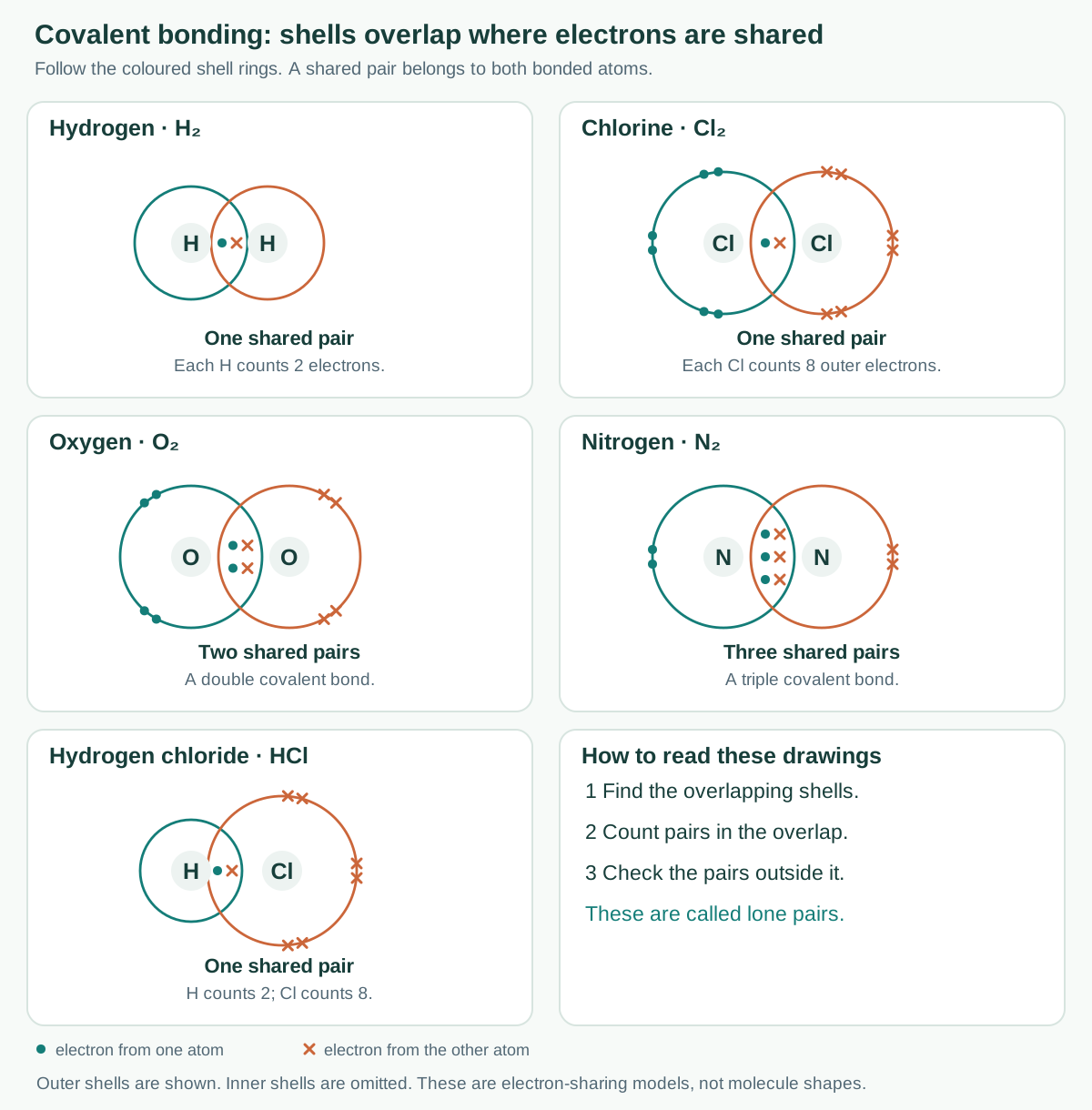
| Molecule | Bonds | Lone pairs |
|---|---|---|
| H₂ | One shared pair: H–H | None |
| Cl₂ | One shared pair: Cl–Cl | Three on each Cl |
| O₂ | Two shared pairs: O=O | Two on each O |
| N₂ | Three shared pairs: N≡N | One on each N |
| HCl | One shared pair: H–Cl | Three on Cl |
| H₂O | Two O–H bonds | Two on O |
| NH₃ | Three N–H bonds | One on N |
| CH₄ | Four C–H bonds | None on C |
A displayed formula uses lines instead of drawing electrons. One line means one shared pair. Double and triple lines mean two and three shared pairs.
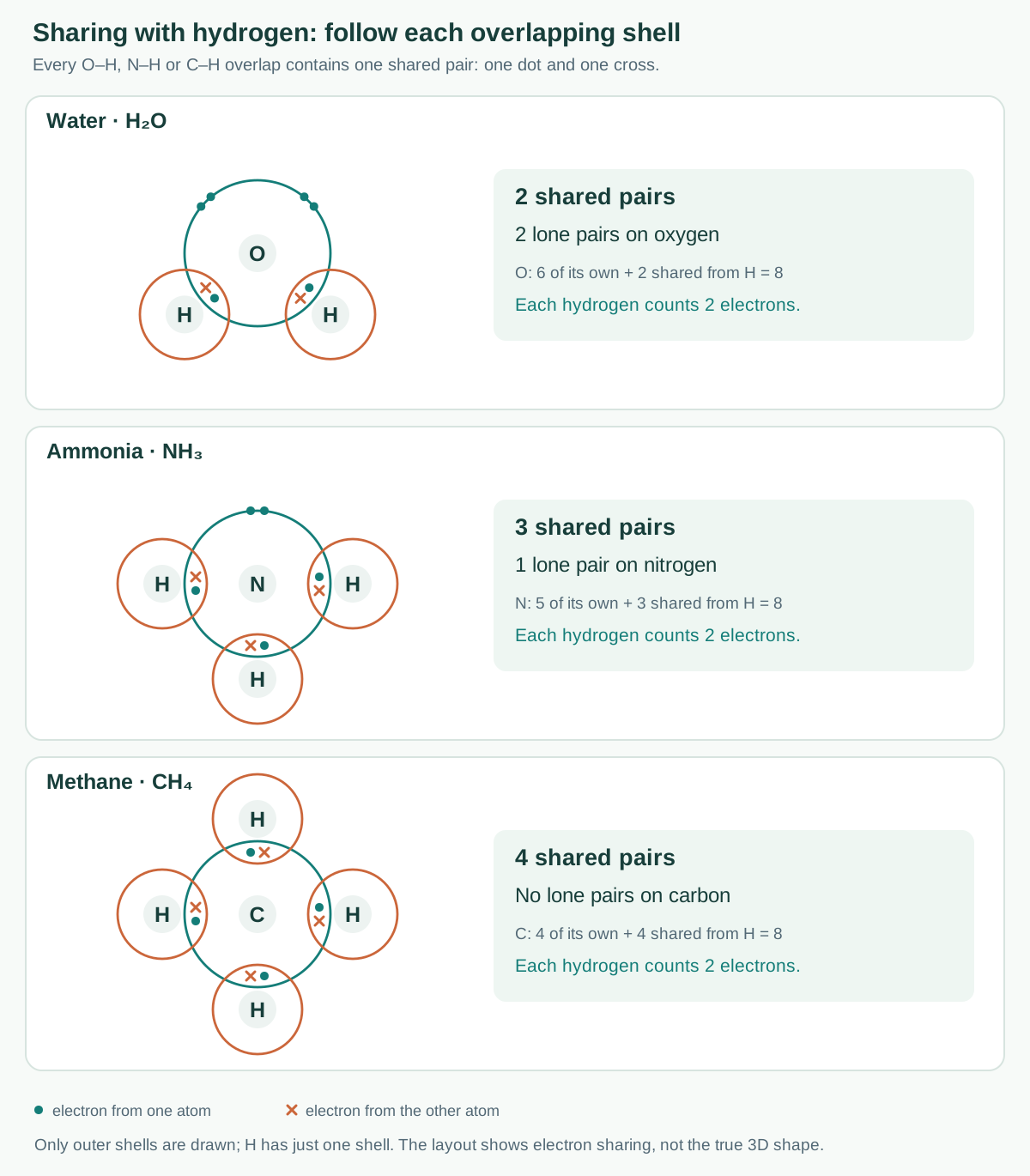
1. Count the electrons available. Oxygen brings six outer electrons. Each hydrogen brings one: 6 + 1 + 1 = 8 electrons to draw.
2. Make the bonds. Put one electron from oxygen and one from hydrogen in each O–H overlap. That makes two shared pairs.
3. Add the electrons left over. Oxygen’s remaining four electrons make two lone pairs.
4. Check the shells. Each hydrogen counts two electrons. Oxygen counts eight. Shared electrons count for both atoms, but they are only drawn once.
Water, oxygen, nitrogen and methane contain small molecules. There are two different kinds of attraction to keep track of:
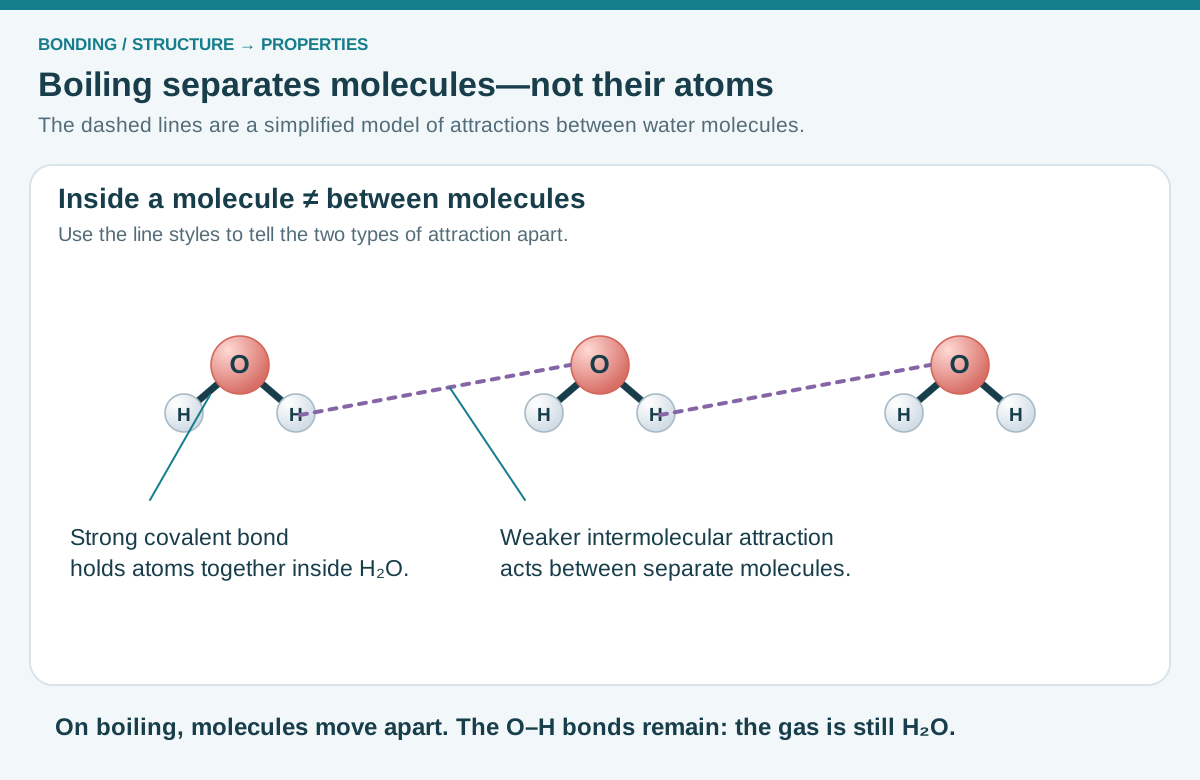
When a molecular substance melts or boils, the molecules move past one another or move apart. The forces between them are overcome. The strong covalent bonds inside them remain. This is why many small molecular substances have low melting and boiling points.
For comparable molecules, larger molecules have stronger intermolecular forces. More energy is needed to separate them, so their boiling points are generally higher.
Small molecular substances usually do not conduct electricity. They have neither mobile ions nor delocalised electrons to carry charge.
A plastic bag contains polymers: substances made of very long molecules. Each molecule has a pattern called a repeating unit that repeats many times along the chain.
Strong covalent bonds join the atoms along each chain. Relatively strong intermolecular forces act between the long chains. These forces help make polymers solids at room temperature.
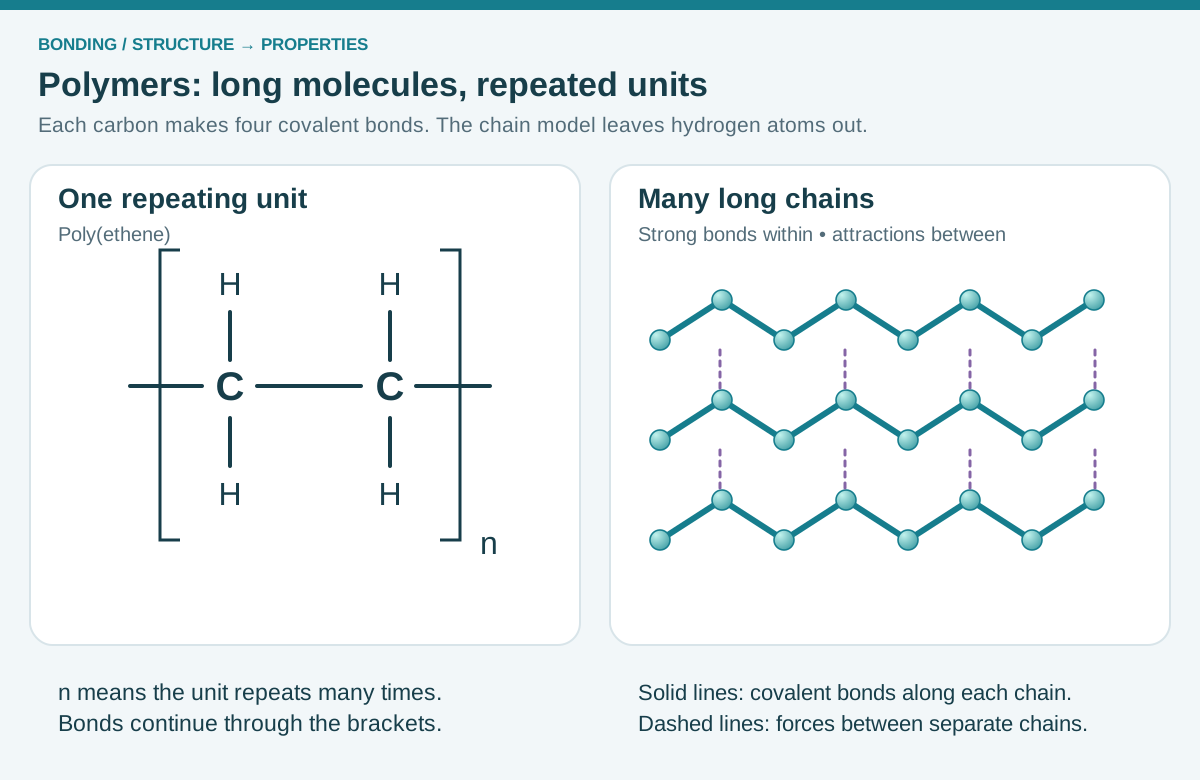
Draw a repeating unit inside square brackets, with bonds continuing through both sides. Put a small n outside: it means the unit repeats a large number of times. For poly(ethene), the unit is [–CH₂–CH₂–]ₙ. Each carbon has four bonds in total.
One –CH₂–CH₂– unit contains 2 carbon and 4 hydrogen atoms.
Five units contain 5 × 2 = 10 carbon and 5 × 4 = 20 hydrogen atoms within those units.
The n applies to the whole unit, not just the nearest atom.
In a giant covalent structure, a very large number of atoms are joined in a continuous network by strong covalent bonds.
Diamond, graphite and silicon dioxide (SiO₂) are examples. They are solids with very high melting points. Breaking up their networks means overcoming many strong covalent bonds, which needs a large amount of energy.
In silicon dioxide, each silicon atom bonds to four oxygen atoms. Each oxygen links two silicon atoms. The overall ratio is one silicon to two oxygen atoms, giving SiO₂. The solid does not contain separate SiO₂ molecules.
Most giant covalent substances do not conduct electricity because they have no mobile charged particles. Graphite and graphene are exceptions: they have electrons that can move through the structure. You will meet them in the carbon section.
Why can a copper wire carry current? A metal has a giant regular arrangement of positive metal ions surrounded by delocalised electrons.
Delocalised means the electrons are not tied to one atom or one bond. They can move through the structure. The attraction between these negative electrons and the positive metal ions is metallic bonding.
An alloy is a mixture containing a metal and one or more other elements. Brass, for example, contains copper and zinc.
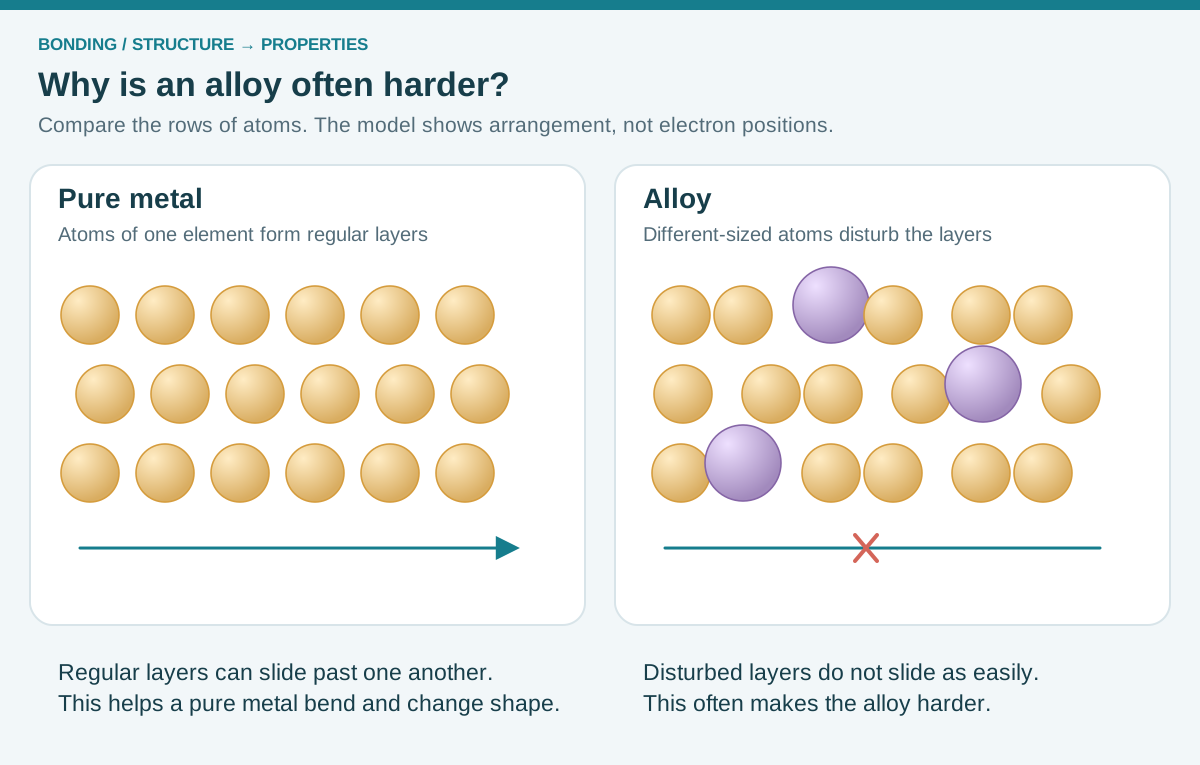
Different-sized atoms disturb the regular layers. The layers cannot slide as easily, so an alloy is often harder than the pure metal.
The same substance can be a solid, liquid or gas. What changes is the particles’ arrangement and movement.
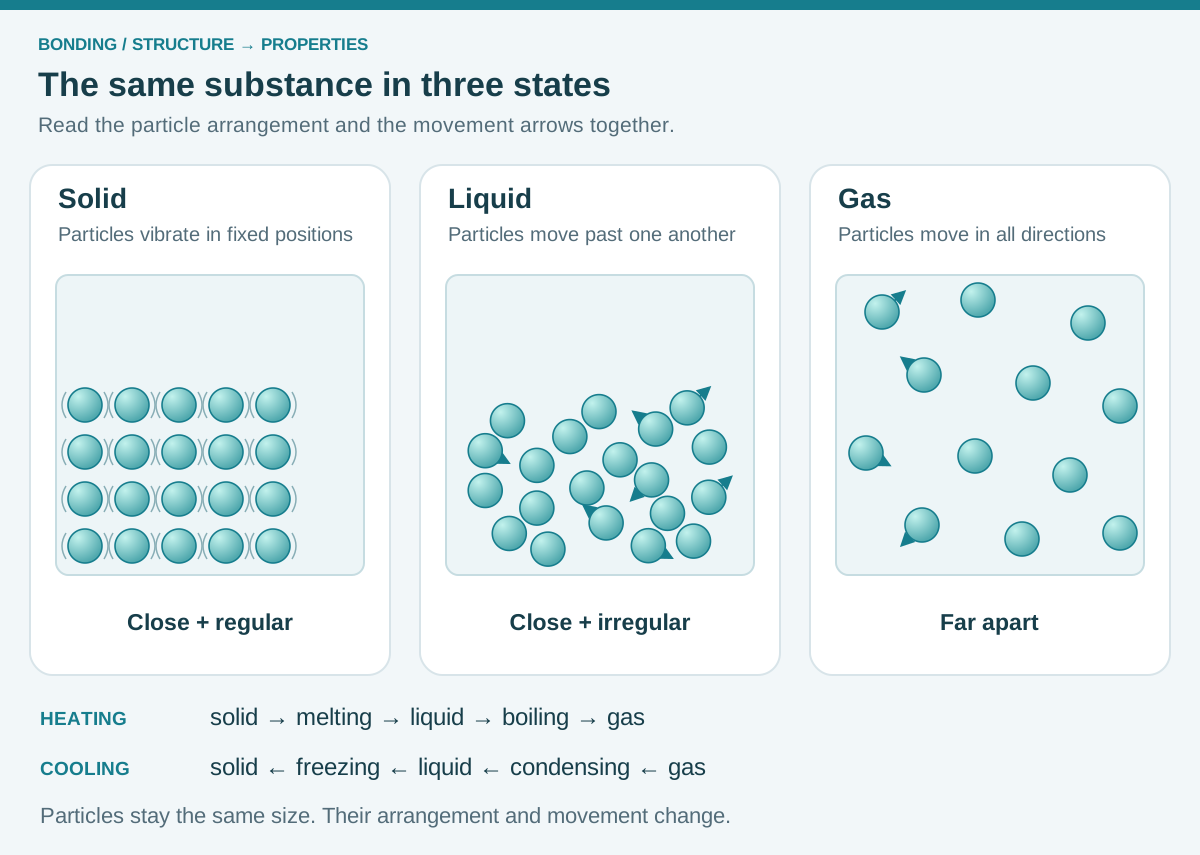
Heating transfers energy to the substance. During melting or boiling, energy is used to overcome attractions. The particles can then become less ordered or move further apart. Stronger attractions need more energy to overcome, so melting or boiling temperatures are higher.
Cooling reverses these changes: a liquid freezes to form a solid; a gas condenses to form a liquid.
To work out a state, compare the temperature with both the melting point and boiling point. At the stated pressure: below the melting point = solid; between the two points = liquid; above the boiling point = gas. At a change-of-state temperature, two states can be present together while the change happens.
| Symbol | Meaning | Example |
|---|---|---|
| (s) | Solid | NaCl(s) |
| (l) | Liquid | H₂O(l) |
| (g) | Gas | O₂(g) |
| (aq) | Dissolved in water | NaCl(aq) |
A substance melts at −20 °C and boils at 60 °C.
At −30 °C: below −20 °C → solid.
At 25 °C: between −20 °C and 60 °C → liquid.
At 80 °C: above 60 °C → gas.
Being above the melting point alone is not enough to decide it is a liquid. Check the boiling point too.
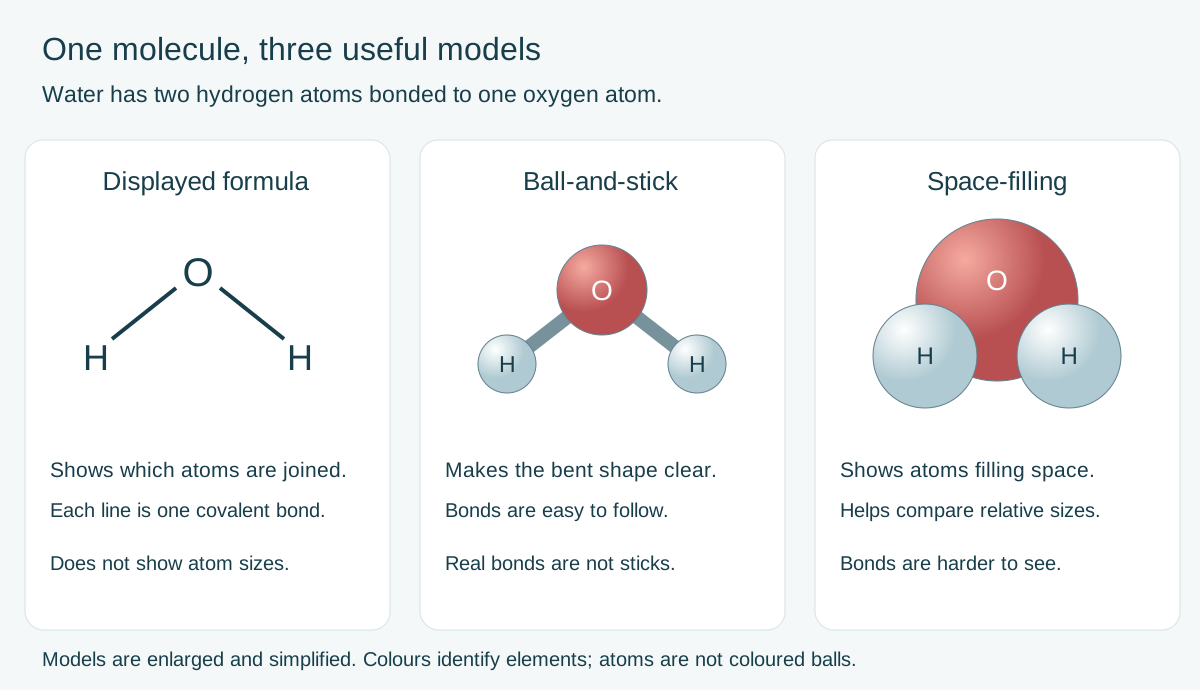
A diagram makes invisible particles easier to understand. But it is a model, not a photograph. Ask yourself: “What does this show clearly, and what has it left out?”
One copper atom is not “bendy”. Bending and other properties describe how a large arrangement of particles behaves, not one atom on its own.
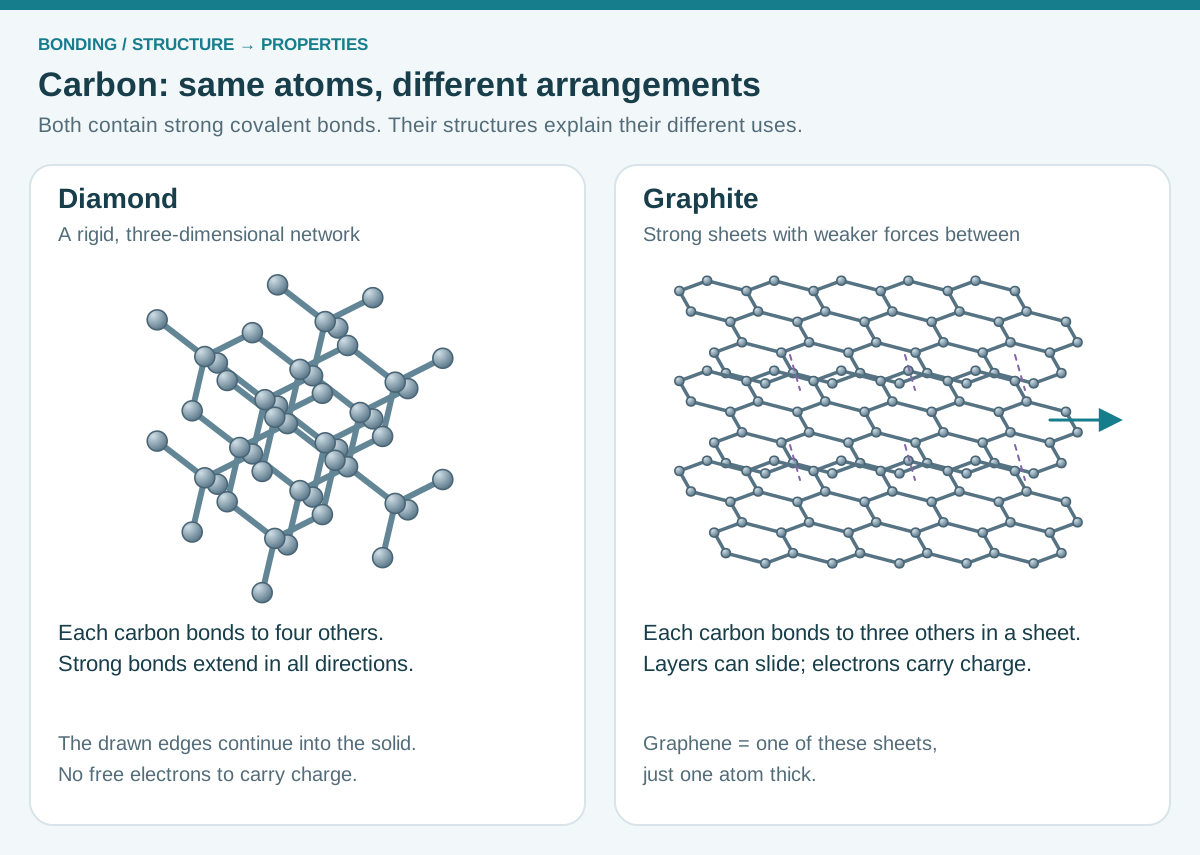
Diamond and pencil graphite are both made of carbon. Their very different properties come from the way the carbon atoms are joined.
Diamond: a rigid network. Each carbon makes four strong covalent bonds in three dimensions. There are no layers that slide easily. This makes diamond very hard and useful for cutting tools. Many strong bonds give it a very high melting point. All outer electrons are involved in bonds, so there are no delocalised electrons to carry current.
Graphite: layers that slide. Each carbon makes three covalent bonds in a sheet of hexagonal rings. Strong bonds within the sheets give a high melting point. Weak attractions between sheets let them slide, making graphite useful in pencils and as a lubricant. One electron from each carbon is delocalised. These electrons carry charge, so graphite conducts and can be used as an electrode.
Graphene: just one sheet. Graphene is one layer of graphite, only one atom thick. Strong carbon–carbon bonds make it strong for its mass, and delocalised electrons make it conducting. It can strengthen composite materials (materials made by combining different materials) and can be used in electronic devices.
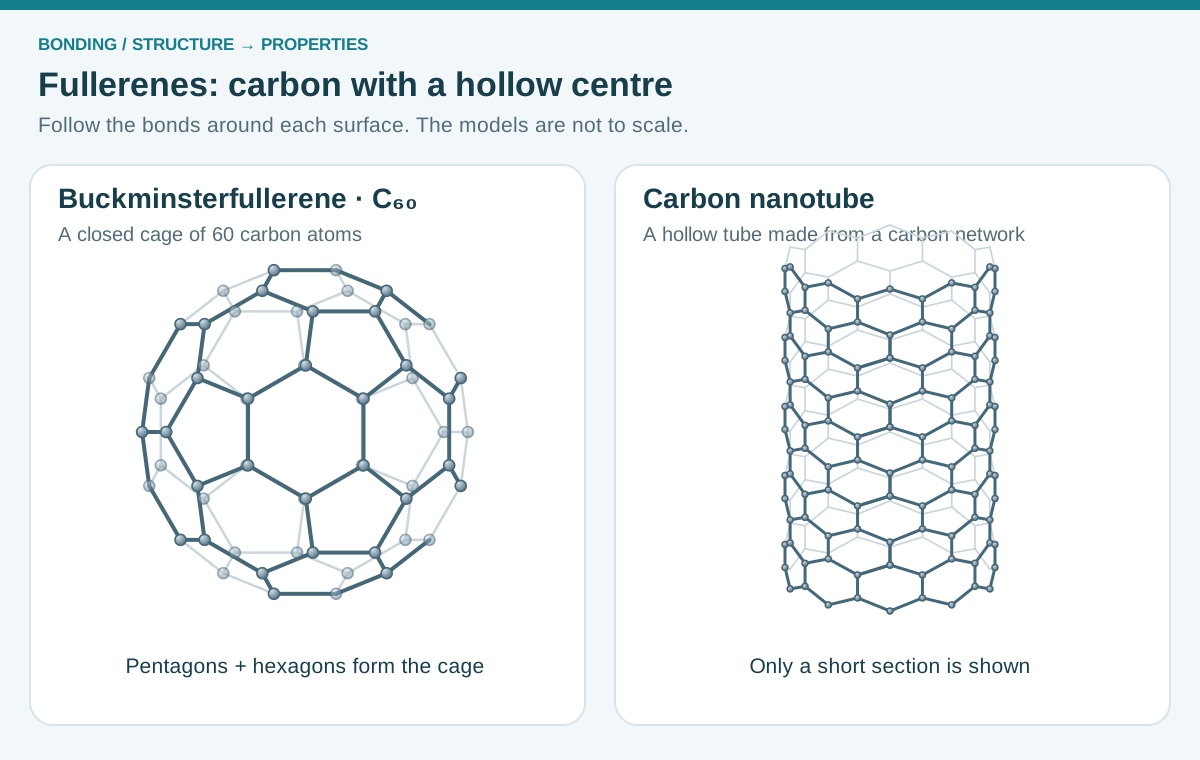
Fullerenes: hollow carbon molecules. Their structures contain mainly hexagons; pentagons or heptagons can also occur. Buckminsterfullerene, C₆₀, is a roughly spherical cage. Its hollow centre can hold other substances, which is useful in research into drug delivery. The large surface area of fullerenes can also support catalysts.
Carbon nanotubes: hollow cylinders. These cylindrical fullerenes are very long compared with their diameter. Strong bonding and low mass make them useful for reinforcing materials. Suitable nanotubes conduct electricity and can be used in electronics. They are not solid carbon rods.
Think like a materials scientist: use more than one clue. A high melting point alone does not tell you whether a substance is ionic, metallic or giant covalent.
| Evidence | Likely explanation |
|---|---|
| Conducts as a solid; bends easily | Metal with mobile electrons and sliding layers |
| High melting point; conducts when molten, not when solid | Ionic lattice with ions mobile only after melting |
| Low boiling point; does not conduct | Small molecules with weak intermolecular forces |
| Very high melting point; extremely hard; no conduction | Giant covalent network such as diamond |
To compare electrical conductivity in a school investigation, use a low-voltage circuit and test samples under the same conditions. If a sample dissolves, test its solution in distilled water. Test the distilled water on its own too: this is your control.
Rinse the electrodes between samples so you do not carry substances from one test to the next. Do not try to melt high-melting salts in this classroom comparison.
There is no separate AQA required practical in this topic, but you can still be asked to interpret results and evaluate an investigation.
Start with the 35 main questions. Higher-only questions are labelled. You can complete this topic over several sessions; your answers save as you go. Use a hint if you get stuck, then compare your work with an example answer. Your tutor can mark written answers.
These are invented practice results. Treat each result as a clue. Use at least two clues before choosing a structure.
| Sample | Melting point / °C | Conducts as solid? | Conducts as liquid? |
|---|---|---|---|
| A | 800 | No | Yes |
| B | −180 | No | No |
| C | 1080 | Yes | Yes |
A is likely ionic: high melting point suggests strong attractions, and ions become mobile when molten. B is likely small molecular: low melting point suggests weak intermolecular forces, and no mobile charge carriers explains no conduction. C is likely metallic: strong metallic bonding gives a high melting point and delocalised electrons carry charge in both states.
Start with H₂ on paper, then try the other seven molecules in section 4. Draw the overlapping outer shells first. Add the shared pairs, then the lone pairs. Check that hydrogen counts two electrons and each other atom counts eight. Next, try the ionic diagrams for MgCl₂ and Na₂O, including brackets and charges. Compare your work with the teaching diagrams before moving on.
When connected with your pupil code, your answers save online for Kevin to see. Click Submit to Kevin when you have finished. Downloads are optional.
Connect with your pupil code above to submit.
Use a scientific idea and a specific example in your reflection.