Bioenergetics
Work through one section at a time. Higher-only material is labelled explicitly; optional challenges can also use Foundation content.
 GCSE BIOLOGY · AQA TRILOGYTutor dashboardSaves on this device
Your answers save automatically as you work.
Saved in this browser on this device.
How do plants make food, and how do living cells use it? Explore photosynthesis, respiration and the reactions that keep organisms alive.
Supported GCSE version · Clear examples, worked calculations and optional challenges.
Work through one section at a time. Higher-only material is labelled explicitly; optional challenges can also use Foundation content.
Making glucose from carbon dioxide and water using energy from light.
The green pigment that absorbs light for photosynthesis.
Taking in energy from the surroundings.
Transferring energy out of a reaction to the surroundings.
How much changes or is produced in each unit of time.
A factor in short supply that prevents a process becoming faster.
Respiration that uses oxygen to break down glucose fully.
Respiration without oxygen, transferring less energy per glucose molecule.
Anaerobic respiration in yeast, producing ethanol and carbon dioxide.
The product of anaerobic respiration in muscles.
The extra oxygen needed after vigorous exercise to deal with accumulated lactic acid.
All the chemical reactions in a cell or organism.
A storage carbohydrate made from glucose in animals.
A carbohydrate made from glucose that strengthens plant cell walls.
Mineral ions absorbed by roots, needed to make amino acids and proteins.
The total of the values divided by how many values there are.
A factor kept the same to make a comparison fair.
The amount of air moved in one breath.
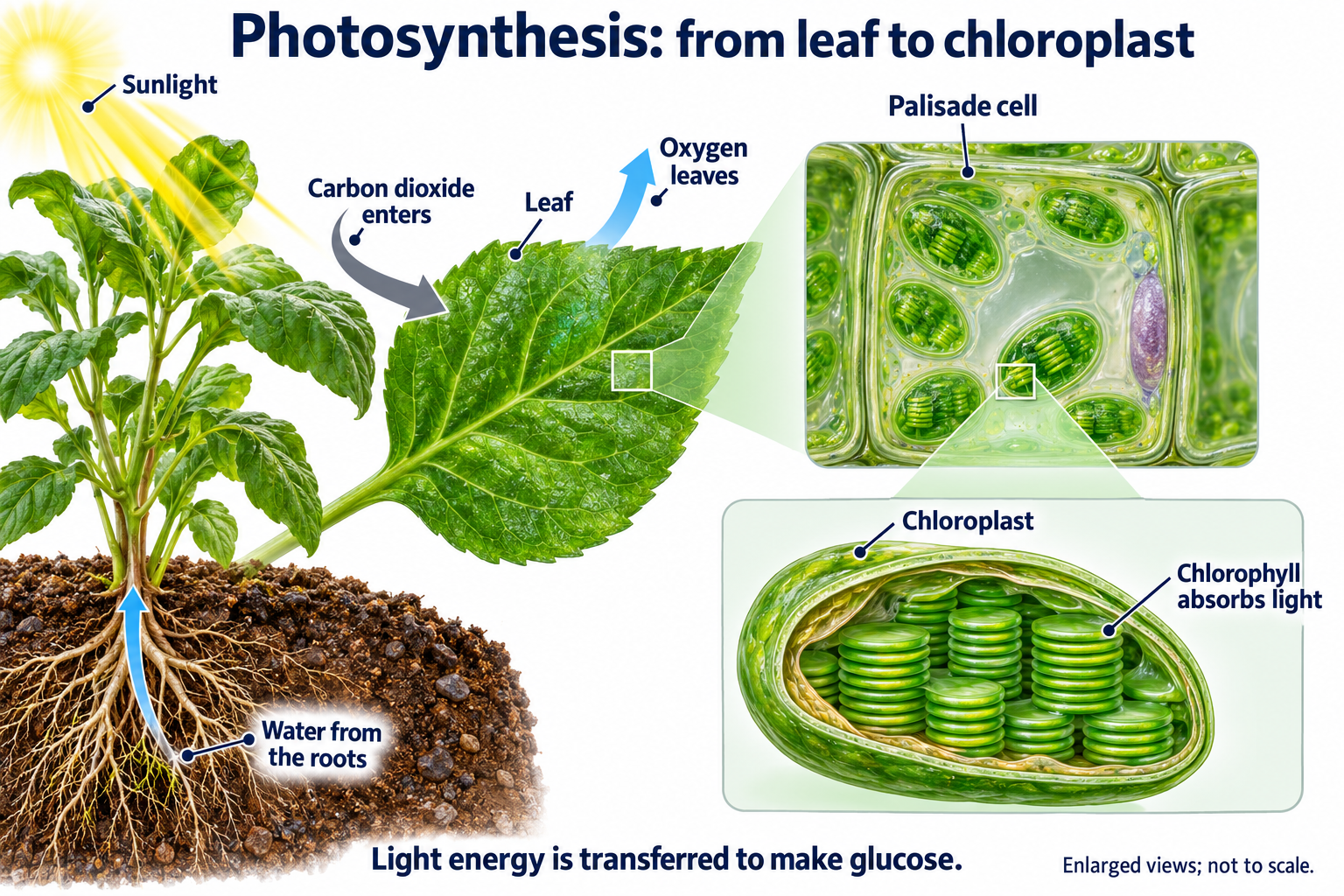
Think of a growing tomato plant. It makes new leaves, roots and fruit, but it does not eat food. Instead, it uses photosynthesis to make glucose, a sugar, from carbon dioxide and water.
Carbon dioxide enters leaves from the air. Roots take up water, which travels to the leaves. Inside green plant cells, chloroplasts contain chlorophyll, a green pigment that absorbs light.
Photosynthesis is endothermic: energy is taken in from the surroundings. Light transfers that energy to the chloroplasts. Some of it becomes stored in the glucose made.
Recognise these formulae: carbon dioxide CO2, water H2O, oxygen O2 and glucose C6H12O6.
6CO2 + 6H2O → C6H12O6 + 6O2, with light supplying energy. The numbers balance the atoms. For Trilogy, make sure you can recall the word equation and recognise the four formulae.
A plant can use its glucose straight away or turn it into other useful substances.
| Use | Why the plant needs it |
|---|---|
| Respiration | Transfers energy for the plant’s life processes. |
| Starch | An insoluble store that can be broken down when glucose is needed. |
| Fats and oils | Store energy, for example in seeds. |
| Cellulose | Makes strong cell walls that support the plant. |
| Amino acids, then proteins | Builds proteins needed for growth, including enzymes. |
To make amino acids, plants need nitrate ions as well as material from glucose. Roots absorb nitrate ions from the soil. A plant with too little nitrate cannot make enough protein for healthy growth.
Rate means how quickly something happens. One way to estimate photosynthesis rate is to measure how much oxygen a plant produces in a set time.
| Factor | What happens and why? |
|---|---|
| Light intensity | Increasing light usually increases the rate at first because more energy is available. The increase eventually levels off. |
| Carbon dioxide concentration | More carbon dioxide can increase the rate because it is a reactant. The increase eventually levels off. |
| Temperature | Warming a cold plant usually speeds up enzyme-controlled reactions. Above the optimum, enzymes lose their useful shape and the rate falls. |
| Amount of chlorophyll | Less chlorophyll means less light can be absorbed, so photosynthesis may be slower. Disease or mineral shortage can reduce chlorophyll. |
A limiting factor is something in short supply that prevents the rate increasing further. On a graph, check the axes first. A steep rising line means the rate is increasing quickly. A horizontal section means the rate has stopped increasing, even though the x-axis value is still rising.
When drawing a graph, put the factor you changed on the horizontal axis and the rate on the vertical axis. Use sensible, evenly spaced scales, add units, plot carefully and draw a suitable line or curve through the trend. Do not force the line through the origin unless the evidence supports it.
Aim: investigate how light intensity affects the rate of photosynthesis in an aquatic plant, such as pondweed. Complete practical work in school with your teacher’s guidance.
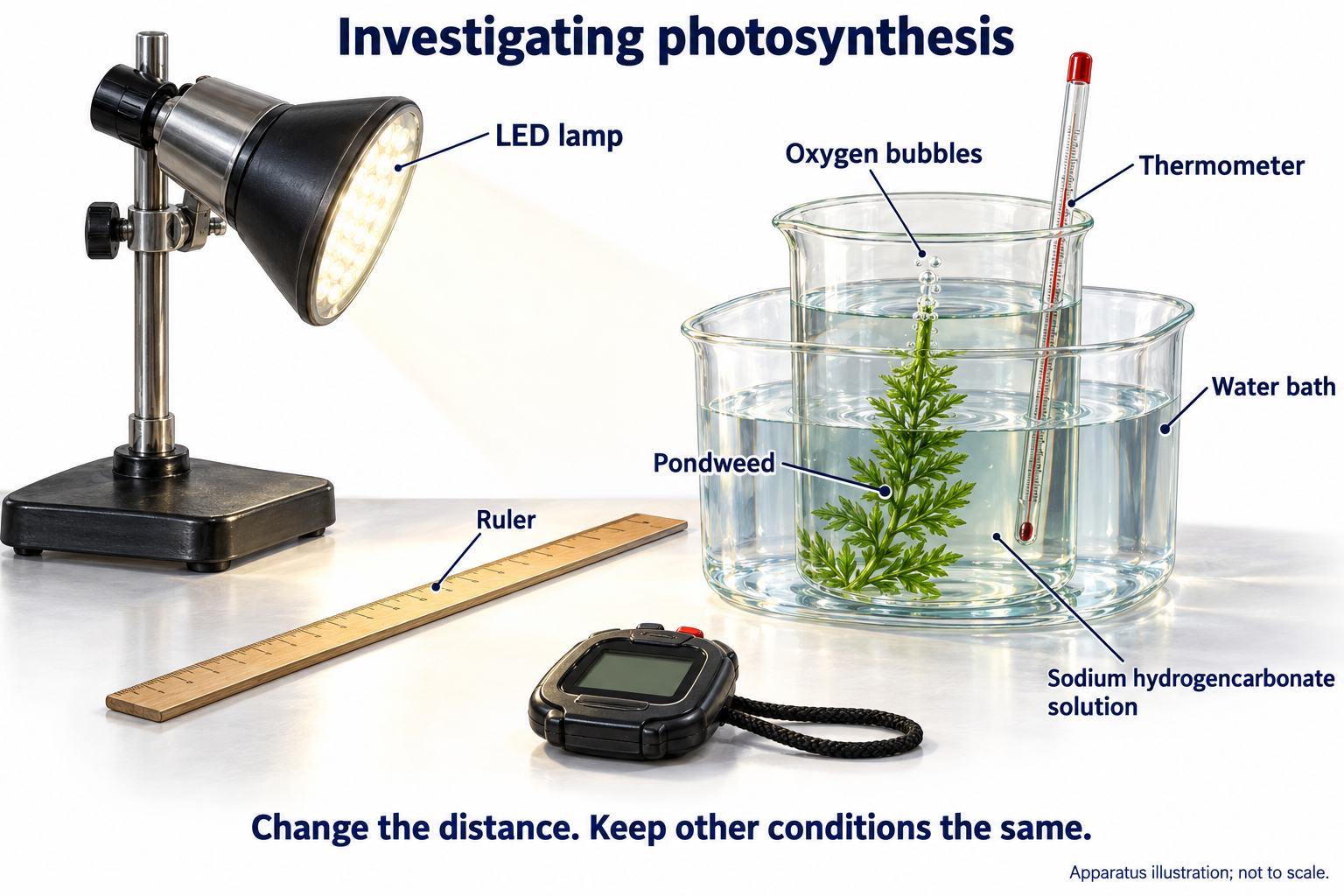
Independent variable: light intensity, changed by moving the lamp. Distance is the measurement used to change it. Dependent variable: oxygen production per unit time, estimated using bubbles per minute.
Safety: keep electrical equipment and plugs away from water, avoid touching hot lamps, handle glass carefully, and let the teacher manage any sharp blade used to cut pondweed. Do not look directly into a bright lamp.
Evaluate the method: bubbles can have different sizes, making counts an imperfect measure of oxygen volume. Some oxygen dissolves in the water. Collecting oxygen and measuring its volume over time with suitable gas-collection equipment gives a better estimate than bubble counts. Repeat readings improve confidence, but they do not remove a consistent temperature error.
Worked example: a plant releases 72 bubbles in 2 minutes. Rate = 72 ÷ 2 = 36 bubbles per minute. Alternatively, 2 minutes = 120 seconds, so the rate is 72 ÷ 120 = 0.60 bubbles per second.
Three one-minute counts are 34, 36 and 38. Mean = (34 + 36 + 38) ÷ 3 = 36 bubbles per minute. Use the same unit when comparing results.
| Lamp distance / cm | Trial 1 / bubbles min⁻¹ | Trial 2 / bubbles min⁻¹ | Trial 3 / bubbles min⁻¹ | Mean / bubbles min⁻¹ |
|---|---|---|---|---|
| 10 | 38 | 40 | 42 | 40 |
| 20 | 28 | 30 | 32 | 30 |
| 30 | 18 | 20 | 22 | 20 |
| 40 | 10 | 12 | 14 | 12 |
These results suggest that the rate increases as the lamp moves closer. They do not show that light is the only factor that ever affects photosynthesis.
A plant produces 4.5 cm³ of oxygen in 3 minutes. Rate = 4.5 ÷ 3 = 1.5 cm³ min⁻¹. At the same rate, 6 cm³ takes 6 ÷ 1.5 = 4 minutes. In 5 minutes it produces 1.5 × 5 = 7.5 cm³.
Higher only. Light, carbon dioxide and temperature interact. Increasing one factor only helps while that factor is limiting. For example, a well-lit plant may still grow slowly if it has too little carbon dioxide.
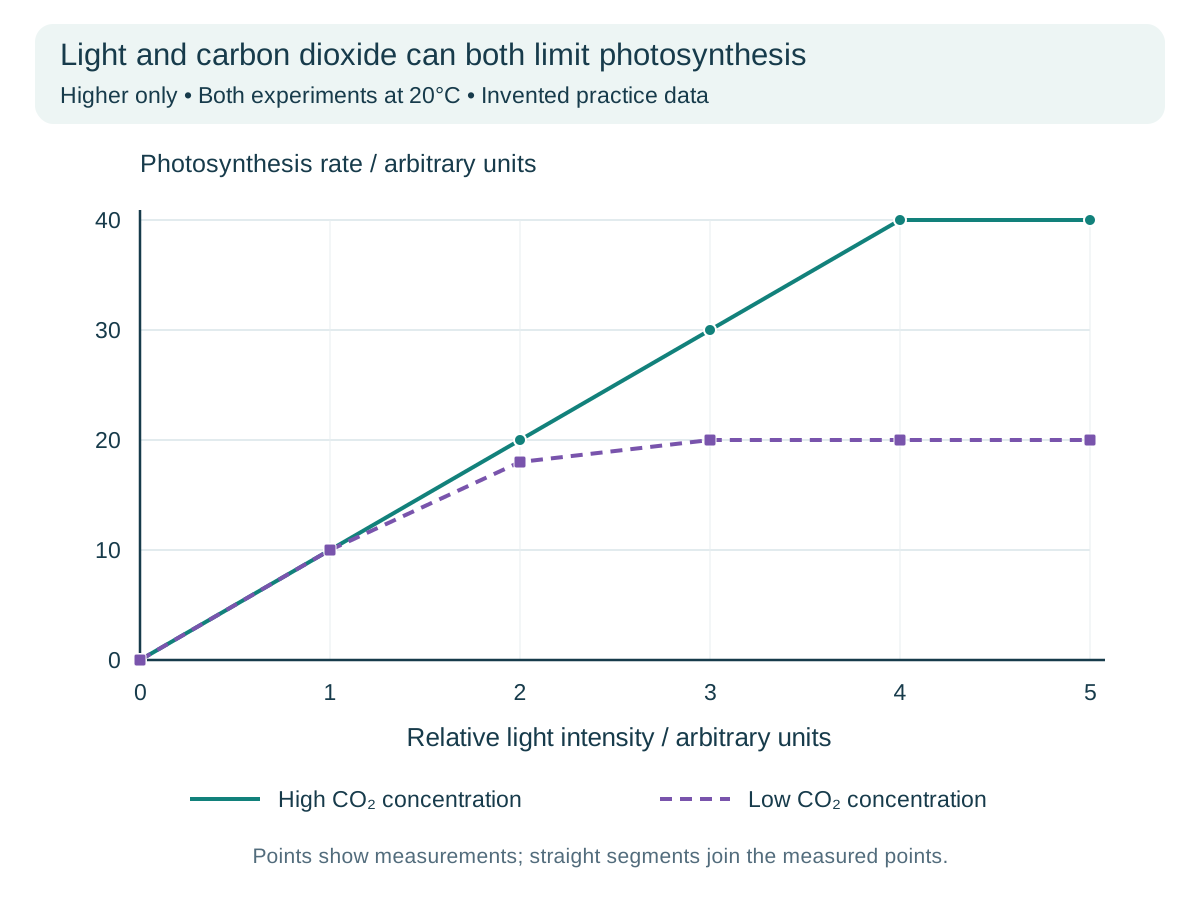
At low light, the two curves are close: adding carbon dioxide makes little difference because light is limiting. At high light, raising carbon dioxide increases the rate. Carbon dioxide was limiting the lower curve. The upper curve’s plateau tells us another factor prevents a further rise; we need more evidence before naming it. A temperature experiment could test whether temperature is limiting.
Higher only — inverse-square relationship: for a suitable lamp setup, relative light intensity is proportional to 1 ÷ distance². It is a useful model; background light and reflections can make real results differ.
Worked example: at 10 cm, 1/d² = 1/100 = 0.010 cm⁻². At 20 cm it is 1/400 = 0.0025 cm⁻². The second value is one-quarter of the first. These are relative values, not measured light intensity in lux.
In a greenhouse, lamps, heaters and extra carbon dioxide cost money. A grower should compare the extra income from a bigger crop with the extra running cost. Raising a factor that is not limiting can waste money. The fastest growth does not always give the greatest profit.
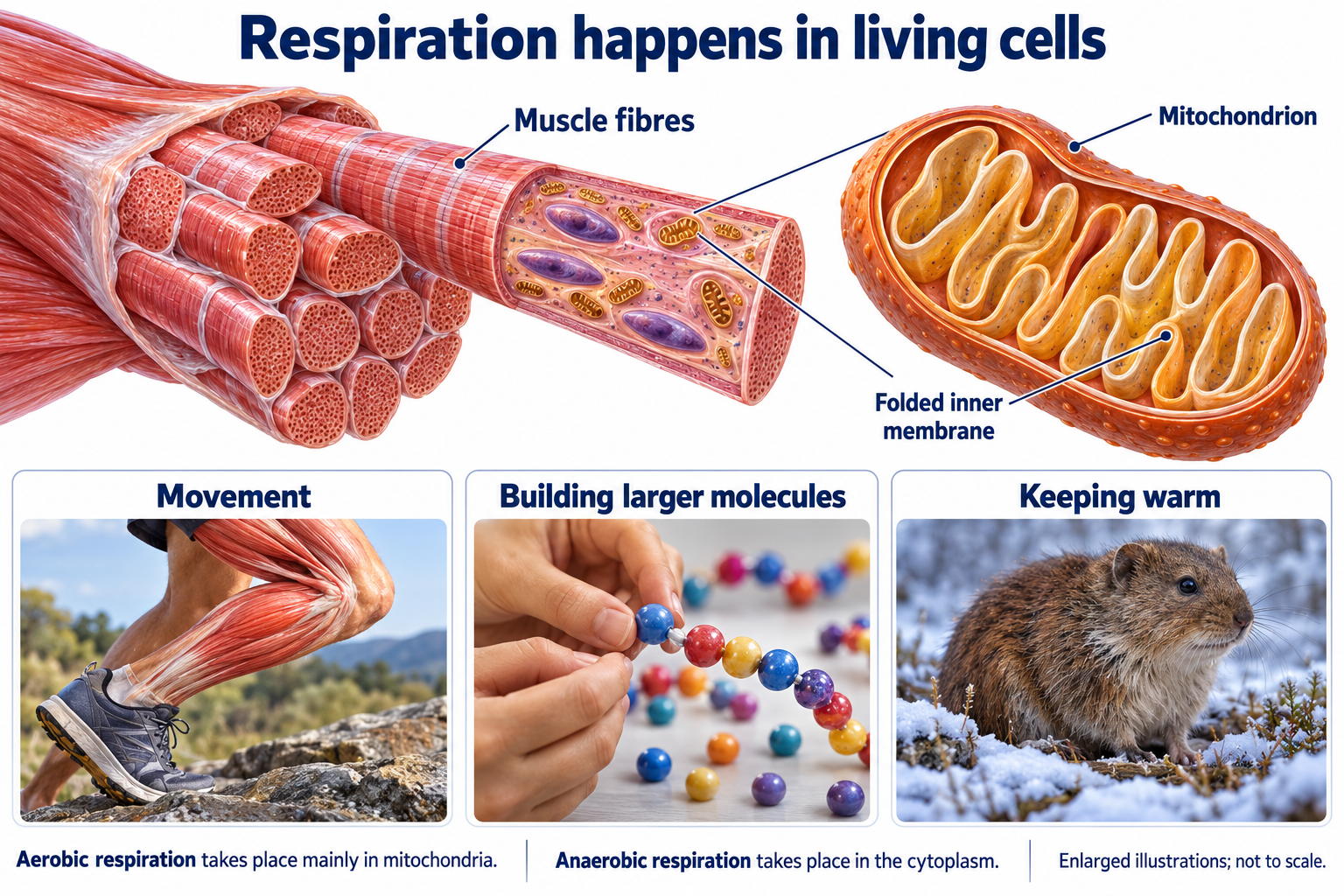
You need energy to move, make new molecules and keep warm. Your cells transfer this energy through respiration. Plants need respiration too: their roots, leaves and other living cells carry it out continuously.
Respiration is exothermic: energy is transferred out of the reaction. Some is used for the cell’s activities and some warms the surroundings. Breathing moves air into and out of the lungs; respiration is a set of chemical reactions in cells.
Aerobic respiration uses oxygen and breaks down glucose fully.
Recognise glucose (C6H12O6), oxygen (O2), carbon dioxide (CO2) and water (H2O). Oxygen reaches muscle cells from the blood. Carbon dioxide leaves the cells and is carried to the lungs to be breathed out.
Respiration provides energy for reactions that build larger molecules from smaller ones, muscle movement and keeping body temperature suitable.
During a sprint, muscles may need energy faster than oxygen can be delivered. They can also carry out anaerobic respiration, which does not use oxygen.
Glucose is not broken down fully, so much less energy is transferred per glucose molecule than in aerobic respiration. Lactic acid builds up. During prolonged vigorous activity, muscles become fatigued and do not contract as effectively.
Anaerobic respiration also happens in yeast and some plant cells. The products are different:
In yeast, this process is called fermentation. In bread-making, carbon dioxide makes the dough rise. In brewing, ethanol is the useful alcohol product. Baking removes much of the ethanol from bread.
| Process | Uses oxygen? | Products | Energy per glucose molecule |
|---|---|---|---|
| Aerobic respiration | Yes | Carbon dioxide and water | More |
| Anaerobic respiration in muscles | No | Lactic acid | Much less |
| Anaerobic respiration in yeast/plants | No | Ethanol and carbon dioxide | Much less |
Do not write that anaerobic respiration produces no energy. It transfers less energy, but that energy still helps cells work.
Working muscles respire faster. Your heart rate increases, so blood delivers oxygen and glucose faster. Your breathing rate increases and each breath becomes deeper: breath volume is the amount of air moved in one breath.
Together, these changes help supply the muscles with more oxygenated blood. If the supply is still too small for the demand, anaerobic respiration contributes more, lactic acid builds up and an oxygen debt develops.
Breathing and heart rate stay above resting levels for a while after exercise. The body still needs extra oxygen during recovery.
Worked example: at rest, a person takes 12 breaths each minute, with 0.5 dm³ per breath. Air moved per minute = 12 × 0.5 = 6 dm³ min⁻¹. During exercise, 25 breaths of 1.6 dm³ move 40 dm³ min⁻¹. This measures ventilation, not the volume of oxygen actually absorbed.
Exercise investigations are useful supporting activities, not a separate Biology required practical for this topic. Take part only in teacher-approved activity suitable for your health. Do not use exhaustion as a target.
Metabolism means all the chemical reactions happening in a cell or organism. It includes both building molecules and breaking them down. Enzymes control these reactions. Energy transferred by respiration helps keep many of the building reactions going.
| Starting materials | What happens | Why it matters |
|---|---|---|
| Glucose | Joined to make starch in plants or glycogen in animals | Stores glucose for later use. |
| Glucose | Joined to make cellulose in plants | Builds strong cell walls. |
| Glycerol + fatty acids | One glycerol joins with three fatty acids to form a lipid molecule | Makes fats and oils. |
| Glucose + nitrate ions in plants | Used to make amino acids; amino acids join to form proteins | Builds cell structures and enzymes. |
| Glucose | Broken down in respiration | Transfers energy. |
| Excess proteins | Broken down; urea is formed | Urea is removed from the body in urine. |
Digestion breaks large food molecules into smaller ones. Cells can then use these smaller molecules to build the carbohydrates, proteins and lipids they need. For example, absorbed amino acids can be joined in a different order to make a human protein.
For a calculation, write the relationship, substitute numbers, calculate and give a unit. For a graph comparison, use values and units rather than only saying “higher”.
For a six-mark method, organise your answer around what you change, what you measure, what you keep the same, repeats and safety. For an explanation, link cause and effect: “The muscles need more energy, so their respiration rate increases…”
All questions here are original exam-style practice, not copied from AQA papers. Higher-only work is labelled separately from optional challenges.
Start with the 36 main questions. Higher-only questions are labelled. You can complete this topic over several sessions; your answers save as you go. Use a hint if you get stuck, then compare your work with an example answer. Your tutor can mark written answers.
Use the full method in Learn, then analyse these invented results. At 30 cm, one-minute bubble counts were 18,20 and 22. At 15 cm, they were 35,37 and 36. Water temperature stayed at 20°C.
At 30 cm: (18 +20 +22) ÷3 =20 bubbles min⁻¹. At 15 cm: (35 +37 +36) ÷3 =36 bubbles min⁻¹. The plant produced oxygen faster with the closer lamp. Bubble sizes can vary, so I would measure the total oxygen volume produced in a fixed time. More distances would show the pattern more clearly. These results do not prove that halving distance always doubles photosynthesis rate.
Higher extension: halving distance gives approximately four times the light intensity in the inverse-square model. Here the rate rises by only 1.8 times. Another factor may be limiting; bubble counting is also only an estimate.
When connected with your pupil code, your answers save online for Kevin to see. Click Submit to Kevin when you have finished. Downloads are optional.
Connect with your pupil code above to submit.
Use a scientific idea and a specific example in your reflection.