Chemistry of the atmosphere
Work through one section at a time. Higher-only material is labelled explicitly; optional challenges can also use Foundation content.
 GCSE CHEMISTRY · AQA TRILOGYTutor dashboardSaves on this device
Your answers save automatically as you work.
Saved in this browser on this device.
Why has Earth’s air changed, and how do our choices affect it? Use evidence, graphs and everyday examples to explore climate and air pollution.
Supported GCSE version · Clear examples, worked calculations and optional challenges.
Work through one section at a time. Higher-only material is labelled explicitly; optional challenges can also use Foundation content.
The mixture of gases surrounding Earth.
A gas changes into a liquid.
Solid material that settles in layers.
A compound containing carbonate ions, for example calcium carbonate in limestone.
A carbon-rich fuel formed from ancient organisms over millions of years.
A gas that absorbs and emits infrared radiation.
Radiation emitted by a warm surface; its wavelength is longer than visible light.
Weather patterns over many years.
Specialists examine another scientist’s methods and reasoning.
Total greenhouse gas emissions over a product, service or event’s full life cycle.
A tiny airborne solid particle or liquid droplet.
Burning with too little oxygen for all the carbon to become carbon dioxide.
A reduction in sunlight reaching the surface caused partly by airborne particles.
A common unit used to compare the warming effects of greenhouse gases.
The atmosphere is the mixture of gases surrounding Earth. Air is a mixture, not a compound: its gases are not all chemically joined together. Dry air contains about 78% nitrogen and 21% oxygen. The remaining roughly 1% includes argon and other noble gases, plus a small amount of carbon dioxide. Water vapour varies with weather and location.
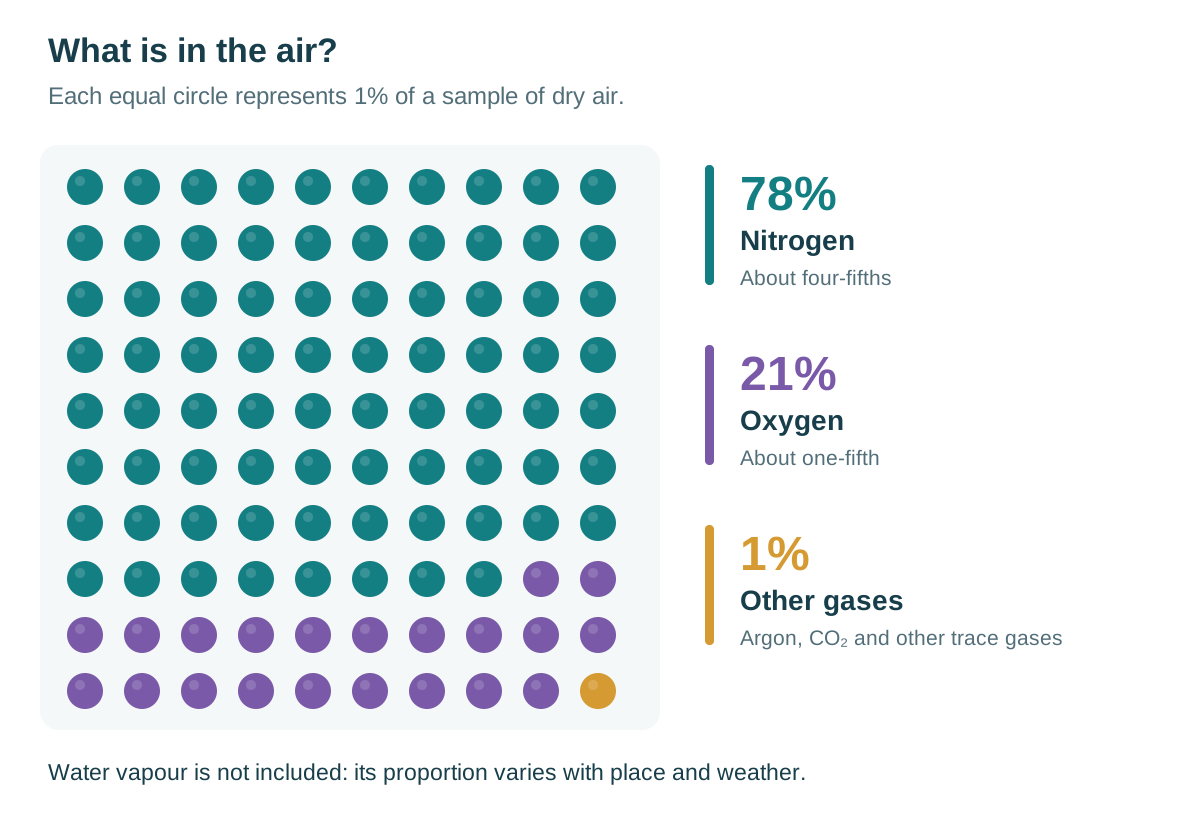
The main proportions have been broadly similar for about 200 million years. This does not mean that every gas has stayed exactly constant. A small change in a trace gas such as carbon dioxide can still have a large effect.
Earth formed about 4.6 billion years ago. There are no direct air measurements from that time. Scientists piece together evidence from ancient rocks, gases released by volcanoes and comparisons with other planets. Much early rock has been changed or destroyed, so the exact early gas proportions are uncertain.
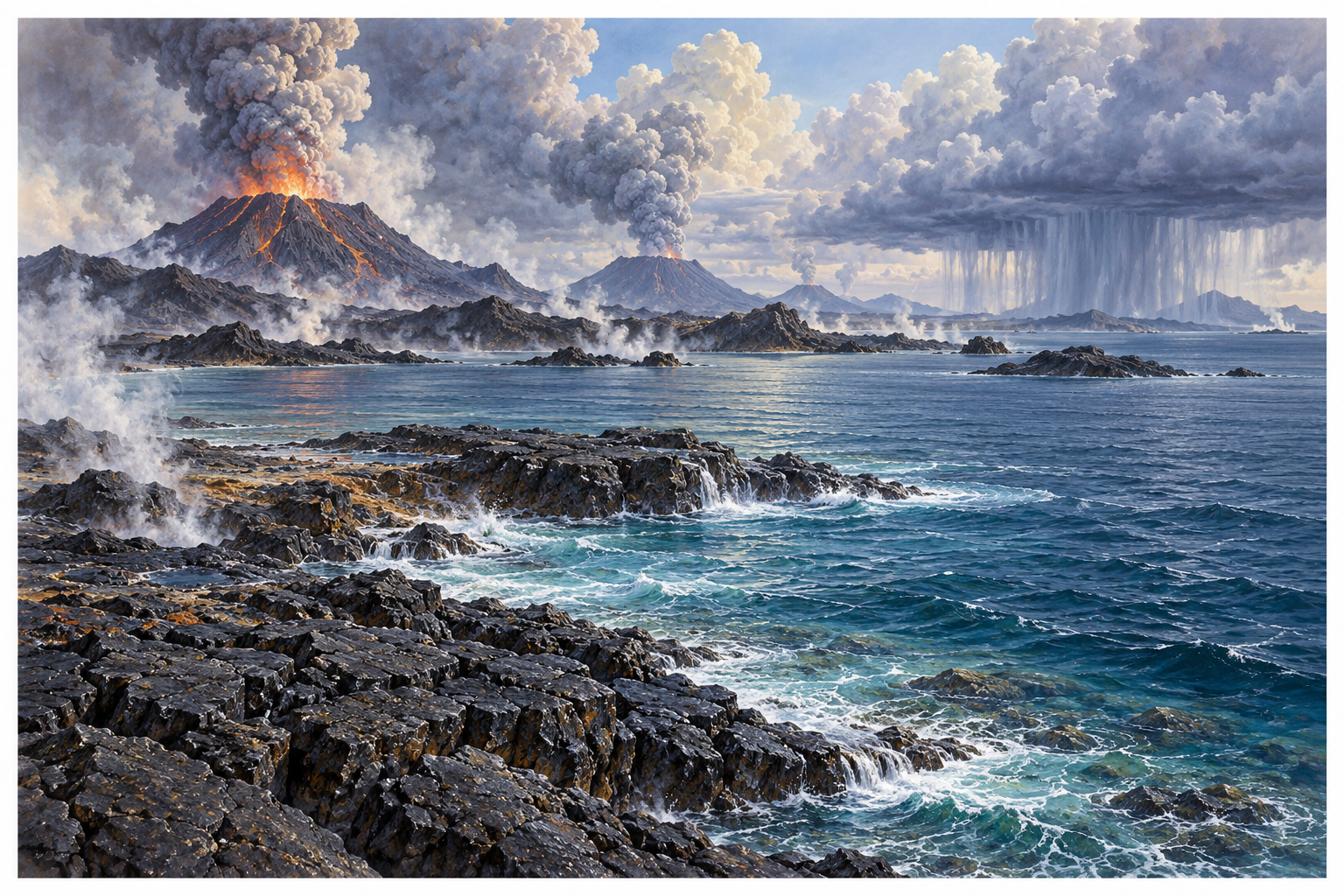
One explanation is that intense volcanic activity released gases that helped form the early atmosphere. It was probably rich in carbon dioxide, with little or no oxygen gas. Volcanoes also released water vapour and nitrogen, with possible small amounts of methane and ammonia. Nitrogen gradually built up. The carbon-dioxide-rich atmospheres of Mars and Venus provide comparisons, but are not exact copies of early Earth.
As Earth cooled, water vapour condensed into liquid water. Rain collected to form oceans. Condensation is a change of state, not a chemical reaction.
Carbon dioxide dissolved in the oceans. Some of the dissolved carbon ended up in carbonate compounds. Carbonates formed sediments on the seabed. Over long periods these sediments became sedimentary rocks, storing carbon outside the atmosphere.
Many marine organisms make shells or skeletons containing calcium carbonate. Their remains can accumulate, compact and form limestone. Both dissolved carbon dioxide and carbonate formation helped lower the amount of carbon dioxide in the air.

Algae began producing oxygen by photosynthesis about 2.7 billion years ago. Photosynthesis uses carbon dioxide and water to make glucose and releases oxygen. Later, plants evolved and oxygen gradually became more abundant. Enough oxygen eventually allowed animals that use aerobic respiration to evolve.
Photosynthesis has two important atmospheric effects: it removes carbon dioxide and adds oxygen. Do not say that plants turn carbon dioxide directly into oxygen: atoms are rearranged to make glucose as well.
| Store | How it formed |
|---|---|
| Limestone | Carbonate sediments and shells accumulated and became rock. |
| Coal | Remains of ancient land plants were buried in waterlogged, low-oxygen conditions, then changed over millions of years by heat and pressure. |
| Crude oil and natural gas | Remains of tiny marine organisms were buried by sediments and changed over millions of years by heat and pressure. |
Burial can prevent complete decomposition. Carbon originally taken into living things by photosynthesis becomes stored in rocks and fossil fuels. Burning fossil fuels releases much of this stored carbon back into the air as carbon dioxide. Fossil fuels form far too slowly to replace the amounts we use within a human lifetime.
Water vapour, carbon dioxide and methane are greenhouse gases. The natural greenhouse effect keeps Earth warm enough for life. The concern is the extra warming caused when human activities increase greenhouse gas concentrations.
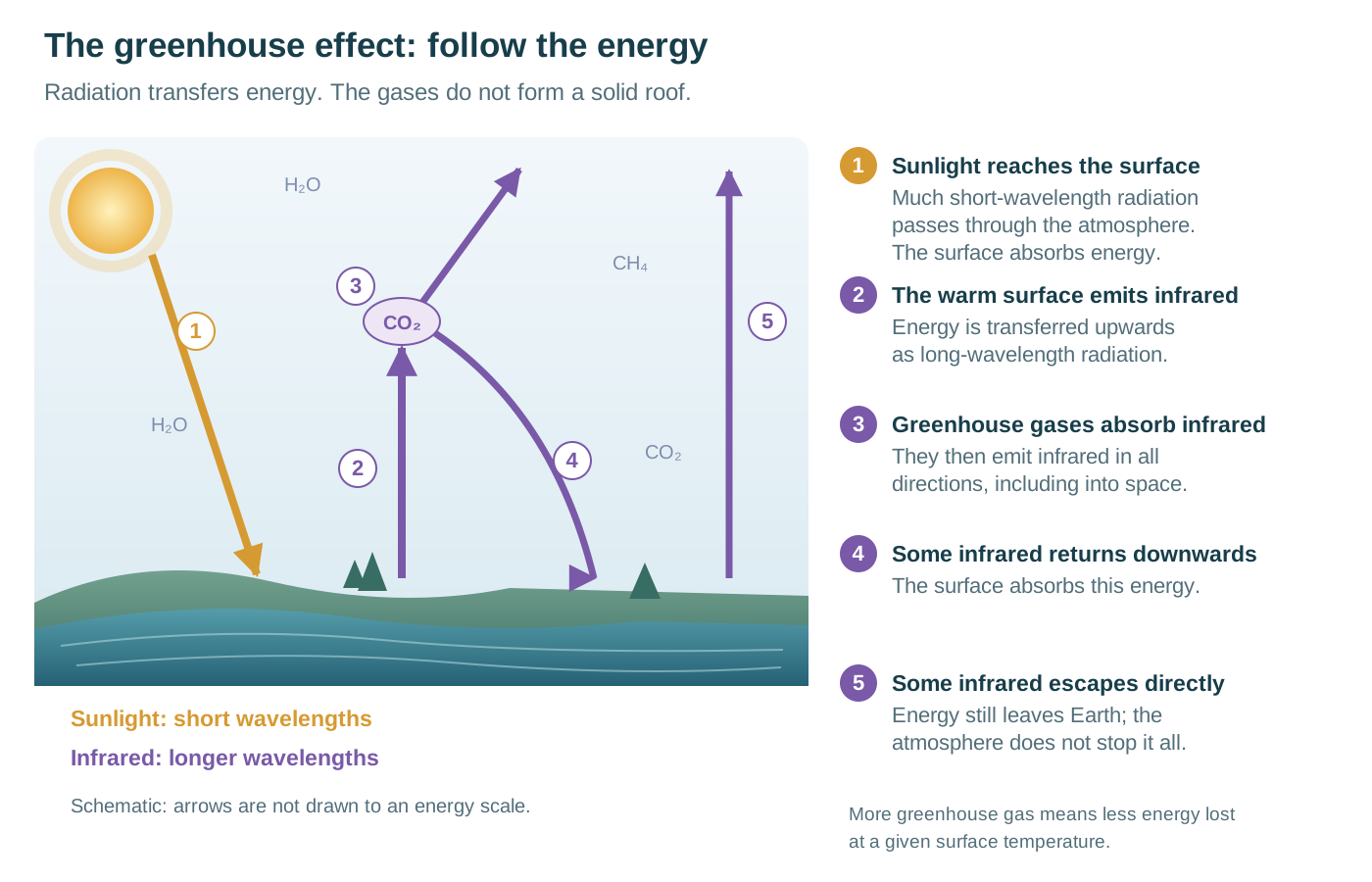
Much short-wavelength radiation from the Sun passes through the atmosphere and is absorbed by Earth’s surface. The warm surface emits longer-wavelength infrared radiation. Greenhouse gases absorb some of this infrared and emit infrared in all directions, including back towards the surface. This reduces the rate at which energy escapes at a given surface temperature. The surface warms until incoming and outgoing energy balance again.
| Gas | Human activity | Why it adds the gas |
|---|---|---|
| Carbon dioxide | Burning coal, oil or natural gas | Carbon in fuel reacts with oxygen during combustion. |
| Carbon dioxide | Deforestation | Burning/decay can release stored carbon; fewer trees remove carbon dioxide by photosynthesis. |
| Methane | Livestock farming | Microbes involved in digestion in animals such as cattle release methane. |
| Methane | Landfill and rice farming | Microbes break down organic matter in low-oxygen conditions. |
Methane can also leak during fossil-fuel extraction and transport. For an exam asking for two activities, give two clearly different examples. “Cars” and “burning petrol in cars” describe the same source.
Weather is short-term conditions; climate describes patterns over many years. One cold day does not show that global warming has stopped. Scientists compare long-term measurements from many places, including temperature records, ice cores and satellite observations.
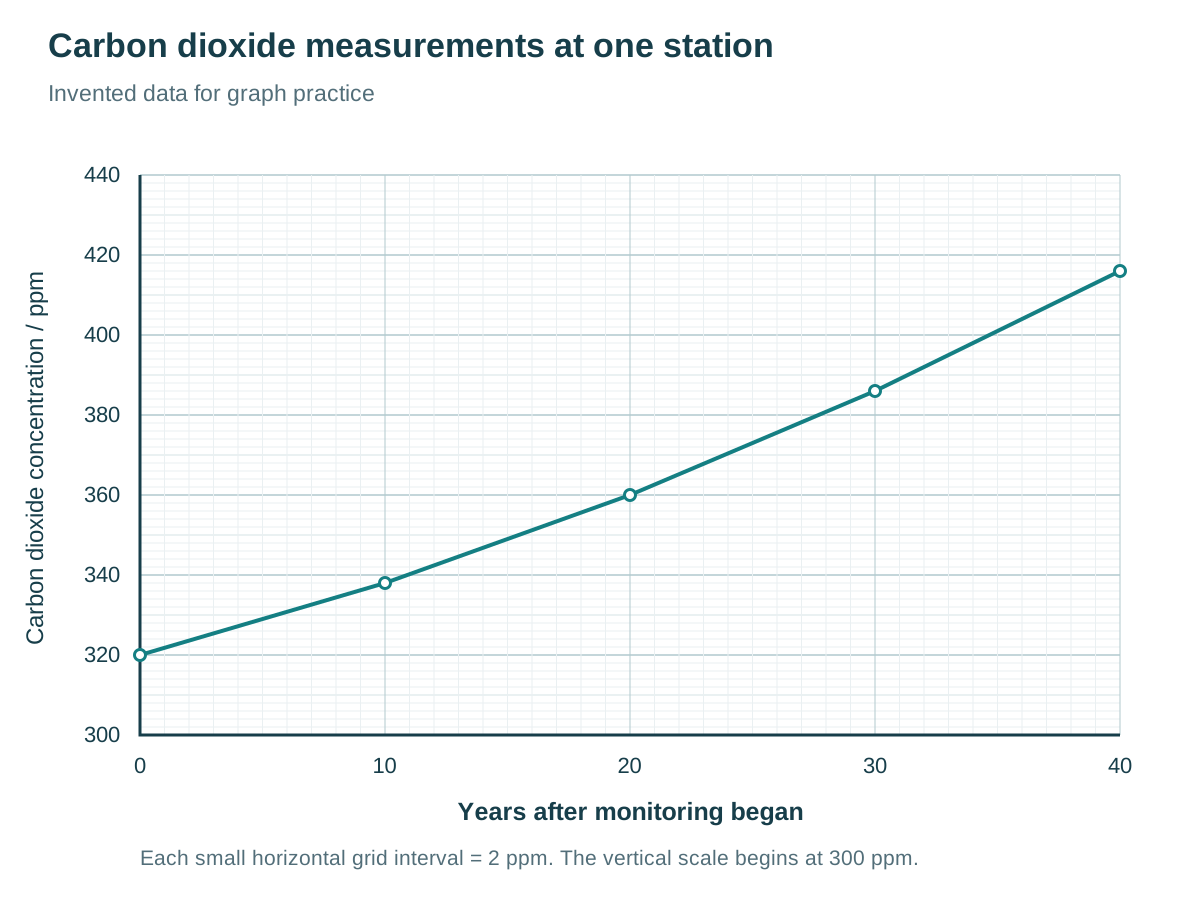
There is strong scientific evidence that human activities are increasing greenhouse gases and warming the planet. Uncertainty remains about the exact size and timing of future regional changes. Climate systems involve many interacting factors, and future emissions depend on human choices. Uncertainty about details does not mean there is no evidence for the overall change.
Peer review means other specialists examine a study’s methods and reasoning before publication. It helps identify weaknesses but does not guarantee that a result is perfect. Look for repeatable methods, enough measurements, independent studies and stated uncertainty. A media report can mislead by selecting only a short period, one place or one favourable result.
| Effect | Why it matters |
|---|---|
| Sea-level rise | Warming water expands and melting land ice adds water; low-lying coasts face flooding and saltwater intrusion. |
| Changes in rainfall | Some areas face more drought; others face heavier rainfall and flooding, affecting water supplies and farming. |
| More frequent or severe extremes in some regions | Heatwaves and other extremes can harm health, homes and infrastructure. |
| Changes in habitats and species distributions | Organisms may need to move; some cannot adapt or migrate fast enough, affecting food webs and biodiversity. |
Effects vary between places. Risk depends on both the chance of an event and the damage it could cause. Low-lying communities, vulnerable people and sensitive ecosystems can face large impacts. Decisions must consider the global scale, long timescales and unequal ability to adapt.
A carbon footprint is the total greenhouse gas emissions associated with a product, service or event over its full life cycle. Include raw materials, manufacture, transport, use and disposal. It includes gases such as methane as well as carbon dioxide. Values may be expressed as CO₂ equivalent, which compares their warming effects on a common basis.
Reduce carbon dioxide emissions by improving energy efficiency, using low-carbon energy, reducing unnecessary journeys and protecting forests. Reduce methane emissions by preventing gas leaks, collecting landfill gas and reducing food waste sent to landfill. Captured methane can be burned for useful energy; this makes carbon dioxide, so it is not an emission-free process.
Changes may be limited by cost, available technology, access to public transport, energy demand, land use and international cooperation. A claim such as “zero emissions” may count only the use stage and ignore manufacture or electricity generation.
| Substance | How it forms |
|---|---|
| Carbon dioxide and water | Complete combustion of a fuel containing carbon and hydrogen, with enough oxygen. |
| Carbon monoxide and soot | Incomplete combustion when oxygen is limited. Soot is mainly carbon particles. |
| Sulfur dioxide | Sulfur impurities in the fuel react with oxygen. |
| Oxides of nitrogen | Nitrogen and oxygen from the air react at high temperatures, for example inside engines. |
| Particulates | Tiny solid particles, including soot, and unburned hydrocarbon droplets are released. |
Use the information in the question. A pure fuel containing only carbon and hydrogen has no sulfur to form sulfur dioxide. However, nitrogen oxides can still form from the air at high temperatures. More complete combustion reduces carbon monoxide and soot but does not remove carbon dioxide emissions.
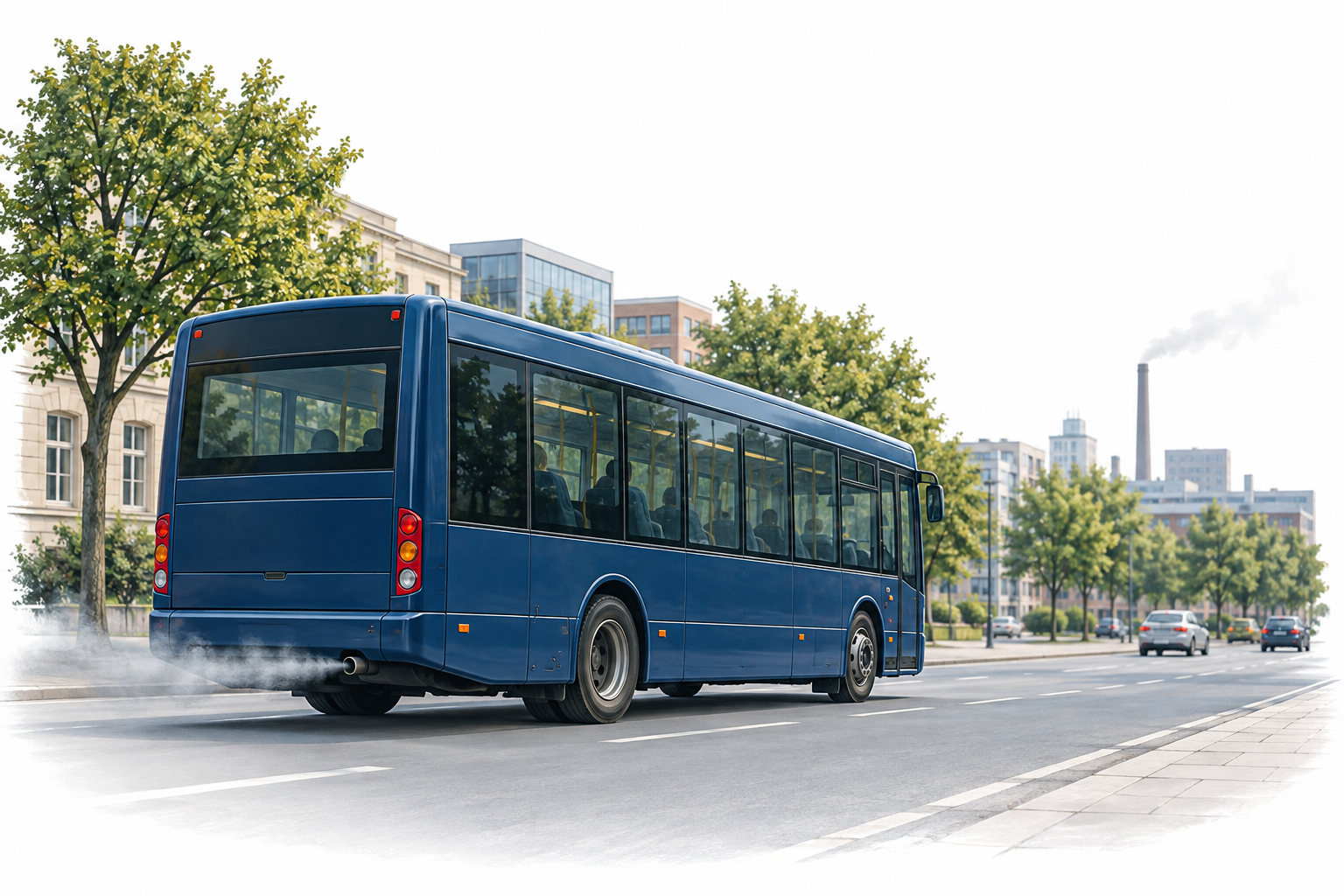
| Pollutant | Main effects |
|---|---|
| Carbon monoxide (CO) | Toxic, colourless and odourless. It reduces the blood’s ability to carry oxygen. |
| Sulfur dioxide and oxides of nitrogen | Cause respiratory problems and contribute to acid rain, damaging ecosystems and buildings. |
| Particulates | Can damage health, especially the respiratory system; scattering/reflecting sunlight contributes to global dimming. |
| Carbon dioxide and methane | Increase the greenhouse effect when their atmospheric concentrations rise. |
Global dimming means less sunlight reaches the surface because particles scatter or reflect it. It is different from the greenhouse effect. Reducing visible smoke does not prove that invisible harmful gases have been removed.
For an “explain” question, link cause to effect. For “evaluate”, use the supplied evidence, consider limitations and reach a justified conclusion. No required practical is assigned specifically to 5.9; the data task below develops the same graph and evidence skills used in exams.
Start with the 35 main questions. Higher-only questions are labelled. You can complete this topic over several sessions; your answers save as you go. Use a hint if you get stuck, then compare your work with an example answer. Your tutor can mark written answers.
This is a data-analysis task, not a separate AQA required practical. A school can spend its budget on one change. Option A insulates buildings and reduces heating emissions by 3 tonnes CO₂e each year. Option B creates safe cycle storage; its saving depends on how many families stop driving. Explain what evidence you would collect and how you would make a fair recommendation.
I would check each option’s cost, lifespan, manufacture footprint and expected annual saving. I would survey realistic cycling uptake and measure the heating baseline over comparable weather conditions. I would compare total savings over the same number of years, state uncertainty and consider access and safety. A gives a quantified saving, but B may have wider health and traffic benefits; the evidence does not yet justify claiming B saves more carbon.
When connected with your pupil code, your answers save online for Kevin to see. Click Submit to Kevin when you have finished. Downloads are optional.
Connect with your pupil code above to submit.
Use a scientific idea and a specific example in your reflection.